Military and Naval Binoculars
Military and Naval Binoculars
Military and Naval Binoculars


"Vulkanite" schwarzes Kunstleder (black synthetic leather) Körperbedeckung (body covering) In Germany in the 1930s, an early type of black plastic synthetic leather called "Vulkanite" was

Strichplatte (Reticle) markings : "m" or "M" and "H/6400" TM 30-506, WAR DEPARTMENT TECHNICAL MANUAL, GERMAN-ENGLISH MILITARY DICTIONARY, WAR DEPARTMENT, 20 MAY I944 Strichplatte / graduated
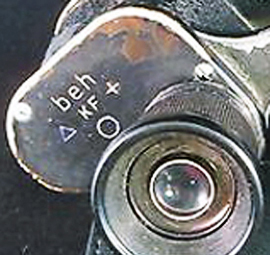
Kältefettmarkierungen (Cold Resistant Grease Markings) The beginning of World War II in September 1939, and the soon realized shortage of petroleum in Germany, initiated intense efforts
By 1901, in Paris, 1922 address 18 rue de Naples, Paris. Exhibitions: medal at Melbourne 1880 (pre-production?), medal at Anvers 1885, Chicago 1893, Paris 1900.
|
|
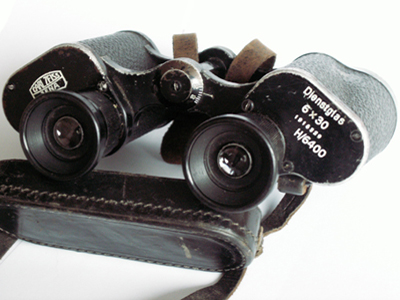
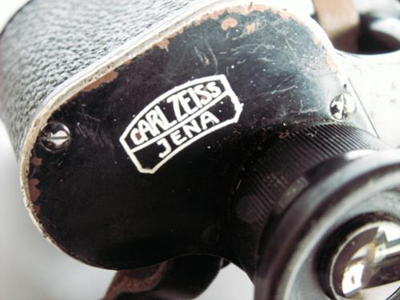
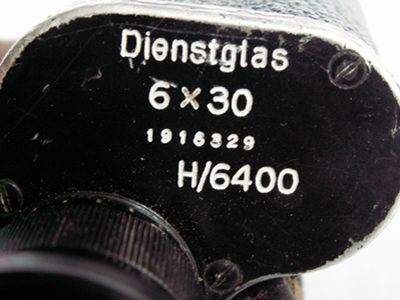
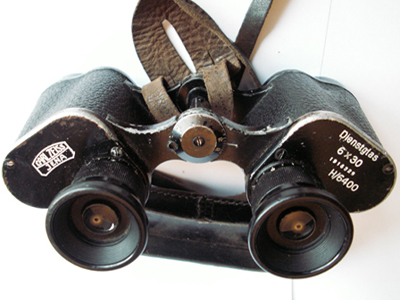
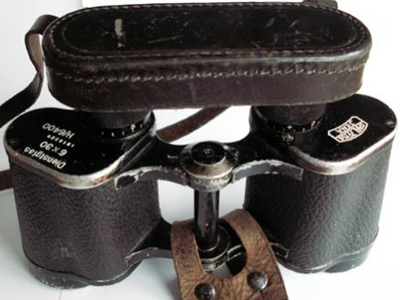
In the German armed forces, Doppelfernrohr (binoculars) were marked with the word Dienstglas (service glass) to identify them as government military property.
A Dientglas was issued to soldiers with specialized functions. For example, a Gruppenführer (group leader), or an Artilleriebeobachter (artillery observer), was issued a Dienstglas to perform his duties.
The most common type of service glass was the 6×30 Dienstglas.
The number “6” identifies the magnification power of the Dienstglas (in this case, “6” indicates that objects appear six times closer than their actual distance).
The number “30” identifies the diameter in millimeters of the front (objective) lenses — the light gathering lenses — in this case 30 millimeters in diameter. |
The marking H/6400 on the right side prism cover indicates the presence of a Strichplatte (range-finding reticle) in the right-hand lens. The H/6400 refers to the mil graduations on the reticule, which helped soldiers estimate distance when viewing a target. This reticle, or graticule, was based on the size of known objects like men or trucks seen through the binoculars.
|
|
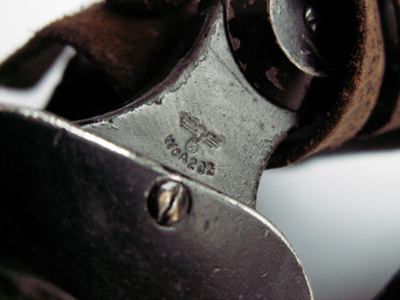
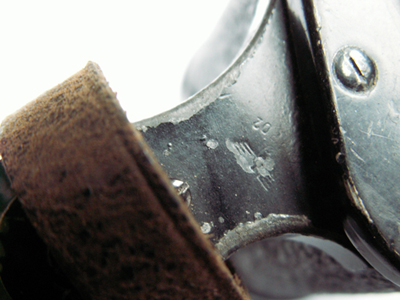
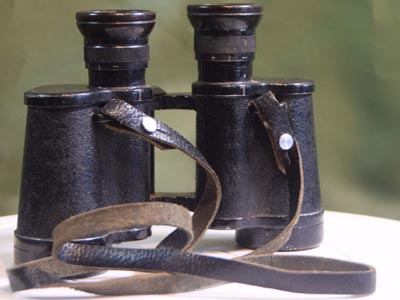
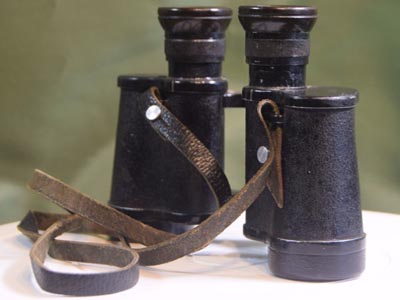
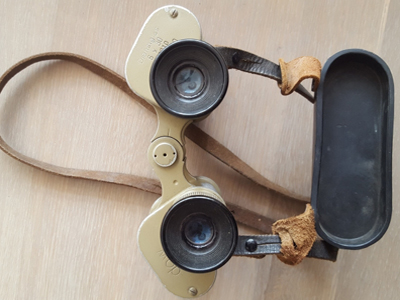
Tragereimen (carrying strap) — a narrow leather strap attached to the two rectangular metal loops on the dienstglas frame for the soldier to carry his dienstglas around his neck.
Sometimes the tragereimen had multiple adjusting holes for the metal studs, but usually there were only two stud holes on either end of the leather strap. |
|
|
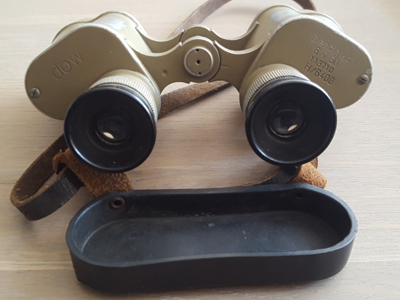
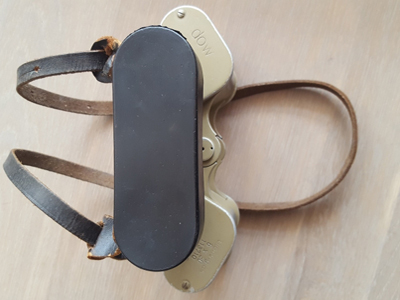
Okularshutz (eye piece protector) or Regenschutzdeckel (rain protection cover) or Benutzerkappe (user cap) — a leather, Bakelit or Presstoff (Bakelite), or rubber eye shield, sometimes called a rain shield, attached to the Tragereimen straps, to keep dirt out of the rear lenses. |
|
|
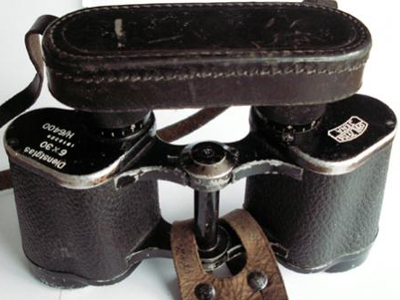
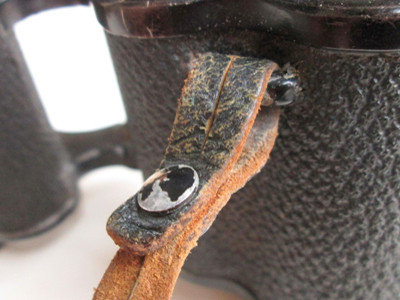
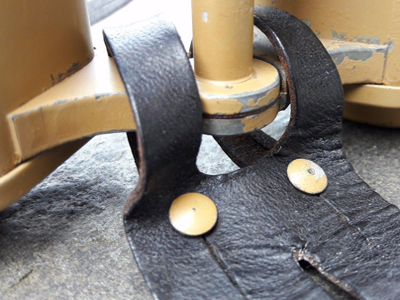
Aknöpflasche (button tab) — a leather flap, attached by folded tabs and studs through the Dienstglas bridge supports front spindle for attachment to a jacket button to prevent uncontrolled bouncing and swinging, and to keep the Dienstglas from being damaged while the wearer is running.
In addition to the leather Trageriemen (carrying strap), a Dienstglas often had a leather Anknöpflasche (button flap) attached, especially the light in weight 6x30s. All Anknöpflaschen were made of leather. Some Anknöpflaschen were marked with a manufacturer mark and year of production, for example, with the “E.LEITZ / WETZLAR” logo and “1939”. More rarely, Anknöpflaschen were marked with a Waffenamtabnahme “WaA” stamp of acceptance by the weapons office. Such markings were either embossed or stamped into the leather. |
|
|
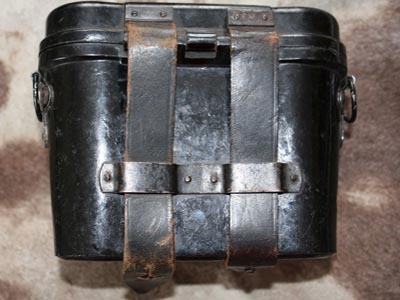
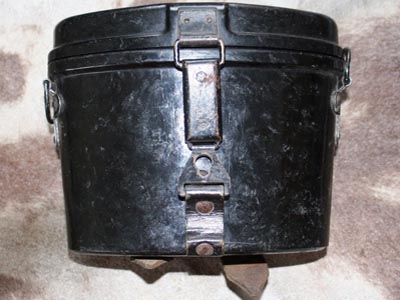
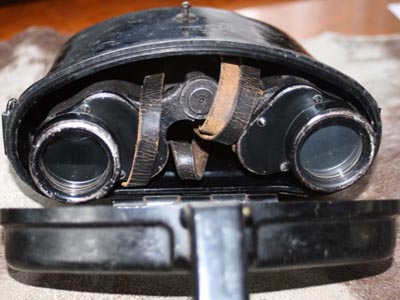
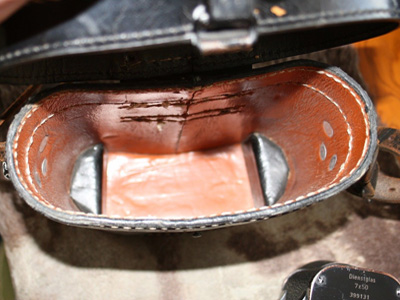
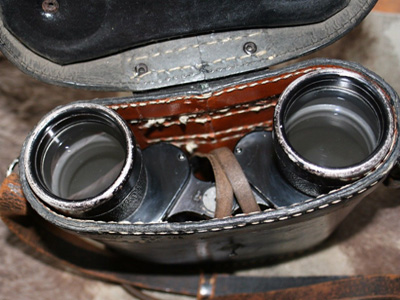
Behalter or Köcher (case) — a leather or Bakelit or Presstoff (Bakelite) carrying case to protect the Dienstglas when in the field.
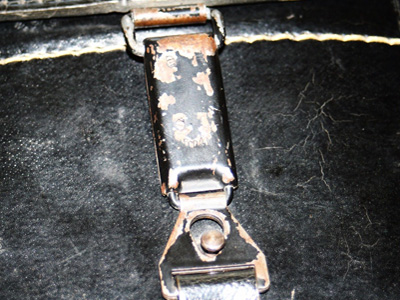
The soldier can use two leather loops on the back of the case to attach the case to the equipment belt or a leather carrying strap to sling the case over the shoulder. Originally, most Dienstglas cases were made of leather. As a result of material shortages, cases were made of other substitute materials, including even pressed cardboard. Bakelit (Bakelite) was also common material for the construction of Dienstglas cases. |