


Kindom of Bavaria contract
Carl Zeiss, Jena, Thuringia, Germany, December 1914-January 1915
In the Kingdom of Bavaria armed forces, military service binoculars were marked to identify them as government military property.
Military service binoculars were issued to soldiers with specialized functions. For example, group leaders and artillery observers were issued military service binoculars to perform their duties.
The most common type of service glass used by the armed forces of the Kingdom of Bavaria during the First World War was the 6×24 D.F. 03 and D.F. 6x military service binocular.
The number “6” identifies the magnification power (in this case, “6” indicates that objects appear six times closer than their actual distance).
The number “24” identifies the diameter in millimeters of the front (objective) lenses — the light gathering lenses — in this case 24 millimeters in diameter.
Some military service binoculars may be marked with the capital letter “J” (Bavarian acceptance mark of Geschofabric Ingolstadt, Ingolstadt Factory).
This is a list of production serial numbers, observed in collections and recorded from sources online, of 6×24 D.F. 03 military service binoculars, manufactured by Carl Zeiss, Jena, for the armed forces of the Kingdom of Bavaria from December 1914 to January 1915, used during the First World War.
6×24 D.F. 03 Dienstglas Serial Number Series
Carl Zeiss, Jena, Thuringia, Kingdom of Bavaria contract
6×24 D.F. 03, January 1912, 277074, Nr. 13704, Jena, Thuringia, Germany
|
|
German 6×24 D.F. 03 Dienstglas military service binoculars, production serial number, 277074, heavy construction, made of brass, black “Vulkanite” schwarzes Kunstleder (black synthetic leather) Körperbedeckung (body covering), brass fittings, manufactured in December 1912 by Carl Zeiss, Jena. Left prism cover marked in white with “CARL ZEISS” / “JENA” trademark logo. Right prism cover marked in white with “K. B. Dienst–” (Königreich Bayern Dienst–, Kingdom of Bavaria Service), over “D.F 03” (“Dopplefernrohr 03″ – Binoculars Model 1903), over “Nr. 13704” (Kingdom of Bavaria armed forces property number). Right prism cover upper inside edge stamped in very small numbers with “277074” (production serial number). This Carl Zeiss D.F. 03, serial number, 277074, appears to be produced in January 1912, within the serial number sequence of the original Carl Zeiss production serial number series established in 1894. |


Carl Zeiss, Jena, Thuringia, Kingdom of Bavaria contract
6×24 D.F. 03, December 1914, 461359, Nr. 15450, Jena, Thuringia, Germany
|
|
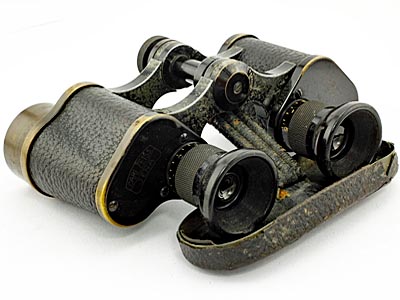
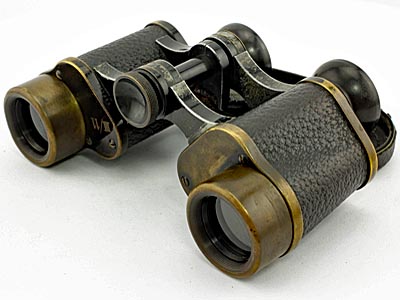
German 6×24 D.F. 03 Dienstglas military service binoculars, production serial number, 461359, heavy construction, made of brass, black “Vulkanite” schwarzes Kunstleder (black synthetic leather) Körperbedeckung (body covering), brass fittings, manufactured in December 1914 by Carl Zeiss, Jena. Left prism cover marked in white with “CARL ZEISS” / “JENA” trademark logo. Right prism cover marked in white with “K. B. Dienst–” (Königreich Bayern Dienst–, Kingdom of Bavaria Service), over “D.F 03” (“Dopplefernrohr 03″ – Binoculars Model 1903), over “Nr. 15450” (Kingdom of Bavaria armed forces property number). Right prism cover upper inside edge stamped in very small numbers with “461359” (production serial number). Front face of left front bridge cross member marked in white with “57386″ (inventory number of this Dienstglas in the property lists of the German armed forces). This Carl Zeiss D.F. 6×, serial number, 461359, appears to be produced in December 1914, within the serial number sequence of the original Carl Zeiss production serial number series established in 1894. |






In 1908, the German optical company, C.P. Goerz of Berlin, released its 6×24 D.F. 03 military service binoculars that it had been producing since 1903. These 6×24 D.F. 03 military service binoculars were well accepted, and became very popular in Germany and other countries. Soon, other German optical companies began to produce their own “D.F. 03” military service binoculars.
In March 1911, the Carl Zeiss optical company of Jena announced the production of its own 6×24 D.F. 03 military service binoculars, mentioning their availability in a letter to the Bavarian Royal War Office in Munich. The Carl Zeiss 6×24 D.F. 03. military service binoculars were a complete analogue of the already very popular Carl Zeiss D.F. 6x (D.F. 6×24) military service binoculars. (Carl Zeiss D.F.6x)
The Carl Zeiss 6×24 D.F. 03 military service binoculars were not produced in the same great numbers as their D.F. 6x (D.F. 6×24) model. Two variants of the Carl Zeiss 6×24 D.F. 03 military service binoculars are known among collectors:
The 1st version Carl Zeiss 6×24 D.F. 03 – the one with double-ring type lens frames, beginning in 1910: (https://binocollection.com/catalog/binoculars-carl-zeiss-jena-df03.html)
The 2nd version Carl Zeiss 6×24 D.F. 03 – the one with rounded objective covers, beginning in 1913:
(xxx)
The Carl Zeiss 6×24 D.F. 03 military service binoculars shown here are of the 2nd variant (with double-ring type lens frames and parallel grooves encircling the inside of the objective lens rings to eliminate reflected light glare). The presence of the wire tension connected eye piece rain protector is a feature of the D.F. 03’s military application.
The very fine vertical-horizontal crosscut grooves of the eyepiece focusing rings are characteristic of Carl Zeiss, Jena, 6×24 D.F. 03 military service binoculars. Each eyepiece tube has a diopter scale to assist with sharpness focusing adjustments.
There are inscriptions “Carl Zeiss Jena” on the left prism cover. There is also an inscription “K.B. Dienst-D.F. 03. Nr.15450” on the right prism cover. The inscription is made in block letters with the help of silver alloy. “K.B. Dienst” (königlich bayrisches) – the binocular was made for the Bavaria Royal War Office.

What the numbers “12485” and “25710” mean, is still unknown, perhaps these are military acceptance numbers.
The lower front face of the right objective cover is marked in white with “III/11”, which seems likely to be unit property marks.
The structure of the Royal Bavarian Army (Königlich Bayerische Armee) in 1914 included three Armeekorps, I, II, and III.
Within the III. Königlich Bayerische Armeekorps (3rd Royal Bavarian Army Corps), based in Nurnberg, Bavaria, was the 11. Infanteriebrigade (11th Infantry Brigade), based in Ingolstadt, Bavaria.
Also within the III. Königlich Bayerische Armeekorps (3rd Royal Bavarian Army Corps) was the 11. Infanterieregiment “von der Tann” (11th Infantry Regiment “von der Tann”), based in Regensburg, Bavaria.
On March 24, 1915, a new army formation was created, the 11. Bayerische Infanterie-Division (11th Bavarian Infantry Division). This new 11th Bavarian Infantry Division was part of a wave of new infantry divisions formed in the spring of 1915 to fight in the First World War.
It seems likely that the “III/11” unit property mark is related to the III. Königlich Bayerische Armeekorps (3rd Royal Bavarian Army Corps), and either of its two subordinate units, the 11. Infanteriebrigade (11th Infantry Brigade), or the 11. Infanterieregiment “von der Tann” (11th Infantry Regiment “von der Tann”), already in existance in 1914, or the new 11. Bayerische Infanterie-Division (11th Bavarian Infantry Division) formed in 1915, after the outbreak of the First World War.

The production serial number, “461359”, of these Carl Zeiss 6×24 D.F. 03 military service binoculars is stamped in very small numbers on the upper inside edge of the right prism cover.
According to author Hans T. Seeger, in his book Zeiss-Feldstecher, Handfernglaser von 1894-1919, Modelle-Merkmale-Mythos, page 834), a batch of 700 Carl Zeiss, Jena, military service binoculars, with production serial numbers from 461001 to 461700, were produced for an “unknown” destination.
The production serial number – “461359” – of this 6×24 D.F. 03, Nr. 15450, produced for the Kingdom of Bavaria in December 1914, falls exactly within this group of 700 production serial numbers mentioned on page 834 of Han Seeger’s book.
This 6×24 D.F. 03, Nr. 15450, production serial number – “461359” – is one of the first of the batch of 700 military service binoculars, numbered from 461001 (December 1914) to 461700 (January 1915), manufactured by Carl Zeiss, Jena, for the armed forces of the Kingdom of Bavaria in December 1914 and January 1915, mentioned in Hans Seeger’s book.
These Carl Zeiss 6×24 D.F. 03 military service binoculars are equipped with the original brown leather case, stamped with the “CARL ZEISS” / “JENA” trademark logo.
The older “twin” of these binoculars – the 6×24 D.F. 03 binoculars manufactured by the C.P. Goerz optical firm – were equipped with the same style of brown leather case. It seems likely that the brown leather cases provided by both optical firms were manufactured by a third-party manufacturer, and produced under contract to accompany each optical company’s finished product 6×24 D.F. 03 military service binoculars.
G. Rodenstock, Munich, Kingdom of Bavaria contract
6×24 D.F. 03, № 17512, München, Königreich Bayern, Deutsches Reich
|
|
German 6×24 D.F. 03 Dienstglas military service binoculars, unknown production serial number, heavy construction, made of brass, black “Vulkanite” schwarzes Kunstleder (black synthetic leather) Körperbedeckung (body covering), brass fittings, unknown date of manufacture by G. Rodenstock, Munich, Bavaria. Left prism cover marked in white with “G. Rodenstock” (name of manufacturer) over “München” (Munich). Right prism cover marked in white with “K. B. Dienst –” (Königreich Bayern Dienst, Kingdom of Bavaria Service), over “D.F. 03.” (“Dopplefernrohr 03″ – Binoculars Model 1903), over “№ 17512” (Kingdom of Bavaria armed forces property number). These 6×24 D.F. 03 military service binoculars are accompanied by the original brown leather carrying strap. |


The front face of the right objective cover is scratched with “R. 16″ over “3. K.” which may be unit property marks.
Within the I. Königlich Bayerische Armeekorps (1st Royal Bavarian Army Corps), based in Munich, Bavaria, was the 2. Infanteriebrigade (2nd Infantry Brigade), also based in Munich, Bavaria.
Within the 2. Infanteriebrigade (2nd Infantry Brigade) was the 16. Infanterieregiment “Großherzog Ferdinand von Toskana” (16th Infantry Regiment “Grand Duke Ferdinand von Toskana”), based in Passau and Landshut, Bavaria.
It may be that the “R. 16″ over “3. K.” markings on the front face of the right objective cover may be the informally scratched unit property markings of the “3. Kompanie (3rd Company) of the 16. Infanterieregiment “Großherzog Ferdinand von Toskana” (16th Infantry Regiment “Grand Duke Ferdinand von Toscana”), within the 2. Infanteriebrigade (2nd Infantry Brigade), of the I. Königlich Bayerische Armeekorps (1st Royal Bavarian Army Corps), in existance at the outbreak of the First World War in 1914.
G. Rodenstock, Munich, Kingdom of Bavaria contract
6×24 D.F. 03, № 26723, München, Königreich Bayern, Deutsches Reich
|
|
German 6×24 D.F. 03 Dienstglas military service binoculars, unknown production serial number, heavy construction, made of brass, black “Vulkanite” schwarzes Kunstleder (black synthetic leather) Körperbedeckung (body covering), brass fittings, unknown date of manufacture by G. Rodenstock, Munich, Bavaria. Left prism cover marked in white with “G. Rodenstock” (name of manufacturer) over “München” (Munich). Right prism cover marked in white with “K. B. Dienst –” (Königreich Bayern Dienst, Kingdom of Bavaria Service), over “D.F. 03.” (“Dopplefernrohr 03″ – Binoculars Model 1903), over “№ 26723” (Kingdom of Bavaria armed forces property number). These 6×24 D.F. 03 military service binoculars are accompanied by the original brown leather carrying strap. |


G. Rodenstock, Munich, Kingdom of Bavaria contract
6×24 D.F. 03, № 28640, München, Königreich Bayern, Deutsches Reich
|
|
German 6×24 D.F. 03 Dienstglas military service binoculars, unknown production serial number, heavy construction, made of brass, black “Vulkanite” schwarzes Kunstleder (black synthetic leather) Körperbedeckung (body covering), brass fittings, unknown date of manufacture by G. Rodenstock, Munich, Bavaria. Left prism cover marked in white with “G. Rodenstock” (name of manufacturer) over “München” (Munich). Right prism cover marked in white with “K. B. Dienst –” (Königreich Bayern Dienst, Kingdom of Bavaria Service), over “D.F. 03.” (“Dopplefernrohr 03″ – Binoculars Model 1903), over “№ 28640” (Kingdom of Bavaria armed forces property number). These 6×24 D.F. 03 military service binoculars are accompanied by the original brown leather carrying strap and case. These 6×24 D.F. 03 military service binoculars are attributed to Karl Friedrich Otto Wolff, with case marked “K. Wolff” |


G. Rodenstock, Munich, Bavaria
The Founding years (1877–1920)
The company was founded in Würzburg, Germany by Josef Rodenstock under the name Optisches Institut G. Rodenstock (Optical Institute G. Rodenstock) in 1877. The company produced barometers, ophthalmic lenses and frames, scales, and various measuring instruments in its precision mechanics workshop.
In 1880, Josef Rodenstock developed his first patented products, the “Diaphragma lenses”, and two years later he exported them to Austria, Switzerland, the Netherlands, Denmark, Italy and Russia. From 1883 onwards, the company was based in Munich. In 1886, he acquired the Rodenstock company grounds at Isartalstraße (today’s Dreimühlenviertel).
A lens grinding shop was established in Regen in 1898. In 1899, Rodenstock started production of the first sunglasses with UV protection. When Josef’s son Alexander Rodenstock joined the company in 1905, Rodenstock’s entire production was moved to Munich.
Camera lens and defense production
In the 1920s, Rodenstock began mass production of camera lenses for a large number of major camera manufacturers. Due to high demand for these lenses, the company stopped production of its own cameras. Between 1930 and 1939, Rodenstock established representatives and offices in all major markets worldwide.
During the First and Second World Wars, Rodenstock manufactured armaments, including military service binoculars and optical prisms for tanks. The company also continued to manufacture eyeglasses, as those were deemed militarily important and indispensable. After the war, Rodenstock once again focused on its core competencies, particularly the fields of ophthalmic lenses and frames.
The Bavarian Army
The Bavarian Army (Bayerische Armee) was the army of the Electorate (1682–1806) and then Kingdom (1806–1918) of Bavaria. It existed from 1682 as the standing army of Bavaria until the merger of the military sovereignty (Wehrhoheit) of Bavaria into that of the German State in 1919.
The Bavarian Army was never comparable to the armies of the Great Powers of the 19th century, but it did provide the Wittelsbach dynasty with sufficient scope of action, in the context of effective alliance politics, to transform Bavaria from a territorially-disjointed small state to the second-largest state of the German Empire after Prussia.
With the establishment of the German Empire, a series of conventions brought the bulk of the various state military forces directly under the administration of the Prussian War Ministry. Bavaria however maintained a degree of autonomy in peacetime, with its own two (later three) army corps remaining outside the Prussian order of battle.
The Bavarian infantry and cavalry regiments retained their historic light blue and green uniforms, distinctive from the Prussian model adopted throughout most of the army. The individual Bavarian soldier swore an oath of loyalty to King Ludwig, though in wartime this pledge of obedience was extended to Kaiser Wilhelm as supreme commander. In July 1914, the Bavarian Army numbered 92,400 or 11 percent of the total Imperial German Army.
The First World War and the end of the Kingdom of Bavaria
In 1914, a clash of alliances occurred over Austria-Hungary’s invasion of Serbia following the assassination of Austrian Archduke Franz Ferdinand by a Bosnian Serb militant. Germany went to the side of its former rival-turned-ally, Austria-Hungary, and declared war on France and Russia.
Following the German invasion of neutral Belgium, the United Kingdom declared war on Germany.
Initially, in Bavaria and all across Germany, many recruits flocked enthusiastically to the Army. At the outbreak of the war, King Ludwig III sent an official dispatch to Berlin, to express Bavaria’s solidarity. Later Ludwig even claimed annexations for Bavaria (Alsace and the city of Antwerp in Belgium), to receive access to the sea). His hidden agenda was to maintain the balance of power between Prussia and Bavaria within the German Empire after a victory. Over time, with a stalemated and bloody war on the western front, Bavarians, like many Germans, grew weary of the conflict.
In the Constitution of the German Empire, Bavaria was able to secure for itself extensive rights, in particular regarding military sovereignty. Not only did the army retain, like the kingdoms of Saxony and Württemberg, its own troops, War Ministry and military justice system, but it was also excluded from the Empire-wide regimental re-numbering of the army regiments and would only come under Imperial control in times of war.
Bavaria also kept its light-blue infantry uniforms, the Raupenhelm (until 1886), the Light Cavalry and some other peculiarities. The officers and men of the Bavarian Army continued to swear their oaths to the King of Bavaria and not the German Emperor. Nevertheless, the uniform cut, equipment and training was standardised to the Prussian model. When field-grey uniforms were introduced, only the cockade and a blue-and-white lozenge edging to the collar distinguished Bavarian units.
At the beginning of the First World War, the Bavarian Army had an effective strength of 87,214 men including 4,089 officers, physicians, veterinarians and officials; and 83,125 NCOs and other ranks, plus 16,918 horses.
With the beginning of mobilisation on August 1, 1914, the supreme command of the Bavarian field army passed from the 4th Army Inspectorate to the German Emperor. Units in Bavaria remained under the command of the Bavarian War Ministry.
The Bavarian Army — consisting of the three Bavarian Army Corps, and the Bavarian Cavalry Division — was bolstered by the addition of the XXI Corps (of two divisions, recruited largely in the Rhineland and Westphalia), and transported to the Western Front as the German 6th Army under the command of Crown Prince Rupprecht.
The Bavarian Army fought at the Battle of the Frontiers, the last time that it fought together as a single unit. The exclusive Bavarian command of Bavarian forces began to be diluted from the Imperial German Army reorganisations in Autumn 1914 onwards. Rupprecht held command for the duration of the war and was promoted to Field Marshal in 1916, largely on account of his outstanding ability, however, after the Battle of the Frontiers, the units under his command came largely from outside Bavaria.
During the First World War, around 200,000 soldiers of the Royal Bavarian Army were killed.
Although the German Empire fell in the German Revolution of 1918–19, and King Ludwig III was forced to abdicate, Bavaria retained its military sovereignty. However, the rise of the Bavarian Soviet Republic and the confusion surrounding its overthrow and the defeat of its “Red Army” persuaded the drafters of the Bamberg Constitution of 1919 to relinquish military sovereignty to the Weimar Republic.
Regular Bavarian troops had been demobilized after the war to the extent that most of the fighting against the Red Army was done by Freikorps units and other German troops from outside Bavaria.
King Ludwig III in Lwów (Lemberg), 1915 during the First World War
In 1917, the Bavarian Prime Minister, Georg von Hertling, became German Chancellor and Prime Minister of Prussia. Otto Ritter von Dandl became the new Prime Minister of Bavaria. Accused of showing blind loyalty to Prussia, Ludwig III became increasingly unpopular during the war.
In 1918, the kingdom attempted to negotiate a separate peace with the allies, but failed. By 1918, civil unrest was spreading across Bavaria and Germany, Bavarian defiance to Prussian hegemony and Bavarian separatism being key motivators.
On November 7, 1918, Ludwig fled from the Munich Residenz with his family due to the outbreak of the German Revolution. He was the first of the monarchs in the German Empire to be deposed. Only days later, the Kaiser abdicated the German throne.
Ludwig took up residence in Austria for what was intended to be a temporary stay. On November 12, 1918, he issued the Anif declaration, declaring that under the circumstances, he was “in no position to lead the government.”
Accordingly, he released his soldiers and officials from their oath to him. Although he never formally abdicated, the socialist-led government of Kurt Eisner took Ludwig’s declaration as such and declared the House of Wittelsbach deposed. With this, the 700-year rule of the Wittelsbach dynasty came to an end, and the former Kingdom of Bavaria became the People’s State of Bavaria.
In 1918, Bavaria became a republic after the German Revolution, and the kingdom was succeeded by the current Free State of Bavaria.
In 1921, it was feared, or hoped, that the funeral of Ludwig III might spark a restoration of the monarchy. Despite the abolition of the monarchy, the former king was laid to rest in front of the former royal family, the Bavarian government, military personnel, and an estimated 100,000 spectators, in the style of royal funerals.
Rupprecht, Crown Prince of Bavaria did not wish to use the occasion of the passing of his father to attempt to re-establish the monarchy by force, preferring to do so by legal means. Cardinal Michael von Faulhaber, Archbishop of Munich, in his funeral speech, made a clear commitment to the monarchy while Rupprecht only declared that he had stepped into his birthright.