


State Optical Factory (GOZ)
• Государственный Oптический завод (ГОЗ)
• Gosudarstvennyy Opticheskiy Zavod (ГОЗ)
Leningrad, Russia (Ленинград, Россия) 1921-1930
In the Russian armed forces, military service binoculars are marked to identify them as government property.
Military service binoculars are issued to soldiers with specialized functions. For example, a group leader or an artillery observer was issued a set of binoculars to perform his duties.
The most common type of Russian military service binoculars used during the period of the State Optics Factory (GOZ) in Russia (1921-1930), began with the 6×30 Model AK military service binoculars. Starting in 1928, production switched to a new 6×30 Type G Model, which in 1930 was slightly updated and renamed 6×30 B-1 Model.
In 1930, the factory received a new name, which later became world-famous, State Optical-Mechanical Factory No. 349 (GOMZ), Государственный оптико-механический завод №349 (ГОМЗ), Gosudarstvennyi Optiko-Mekhanicheskii Zavod №349 (ГОМЗ).
The number “6” identifies the magnification power of the binoculars. In this case, “6” indicates that objects appear six times closer than their actual distance.
The number “30” identifies the diameter in millimeters of the front (objective) lenses — the light gathering lenses — in this case 30 millimeters in diameter.
France — E. Krauss et Compagnie, Paris, France, St. Petersburg / Petrograd, Russia
This is a list of production serial numbers, observed in collections and recorded from sources online, of military service binoculars, manufactured by E. Krauss et Compagnie, Paris, France, and St Petersburg / Petrograd, Russia for the armed forces of Imperial Russia from 1912 to 1917, prior to and during the First World War.
E. Krauss et Compagnie
6×20, 1912, №37911, Saint Petersburg, Russia (Санкт-Петербург, Россия)
|
|
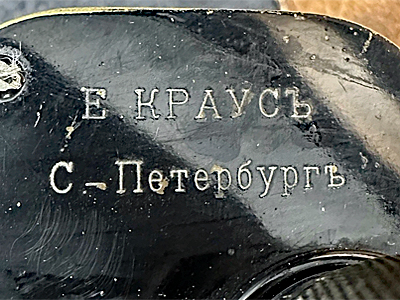
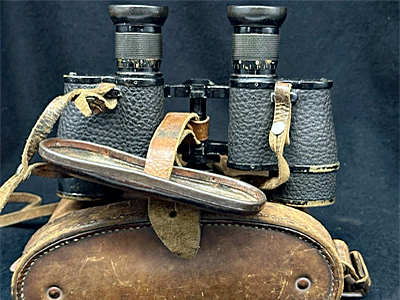
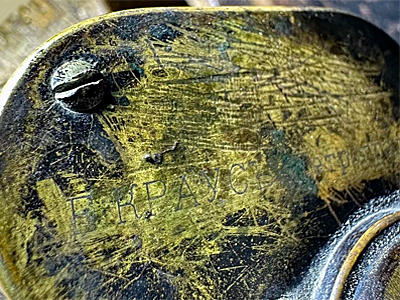
Imperial Russian 6×20 binoculars, production serial number, №37911, heavy construction, made of brass, hard rubber body covering, manufactured in 1912 by E. Krauss et Compagnie, Saint-Petersburg, Russia. Left prism cover marked in white with “E.KPAУCꙎ” (E.KRAUSS) over “С.-ПетербургꙎ” (S.-Petersburg). Right prism cover marked in white with “6x” over “ПризменнЫй Бинокль” (Prism Binoculars) over production serial number, “№37911 — 1912г.” (г. is abbreviation of год, year, of manufacture). These 6×20 binoculars are accompanied by the original brown leather carrying strap, brown leather eye piece protector, brown leather button tab, and brown leather case. |





E. Krauss et Compagnie
8×20 STÉRÉO-JUMELLE, 1913, № 35392, Paris, France
|
|
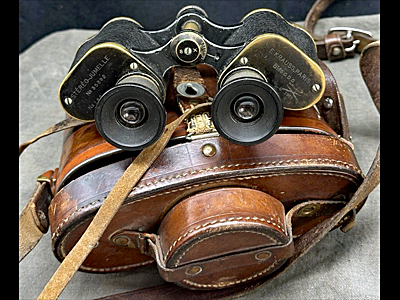
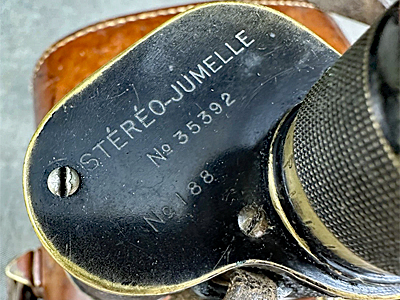
Imperial Russian 8×20 binoculars, production serial number, №35392, heavy construction, made of brass, body covering, manufactured in 1913 by E. Krauss et Compagnie, Paris, France. Left prism cover marked in white with “STÉRÉO-JUMELLE” (STEREO-BINOCULARS) over production serial number, “№ 35392”, over “№ 188”. Right prism cover marked in white with “E. KRAUSS, PARIS” over “BteS.G.D.G.” (Breveté Sans Guarantie du Government, Patented Without Government Guarantee) over a crossed rifles with bayonets insignia over “1913”. On the top cover of the leather carrying case is a small round compartment containing a compass. The metal cover of the compass is marked in white with “КОМПАСЪ” (Compass) over “КАПИТАНА АДРІАНОВА” (Captain Adrianov) over a crossed rifles with bayonets insignia over “Оф. стр. школа” (the abbreviation of Офицерская стрелковая школа, Ofitserskaya strelkovaya shkola, Officers’ Shooting School). |



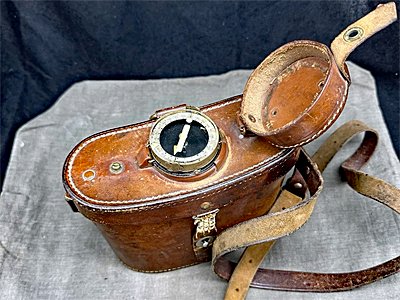
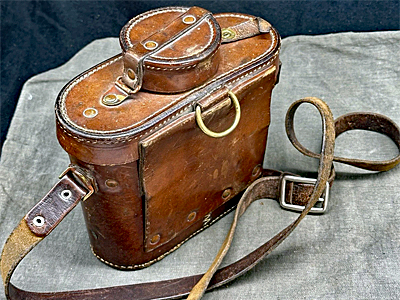
E. Krauss et Compagnie
8×20 STÉRÉO-JUMELLE, 1913, № 35392, Paris, France
E. Krauss et Cie. was founded by Emile Krauss in Germany in 1882. The company produced photographic equipment and Galilean binoculars. In 1892 the company moved from Berlin to Paris at which time a license was obtained from Zeiss to manufacture “Zeiss-Anastigmate” photographic objective lenses.
In 1896, this business relationship grew when Zeiss licensed E. Krauss et Cie to manufacture prismatic binoculars with the objective lenses spaced horizontally farther apart to enhance stereo three dimensional depth perception, which was a design patented by Zeiss until 1908.
During the same time period, Zeiss also licensed Bausch & Lomb in the United States to manufacture stereoscopic binoculars. Another maker, Hensoldt in Germany, violated the Zeiss patent by manufacturing stereoscopic binoculars prior to 1908 without having a license.
Krauss Stéréo-Jumelle Zeiss binoculars were made from 1896/97 until 1908/09. After 1902, the Zeiss name was no longer marked on the binoculars. The binoculars were available in various powers of magnification. Although they were not exact copies of the Zeiss Feldstecher models, they very much resembled them.
The Krauss binoculars were built with a military type clamping knob at the end of the center bar which when tightened immovably fixed the halves of the binocular at a selected setting. The Zeiss Feldstechers were built with a spring tensioned click stop knob which when tightened applied a click stop tension at a selected setting but still allowed the halves of the binocular to be moved out of the click stop setting to another position.
Other than the crossed rifles with bayonets insignia, there are no actual French or Russian military markings on these binoculars.
During this same time period, some Zeiss binoculars were offered for sale as “Armee Modell” Feldstechers, presumably meant for private purchase by German and foreign military personnel.
It could be that these 8×20 Krauss Stéréo-Jumelle Zeiss binoculars were also intended for private purchase by French and foreign army officers.
The 8×20 Krauss Stéréo-Jumelle Zeiss binoculars are just as well constructed as the 8×20 Zeiss Feldstechers, and the optical performance of the binoculars is exactly the same.
Imperial Russian Officer Schools
In 1913, the officer schools of the Imperial Russian Army included eleven infantry schools, two Cossack schools, three cavalry schools, three artillery schools, and one engineer school.
Imperial Russian Army Officer Training: Officers were trained in various military skills, including marksmanship, which was crucial for infantry, cavalry, and artillery units. These schools were designed to train officers for various roles within the military, ensuring a structured and specialized education for future leaders.
There is no specific mention of a shooting school in the Imperial Russian Army school system. However, officer training in the Imperial Russian Army included various military skills, and marksmanship would have been an essential part of the curriculum for most branches, such as infantry, cavalry, and artillery.
Military Schools: These schools provided comprehensive military education, including tactical and strategic training. The schools were part of the military education system for commissioned officers from the page corps, cadet corps, junker and military schools. The junker schools were re-designated as military schools in 1910. There is no specific information regarding marksmanship shooting schools.
E. Krauss et Compagnie
6×20, 1913, №40665, Saint Petersburg, Russia (Санкт-Петербург, Россия)
|
|
Imperial Russian 6×20 binoculars, production serial number, №40665, heavy construction, made of brass, hard rubber body covering, manufactured in 1913 by E. Krauss et Compagnie, Saint-Petersburg, Russia. Left prism cover marked in white with a crossed rifles with bayonets insignia over “E.KPAУCꙎ” (E.KRAUSS) over “С.-ПетербургꙎ” (S.-Petersburg). Right prism cover marked in white with “6x” over “ПризменнЫй Бинокль” (Prism Binoculars) over production serial number, “№40665”, over “1913” годa (years), meaning the year of manufacture. |


E. Krauss et Compagnie
6×20, after August 31, 1914, №50719, Petrograd, Russia (ПетроградꙎ, Россия)
|
|
Imperial Russian 6×20 binoculars, production serial number, №50719, heavy construction, made of brass, hard rubber body covering, manufactured in 1914 by E. Krauss et Compagnie, Petrograd, Russia. On August 31, 1914, after the First World War with Germany had begun, Tsar Nicholas II changed the city’s German-sounding name, “Saint Petersburg,” to Петроград (Petrograd) to avoid and expunge the German words Sankt and Burg. When the city’s “Saint” prefix was omitted, this also changed the eponym and the “patron” of the city from Saint Peter to Peter the Great, its founder. The city was known as Petrograd for 10 years from 1914 to 1924. Left prism cover marked in white with a crossed rifles with bayonets insignia over “E.KPAУCꙎ. ПетроградꙎ” (E.KRAUSS. Petrograd). Right prism cover marked in white with “6x” over “ПризменнЫй Бинокль” (Prism Binoculars) over production serial number, “№50719”. |


E. Krauss et Compagnie
6×20, after August 31, 1914, №61316, Petrograd, Russia (ПетроградꙎ, Россия)
|
|
Imperial Russian 6×20 binoculars, production serial number, №61316, heavy construction, made of brass, hard rubber body covering, unknown date of manufacture (likely between September 1914 and March 1917) by E. Krauss et Compagnie, Petrograd, Russia. On August 31, 1914, after the First World War with Germany had begun, Tsar Nicholas II changed the city’s German-sounding name, “Saint Petersburg,” to Петроград (Petrograd) to avoid and expunge the German words Sankt and Burg. When the city’s “Saint” prefix was omitted, this also changed the eponym and the “patron” of the city from Saint Peter to Peter the Great, its founder. The city was known as Petrograd for 10 years from 1914 to 1924. Left prism cover marked in white with a crossed rifles with bayonets insignia over “E.KPAУCꙎ. ПетроградꙎ” (E.KRAUSS. Petrograd). Right prism cover marked in white characters stamped with “6x” over “ПризменнЫй Бинокль” (Prism Binoculars) over the production serial number, №61316. These 6×20 binoculars are accompanied by the original brown leather carrying strap, brown leather eye piece protector, brown leather button tab, and brown leather case. |


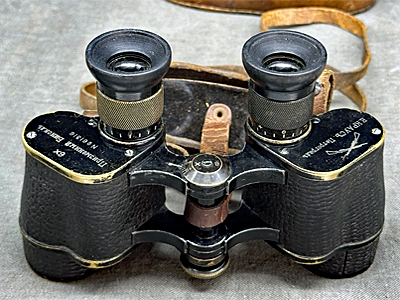


Germany — Carl Zeiss, St. Petersburg, Russia
This is a list of production serial numbers, observed in collections and recorded from sources online, of military service binoculars, manufactured by the Carl Zeiss factory in St. Petersburg, Russia for the armed forces of the Russian Empire from 1908 to 1918, prior to and during the First World War.
Carl Zeiss Russian Empire contract
6×24 D.F. 6x, unknown date of manufacture, № 281, St. Petersburg, Russia
|
|
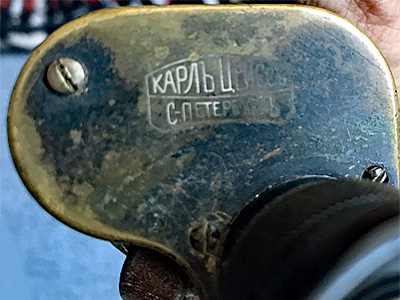
Russian Empire 6×24 D.F. 6x military service binoculars, Russian armed forces property number, № 281, heavy construction, made of brass, brass fittings, hard rubber body covering, unknown date of manufacture (likely before 1910) by Carl Zeiss, St. Petersburg, Russia. Left prism cover marked in white with “КАРЛЪ ЦЕЙССЪ” (KARL ZEISS) / “C.-ПЕТЕРБУРГЪ” (S.-PETERSBURG). Right prism cover marked in white with a crossed rifles with bayonets insignia over D.F. 6x (Doppelfernrohr 6x – Binoculars 6x) / № 281 (Russian armed forces property number). Right objective cover stamped on upper inside edge in very small numbers with unknown production serial number. These 6×24 D.F. 6 military service binoculars are accompanied by the original brown leather carrying strap, and brown leather case. |


Carl Zeiss Russian Empire contract
6×24 D.F. 6x, unknown date of manufacture, № 786, St. Petersburg, Russia
|
|
Russian Empire 6×24 D.F. 6x military service binoculars, Russian armed forces property number, № 786, heavy construction, made of brass, brass fittings, hard rubber body covering, unknown date of manufacture (likely before 1910) by Carl Zeiss, St. Petersburg, Russia. Left prism cover marked in white with “КАРЛЪ ЦЕЙССЪ” (KARL ZEISS) / “C.-ПЕТЕРБУРГЪ” (S.-PETERSBURG). Right prism cover marked in white with a crossed rifles with bayonets insignia over D.F. 6x (Doppelfernrohr 6x – Binoculars 6x) / № 786 (Russian armed forces property number). Right objective cover stamped on upper inside edge in very small numbers with unknown production serial number. These 6×24 D.F. 6 military service binoculars are accompanied by the original brown leather carrying strap. |


Carl Zeiss Russian Empire contract
6×24 D.F. 6x, August 1910, 214949, № 1249, St. Petersburg, Russia
|
|
Russian Empire 6×30 D.F. 6x military service binoculars, production serial number, 214949, heavy construction, made of brass, brass fittings, hard rubber body covering, manufactured in 1910 by Carl Zeiss, St. Petersburg, Russia. Left prism cover marked in white with “КАРЛЪ ЦЕЙССЪ” (KARL ZEISS) / “C.-ПЕТЕРБУРГЪ” (S.-PETERSBURG). Right prism cover marked in white with a crossed rifles with bayonets insignia over D.F. 6x (Doppelfernrohr 6x – Binoculars 6x) / № 1249 (Russian armed forces property number). Right objective cover stamped on upper inside edge in very small numbers with “214949” (production serial number). This Carl Zeiss D.F. 6×, serial number, 214949, appears to be produced about August 1910, within the serial number sequence of the original Carl Zeiss production serial number series established in 1894. These 6×30 D.F. 6x military service binoculars are accompanied by the original brown leather carrying strap. |


Carl Zeiss Russian Empire contract
6×30 D.F. 6x, 1912, № 1197, St. Petersburg, Russia
|
|
Russian Empire 6×30 D.F. 6x military service binoculars, Russian armed forces property number, № 1197, heavy construction, made of brass, brass fittings, hard rubber body covering, manufactured in 1912 by Carl Zeiss, St. Petersburg, Russia. Left prism cover marked in white with “КАРЛЪ ЦЕЙССЪ” (KARL ZEISS) / “C.-ПЕТЕРБУРГЪ” (S.-PETERSBURG). Right prism cover marked in white with “ПРИЗМH.БИН.” (abbreviation of ПРИЗМАТИЧЕСКИЕ БИНОКЛИ, PRIZMATICHESKIYe BINOKLI – PRISM BINOCULARS) / “6x № 1197 1912г” (г is abbreviation of год, year of manufacture). Right objective cover front face marked in white with “2. 32. №2911” (a later Russian armed forces property number). These 6×30 D.F. 6x military service binoculars are accompanied by the original brown leather carrying strap. |


Carl Zeiss Russian Empire contract
8×24 D.F.8x, 1913, St. Petersburg, Russia
|
|
Russian Empire 8×24 D.F. 8x military service binoculars, unknown production serial number, heavy construction, made of brass, brass fittings, hard rubber body covering, manufactured in 1913 by Carl Zeiss, St. Petersburg, Russia. Left prism cover marked in white with “КАРЛЪ ЦЕЙССЪ” (KARL ZEISS) / “C.-ПЕТЕРБУРГЪ” (S.-PETERSBURG). Right prism cover marked in white with “ПРИЗМ.БИН.” (abbreviation of ПРИЗМАТИЧЕСКИЕ БИНОКЛИ, PRIZMATICHESKIYe BINOKLI – PRISM BINOCULARS) / “8x № ____ 1913г” (г is abbreviation of год, year of manufacture). These 8×24 D.F. 8x military service binoculars are accompanied by the original brown leather carrying strap. |


Carl Zeiss Russian Empire contract
6×42 D.F. 6×42, September 1914, 430708, St. Petersburg, Russia
|
|
Russian Empire 6×42 D.F. 6×42 military service binoculars, production serial number, 430708, heavy construction, made of brass, aluminum alloy fittings, not brass, hard rubber body covering, date of manufacture (likely about September 1914) by Carl Zeiss, St. Petersburg, Russia. Left prism cover marked in white with “КАРЛЪ ЦЕЙССЪ” (KARL ZEISS) / “C.-ПЕТЕРБУРГЪ” (S.-PETERSBURG). Right prism cover marked in white with “D.F. 6×42” (Doppelfernrohr 6×42 – Binoculars 6×42) / “430708” (production serial number). This Carl Zeiss D.F. 6×42, serial number, 430708, appears to be produced about September 1914, within the serial number sequence of the original Carl Zeiss production serial number series established in 1894. These 6×42 D.F. 6×42 military service binoculars are accompanied by the original brown leather carrying strap. |




Germany — C.P. Goerz, St. Petersburg, Russia
This is a list of production serial numbers, observed in collections and recorded from sources online, of military service binoculars, manufactured by the C.P. Goerz factory in St. Petersburg, Russia for the armed forces of Imperial Russia from 1908 to 1918, prior to and during the First World War.
C.P. Goerz Russian Empire contract
8×30, 1913, №557, St. Petersburg, Russia
|
|
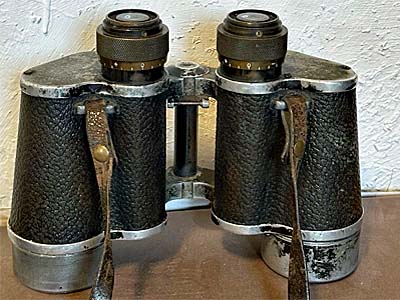
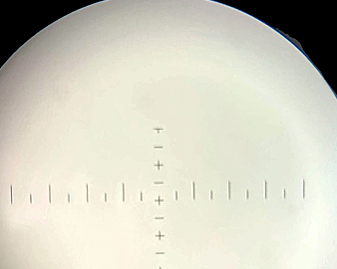
Russian Empire 8×30 military service binoculars, with Strichplatte (graduated range finding scale) in right lens, Russian armed forces property number, №557, heavy construction, made of brass, brass fittings, hard rubber body covering, manufactured in 1913 by C.P. Goerz, St. Petersburg, Russia. Left prism cover marked in white with “К.П.” (C.P.) / “ГЁРЦЪ.” (GOERZ) / “C.ПЕТЕРБУРГЪ” (S.-PETERSBURG). Right prism cover marked in white with “8x” / “№557” (Russian armed forces property number) / “ПРИЗМH.БИНОКЛБ” (abbreviation of ПРИЗМАТИЧЕСКИЕ БИНОКЛИ, PRIZMATICHESKIYe BINOKLI – PRISM BINOCULARS), with year of manufacture “1913г.” marked on the right slanting side of the logo (г. is abbreviation of год, year of manufacture). Right front bridge cross member marked in white with “12284” (production serial number). These 8×30 Russian Empire military service binoculars are accompanied by the original black leather carrying strap and eye piece protector. |


C.P. Goerz Russian Empire contract
8×30, 1913, №2069, St. Petersburg, Russia
|
|
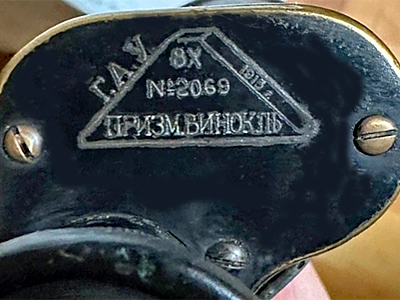
Russian Empire 8×30 military service binoculars, with Strichplatte (graduated range finding scale) in right lens, Russian armed forces peoperty number, №2069, heavy construction, made of brass, brass fittings, hard rubber body covering, manufactured in 1913 by C.P. Goerz, St. Petersburg, Russia. Left prism cover marked in white with “К.П.” (C.P.) / “ГЁРЦЪ.” (GOERZ) / “C.ПЕТЕРБУРГЪ” (S.-PETERSBURG). Right prism cover marked in white with “8x” / “№2069” (Russian armed forces property number) / “ПРИЗМH.БИНОКЛБ” (abbreviation of ПРИЗМАТИЧЕСКИЕ БИНОКЛИ, PRIZMATICHESKIYe BINOKLI – PRISM BINOCULARS). Year of manufacture “1913г.” marked on right slanting side of logo (г. is abbreviation of год, year, of manufacture). “Г.А.У.” (abreviation of Главное артиллерийское управление, Glavnogo artilleriyskogo upravleniya) – Main Artillery Directorate marked on left slanting side of logo. Right front bridge cross member marked with unknown production serial number, illegible. |



Каzan Optical-Mechanical Factory No. 237 (KOMZ)
6×30 Standardized Model B-6, 1946, B 10274, Kazan, Tartarstan
|
|
Soviet Russian 6×30 Standardized Model B-6 military binoculars, production serial number, B 10274, heavy, made of brass, manufactured in 1946 by the Kazan Optical-Mechanical Factory No. 237 (KOMZ), Казанский оптико-механический завод №237 (KOMЗ), of Kazan, Russia. These Russian military binoculars are marked in white characters stamped on the left prism cover with 6×30 at the top, followed by the Soviet hammer, sickle, and star insignia, then by the manufacturer’s trademark logo, and finally by the production serial number, B 10274. These 6×30 Standardized Model B-6 military binoculars are accompanied by the original brown leather carrying strap, brown leather eye piece protector, and original light brown fabric-covered leather case with brown leather carrying strap. The Kazan Optical-Mechanical Factory No. 237 (KOMZ), Казанский оптико-механический завод №237 (KOMЗ), established in 1940, was a company based in Kazan, Russia. |


Каzan Optical-Mechanical Factory No. 237 (KOMZ)
6×30 Standardized Model B-6, 1946, B 17000, Kazan, Tartarstan
|
|
Soviet Russian 6×30 Standardized Model B-6 military binoculars, production serial number, B 17000, heavy, made of brass, manufactured in 1946 by the Kazan Optical-Mechanical Factory No. 237 (KOMZ), Казанский оптико-механический завод №237 (KOMЗ), of Kazan, Russia. These Russian military binoculars are marked in white characters stamped on the left prism cover with 6×30 at the top, followed by the Soviet hammer, sickle, and star insignia, then by the manufacturer’s trademark logo, and finally by the production serial number, B 17000. These 6×30 Standardized Model B-6 military binoculars are accompanied by the original dark brown leather carrying strap. |

Каzan Optical-Mechanical Factory No. 237 (KOMZ)
6×30 Standardized Model B-6, 1947, 25765, Kazan, Tartarstan
|
|
Soviet Russian 6×30 Standardized Model B-6 military binoculars, production serial number, 25765, heavy, made of brass, manufactured in 1947 by the Kazan Optical-Mechanical Factory No. 237 (KOMZ), Казанский оптико-механический завод №237 (KOMЗ), of Kazan, Russia. These Russian military binoculars are marked in white characters stamped on the left prism cover with 6×30 at the top, followed by the Soviet hammer, sickle, and star insignia, then by the manufacturer’s trademark logo, then by the production serial number, 25765, and finally by the year of manufacture, 1947. These 6×30 Standardized Model B-6 military binoculars are accompanied by the original brown leather carrying strap. The Kazan Optical-Mechanical Factory No. 237 (KOMZ), Казанский оптико-механический завод №237 (KOMЗ), established in 1940, was a company based in Kazan, Russia. |

State Optical-Mechanical Factory No. 349 (GOMZ), Государственный оптико-механический завод №349 (ГOMЗ)
Leningrad (Ленинград), 1940-1941, Kazan, Tartarstan (Казань, Татарстан), 1941-1945
|
|
Soviet Russian 6×30 Standardized Model B-6 military binoculars, production serial number, N41042857, heavy, made of brass, manufactured in 1941 by the Kazan Optical-Mechanical Factory No. 349 (KOMZ), Казанский оптико-механический завод (KOMЗ), of Kazan, Russia. These Russian military binoculars are marked with white characters stamped on the left prizm cover with 6×30 at the top, followed by the Soviet hammer, sickle, and star insignia, then by the manufacturer’s trademark logo, and finally by the production serial number, N41042857. The first two numbers, 41, indicate year of manufacture. These 6×30 Standardized Model B-6 military binoculars are accompanied by the original brown leather carrying strap. The Kazan Optical-Mechanical Factory (Казанский оптико-механический завод, KOMЗ), established in 1940, was a company based in Kazan, Russia. |

State Optical-Mechanical Factory No. 349 (GOMZ)
• Государственный оптико-механический завод №349 (ГОМЗ)
• Gosudarstvennyi Optiko-Mechanicheskii Zavod №349 (ГОМЗ)
Leningrad, Russia (Ленинград, Россия) 1940-1941, Tomsk, Siberia (Томск, Сибирь) 1941-1943
In the Russian armed forces, military service binoculars were marked to identify them as government property.
Military service binoculars were issued to soldiers with specialized functions. For example, a group leader or an artillery observer was issued a set of binoculars to perform his duties.
The most common type of military service binoculars was the 6×30 Standardized Model B-6 military service binoculars.
The number “6” identifies the magnification power of the binoculars (in this case, “6” indicates that objects appear six times closer than their actual distance).
The number “30” identifies the diameter in millimeters of the front (objective) lenses — the light gathering lenses — in this case 30 millimeters in diameter.
|
|
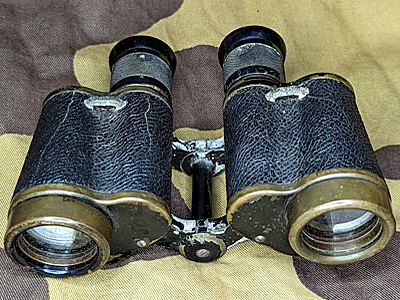
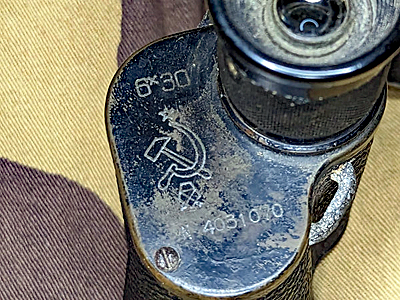
Soviet Russian 6×30 Standardized Model B-6 military service binoculars, production serial number, N 4031070, heavy, made of brass, manufactured in 1940 by the State Optical-Mechanical Factory No. 349 (GOMZ), (Государственный оптико-механический завод №349 (ГОМЗ), Gosudarstvennyi Optiko-Mekhanicheskii Zavod №349 (ГОМЗ), of Leningrad, Russia. These Russian military binoculars are marked with white characters stamped on the left prizm cover with 6×30 at the top, followed by the Soviet hammer, sickle, and star insignia, then by the manufacturer’s trademark logo, and finally by the production serial number, N 4031070. The first two numbers, 40, indicate year of manufacture. From July to August 1941, seven waves of people and equipment from the State Optical-Mechanical Factory No. 349 (GOMZ) in Leningrad were evacuated to the Kazan Optical-Mechanical Factory No. 237 (KOMZ) in Kazan, including 1,284 workers and 327 engineering and technical workers with their families, about 3,500 people. |



State Optical-Mechanical Factory No. 349 (GOMZ), Государственный оптико-механический завод №349 (ГOMЗ)
Leningrad (Ленинград), 1940-1941, Kazan, Tartarstan (Казань, Татарстан), 1941-1945
|
|
Soviet Russian 6×30 Standardized Model B-6 military binoculars, production serial number, N41042857, heavy, made of brass, manufactured in 1941 by the Kazan Optical-Mechanical Factory No. 349 (KOMZ), Казанский оптико-механический завод (KOMЗ), of Kazan, Russia. These Russian military binoculars are marked with white characters stamped on the left prizm cover with 6×30 at the top, followed by the Soviet hammer, sickle, and star insignia, then by the manufacturer’s trademark logo, and finally by the production serial number, N41042857. The first two numbers, 41, indicate year of manufacture. These 6×30 Standardized Model B-6 military binoculars are accompanied by the original brown leather carrying strap. The Kazan Optical-Mechanical Factory (Казанский оптико-механический завод, KOMЗ), established in 1940, was a company based in Kazan, Russia. |
|
|
Soviet Russian 6×30 Standardized Model B-6 military binoculars, production serial number, N41048860, heavy, made of brass, manufactured in 1946 by the Kazan Optical-Mechanical Factory (Казанский оптико-механический завод, KOMZ), of Kazan, Russia. These Russian military binoculars are marked with white characters stamped on the left prizm cover with 6×30 at the top, followed by the Soviet hammer, sickle, and star insignia, then by the manufacturer’s trademark logo, and finally by the production serial number, N41048860. The first two numbers, 41, indicate year of manufacture. These 6×30 Standardized Model B-6 military binoculars are accompanied by the original brown leather carrying strap. The Kazan Optical-Mechanical Factory (Казанский оптико-механический завод, KOMZ), established in 1940, was a company based in Kazan, Russia. |

The Beginning
The exposition of the LOMO History Museum is located in a room with an area of 200 sq. m and contains exhibits, including devices, photographs, and written documents, reflecting all stages of the almost century-long history of the company.
Separate display cases are devoted to the period of the plant’s formation (1914-1917), the years of the Civil War (1917-1922), industrialization (1920-30s), the war period (1941-1945), post-war restoration and development (1945-1962), the company’s work after the merger (1960-80s), and in the new economic conditions.
Of the company’s products, a large place in the Museum’s exposition is occupied by defense products, diffraction gratings, devices for aviation, medical equipment, film and photographic equipment, and observation devices.
The State Optical-Mechanical Factory No. 349 (GOMZ), Государственный оптико-механический завод №349 (ГOMЗ), is one of Russia’s oldest optical manufacturing companies. It was founded in 1914 on the outskirts of the city of Petrograd (Петроград), and was originally established as a French-Russian joint venture the Schneider-Creusot company to produce cameras and lenses.
The beginning of the optical industry in Russia RAOOMP
In Russia at the beginning of the 20th century, all optical devices, from simple eye glasses to telescopes for the Imperial Observatory at Pulkovo, had to be imported from other countries.
Although Russia did not have its own domestic optical industry, the Imperial Observatory at Pulkovo, south of Saint Petersburg, which opened in 1839, was equipped with one of the largest telescopes in the world at the time. Forty-six years later, in 1885, the Imperial Observatory was equipped with a 30-inch (760 mm) telescope, that was still the largest in the world at that time, until the 36-inch (910 mm) telescope at the Lick Observatory of the University of California became operational a few years later.
The first attempts to develop a Russian domestic optical industry were undertaken at the end of the 19th century, but they mostly failed. A truly serious undertaking was the organization of an optical workshop at the Obukhov Factory in 1905.
The workshop mainly fulfilled orders for the Imperial Russian Navy, producing sights, prismatic binoculars, and rangefinders. It was clear, though, that such a small workshop was only a temporary measure that could in no way meet Russia’s needs for optical equipment.
It was necessary to create a specialized optical-mechanical enterprise. The beginning of progress toward the creation of the first domestic optical factory in Russia began in 1912, at the beginning of one of the most turbulent periods in Russian history.
On April 29, 1912, the attorney acting on behalf of the founders of a new joint-stock company, filed a petition with the Ministry of Trade and Industry to register the charter of the Russian Joint-Stock Company of Optical and Mechanical Production (RAOOMP), Российское акционерное общество оптико-механического производства (РAOOMП).
The main shareholders of RAOOMP were the French company, Schneider et Compagnie, the St. Petersburg International Commercial Bank, and the Russo-Asiatic Bank.
Schneider et Compagnie, also known as Schneider-Creusot for its origin in the French town of Le Creusot, was a historic iron and steel-mill company that became a major French industrial military arms manufacturer.
The St. Petersburg International Commercial Bank was a major bank in the Russian Empire, founded in Saint Petersburg in 1869. By the start of the 20th century it was Russia’s second largest private-sector bank by assets, behind the Volga-Kama Commercial Bank. By 1914, it was still the second largest private-sector bank by assets, behind the Russo-Asiatic Bank.
The Russo-Asiatic Bank, formed through the merger of the Russo-Chinese Bank and the Banque du Nord in 1910, was a major Russian bank that operated between 1910 and 1917. By 1914, it had become Russia’s largest private-sector bank by total assets.
The petition of the founders circulated from office to office for a whole year. Such a complex and protracted bureaucratic process was the permitting procedure for the creation of joint-stock companies in Russia. The documents of the joint-stock company underwent a long and complex procedure of “consideration of the issue,” from the trade department of the St. Petersburg mayor to Nicholas II, Emperor of Russia.
The “Russian Joint-Stock Company of Optical and Mechanical Production” was awarded final approval on August 23, 1913 in Livadia. From that day on, RAOOMP received legal status. On February 23, 1914, the Board of the Company published a notice of the beginning of its activities in the newspaper “Vedomosti Sankt-Peterburgskogo Gradonachalstva” and in the “Bulletin of Finance, Industry and Trade.”
To build the new enterprise, a plot of land on Chugunnaya Street was purchased from the townspeople of Shcherbakov, an area in the industrial outskirts of Saint Petersburg. Construction work proceeded rapidly, but actual production was begun in a temporary workshop prior to the completion of the factory.
“Dear Sirs,” read the first notice published by the new company, “We hereby have the honor to inform you that on February 4 of this year, 1914, the government-approved “Russian Joint-Stock Company for Optical and Mechanical Production” (:) began operations. The Company sets as its goal the development of Russian optical and precision mechanical production. For this purpose, the Company is building a plant in St. Petersburg, at 8 Chugunnaya Street, at which plant, under the supervision of Russian specialists, by Russian workers, if possible from Russian materials, all devices falling within the field of optical and precision mechanical production will be manufactured, upon request, such as: optical devices for a wide variety of military and civilian purposes, photographic objectives, small astronomical instruments (specially school types), geodetic instruments, meteorological instruments, physical and other devices falling within the field of precision mechanics and optics. The Company also sets as its goal the development of inventions in the said areas produced by Russian inventors. A.L. Gershun has been invited as the managing director of the Society and the plant, and will be in charge of the immediate management of the affairs and the plant.”
This date – February 4, 1914 – is the birthday of RAOOMP, the first optical factory in Russia.
The final opening date of the plant was set for August 1, 1914, but individual divisions had been actively functioning since early April. Optical instruments were being repaired and the first design developments were being made. It was at this time that L. G. Titov, A. V. Pavsky, and A. A. Shelashev came to RAOOMP, who later played a major role in the life of the plant.
The plant began to be equipped. The plant received equipment and materials from practically all over the world: optical machines and optical glass from the Parra Mantua company, turning and milling machines from the Schuchhardt and Schutte company, and from the Putilov factories, electrical installation equipment from the Siemens and Schuckert company, and steel from the United Steelworks in America. The dividing machine was ordered from Geneva.
The principal customers of RAOOMP were the Main Artillery Directorate and the Main Directorate of Shipbuilding of the Military Department. It is not surprising that the first product developed and built at Chugunnaya was a device for checking gun sighting lines. In addition, on August 1, 1914, the same day as the opening of the plant, the First World War began, which provided the enterprise with stable large orders.
The plant produced sights, periscopes for artillery, and stereoscopic tubes, and also repaired rangefinders and other optical devices. In addition to the main profile, another type of military product, detonator tubes, was launched. They provided the plant with the majority of its profits, allowing it to grow at a rapid pace. In 1915, about 300 people worked at the plant, increasing to about 900 by 1916. The first issue of shares of the enterprise was scheduled for the same year, 1916.
The production of optical devices was constantly increasing, which was dictated by the growing needs of the army and navy. RAOOMP products were distinguished by their high quality, in many respects equal in quality to similar imported products.
From 1916 onwards, a growing strike movement began to exert an increasing influence on the course of events in Russia. Strikes took place at the RAOOMP optical factory. In 1916, a factory workers’ committee (zavkom) was formed. The workers struck for better working conditions and higher wages, and the owners of the factory were forced to make partial concessions.
In 1917, Russia was swept by a wave of violent revolution. Workers of the RAOOMP factory took an active part in the February 1917 and October 1917 riots in Petrograd. By autumn, production at the plant had practically stopped. A new era of violent revolution was exploding in Russia.
On March 15, 1917, Tsar Nicholas II, Emperor of Russia, was forced to abdicate his throne, in the midst of the First World War and the February Revolution, bringing an end to the 304 year rule, from 1613 to 1917, of the Romanov dynasty and the Russian Empire. Five days later, on March 20, 1917, Tsar Nicholas II and his family were arrested by the Bolsheviks.
On July 17, 1918, Tsar Nicholas II and Tsarina Alexandra Fedorovna, and their daughters, Olga, Tatiana, Maria, Anastasia, and their son, the Tsarevich Alexei Nicolaevich, were murdered by a Bolshevik firing squad. Also killed with Nicholas, Alexandra and their children were their doctor and three of their servants, who had voluntarily chosen to remain with the family.
During Russia’s participation in the First World War from August 1914 to October 1917, the RAOOMP factory in Petrograd manufactured gun sights for the Russian armed forces.
Following the Bolshevik Revolution of October 1917, revolutionary events forced changes in the life of Russia, and also the RAOOMP factory. On November 14, 1917, the All-Russian Central Executive Committee, a control commission with power in Russia, adopted the “Regulations on Workers’ Control.”
This regulation stopped the RAOOMP joint-stock company board of directors from fulfilling the company’s contractual obligations to the Schneider-Creusot company by preventing the transfer of 1.5 million rubles to the accounts of the French company. Instead, the money was used to pay delayed wages to factory workers involved in the revolutionary riots of the Bolshevik October Revolution.
Representatives of the control commission devised a plan for the development of the factory in peacetime, but this plan was never implemented. Instead, the Russian Civil War broke out, and many of the factory’s workers went to the fronts to fight in the civil war.
After the Russian Revolution in 1917, the revolutionary Bolshevik government confiscated the RAOOMP factory. The shareholders of the enterprise, Schneider et Compagnie, the St. Petersburg International Commercial Bank, and the Russo-Asiatic Bank, were defrauded of their ownership.
Schneider et Compagnie, also known as Schneider-Creusot for its founding in the French town of Le Creusot (Saône-et-Loire) in 1836, was a historic company dealing in steel, railways, armaments, and shipbuilding. The Russian operations of Schneider et Compagnie were confiscated and absorbed into the State Bank of the Russian Soviet Federative Socialist Republic without compensation to company shareholders.
The Saint Petersburg International Commercial Bank, Санкт-Петербургский международный коммерческий банк, like all other commercial banks in Russia, was confiscated and absorbed into the State Bank of the Russian Soviet Federative Socialist Republic without compensation to bank shareholders.
The Russian operations of the The Russo-Asiatic Bank were confiscated by the State Bank of the Russian Soviet Federative Socialist Republic, Российская Советская Федеративная Социалистическая Республика, Rossiyskaya Sovetskaya Federativnaya Sotsialisticheskaya Respublika, without compensation to bank shareholders. The Russo-Asiatic Bank’s activities in Europe and China continued for a while, but were eventually liquidated in 1926.
On June 28, 1918, the RAOOMP enterprise was nationalized, and the enterprise was reorganized and renamed several times.
In September 1921, the factory was named the State Optics Factory (GOZ), Государственный оптический завод (ГOЗ).
The Soviet hammer, sickle and star was symbol was adopted in 1923 and finalized in the 1924. Soviet Constitution. Camera production was resumed in 1925. Several lens designs were tested between 1925 and 1929.
Further reorganizations of the State Optics Factory (GOZ) occurred in several stages.
In 1930, the factory received a new name, which later became world-famous, State Optical-Mechanical Factory No. 349 (GOMZ), Государственный оптико-механический завод №349 (ГОМЗ), Gosudarstvennyi Optiko-Mekhanicheskii Zavod №349 (ГОМЗ).
The GOMZ factory produced civilian and military binoculars in the 1920s and 1930s. A copy of the Leica camera was developed between 1932 and 1935. In 1936, GOMZ stopped the production of its own design 6×30 Model B-1 military service binoculars.
In 1940, GOMZ restarted the production of military service binoculars, but did not resume production of its own design 6×30 Model B-1 military service binoculars. Instead, GOMZ began the manufacture of 6×30 Standardized Model B-6 military service binoculars.
aaaaaaaaaaaaaaaaaaaaaaaaaaaaaaaaaaaaaaaaaaaaaaaaaaaaaaaaaaaa
History of GOMZ in the 20s and 30s
The revolutionary events of October 1917 became a turning point in the life, not only of Russia, but also the plant. In accordance with the “Regulations on Workers’ Control,” adopted by the All-Russian Central Executive Committee on November 14, 1917, a control commission was created at the enterprise, which had the real power.
xxxxxxxxxxxxxxxxxxxxxxxxxx
One of the first steps of the control commission was to stop the attempt of the Board of the joint-stock company to transfer 1.5 million rubles to the accounts of the Schneider-Creusot company. This allowed the workers to be paid their delayed wages. In accordance with the decree of June 28, 1918, the enterprise was nationalized. Representatives of the control commission developed a plan for the development of the plant in peacetime, but it was not necessary to implement it. The Civil War began, and many of the enterprise’s workers went to the fronts.
xxxxxxxxxxxxxxxxxxxxxxxxxxxxxxxxxxxx
Nevertheless, the production of new products continued. In April 1918, after an appeal to the People’s Commissar of Education A. V. Lunacharsky, an order was received to develop the first domestic film projection device. A prototype of the device, called “Rus,” was manufactured in June.
The work on its creation was supervised by I. P. Miettinen and L. G. Titov. It was decided to release the first batch of devices by the anniversary of the revolution. This was successful, although the lens was assembled literally half an hour before the festive meeting, at which the first session in the history of the country using a domestic film projection device took place.
In 1919, hard times came upon the plant. The enterprise was officially closed, although in reality the production of products continued. This situation did not last long, In 1920, qualified workers were urgently returned from the fronts of the Civil War, among them L. G. Titov, who became the first “red director” of the enterprise.

The plant started working again, although in addition to optical instruments, it had to produce glass for eye glasses, weights, irons, shovels, braces and even curling irons. At that time, it became a matter of survival to produce products for which there was a real demand.
Since 1922, a huge homemade wooden machine was used to manufacture optical parts, which the workers nicknamed “forty martyrs.” The oak bars creaked and groaned loudly during operation. This is how the history of the company began, the company that later became the leader of the Russian domestic optical-mechanical industry.
In September 1921, the enterprise received the name Государственный оптический завод (ГOЗ), State Optical Factory (GOZ). Soon it was transformed into the Trust of Optical-Mechanical Production. The stationary film projector TOMP-4 and the mobile film projector “GOZ” were created here. Devices for the army, as well as geodetic instruments were produced.
In 1926, optical production received a new impetus. The country began to melt its own optical glass. In the same year, an order was received for the production of a two-meter stereo rangefinder, which in 1928 brilliantly passed state tests. One of the pioneers of domestic optical engineering, V. S. Ignatovsky, who headed the plant’s computing bureau at the time, took part in its creation. The close connection between science and production had already become one of the characteristic features of the enterprise in those years.
In the late 1920s, industrialization began in Russia. The question of expanding the production areas at GOMZ arose. At first, GOMZ tried to get a reconstruction plan from the Carl Zeiss company, but the Germans set such onerous conditions that the Leningrad opticians decided to refuse, and did everything themselves. Already in August 1929, the foundation of new buildings for the plant took place. The enterprise grew rapidly.

The year 1930 became one of the biggest milestones in the history of the plant, and also of Russian domestic optical instrument making. The first Soviet mass amateur camera, called “Photocor,” was created at the enterprise. At first stage, shutters had to be purchased in Germany, but the plant’s photo lab, headed by A. A. Vorozhbit, was able to rectify the situation in a short time. In 1932, the camera was completely made of domestic components. To sharply increase its production, a special photo loan was issued in 1931.
In 1930, the factory received a new name, which later became world-famous – “State Optical-Mechanical Plant” (GOMZ). In the spring of the following year, 1931, GOMZ completed the first five-year plan ahead of schedule (in 2.5 years). At that time, the plant was part of the All-Union Association of Optical-Mechanical Industry (VOOMP), which existed for several years, but retained complete independence.
In the 1930s, GOMZ developed at a particularly rapid pace. In 1931, the plant was visited by a delegation headed by M. N. Tukhachevsky, which gave a new impetus to the development and production of military products. A new generation of devices for the Navy was created, including sights, rangefinders, and visors. GOMZ also played a major role in the development of Russian domestic military aviation. It was here that designer A. Ya. Simanovsky developed photo-cinema machine guns, bombing and rifle turret sights, and many other products.
However, GOMZ gained wide recognition, first of all, thanks to civilian instrument making. It produced cameras, film installations, geodetic and astronomical devices. In 1932, I. A. Uvarov became the director of GOMZ. At the same time, the creation of technological equipment of its own manufacture began.


In 1934, a sound film mobile was created at GOMZ, which was named “GEKORD” in honor of the People’s Commissar of Heavy Industry G. K. Ordzhonikidze. At the same time, designs for a photographic enlarger were created, and the first samples of the “Sport” reflex camera were manufactured. The TOMP-4 film projector was replaced by the more powerful KZS-1.
In 1935, the design of the “Tourist” camera was developed. Four years later, seven types of cameras were already being produced. Shortly before the war, the first “Smena” was born, the predecessor of the most popular camera on the planet.
Since 1929, the plant began developing and manufacturing astronomical instruments. This work was led by the remarkable designer N. G. Ponomarev. In 1934, a special astro workshop was created at GOMZ, and the following year, Leningrad opticians began manufacturing flat mirrors with a diameter of 300 mm for the first time in the USSR.
One of the first works of the workshop was the design of expedition-type coelostats for observing the total solar eclipse of June 19, 1936. At the same time, the young engineer B. K. Ioannisiani came to work here. The astroworkshop’s credits include the creation of the optical complex of the Leningrad Planetarium, the only astrographic telescope in Europe for photographing celestial bodies for the Pulkovo Observatory, and many other interesting and important developments.
In 1936, the first All-Union industry conference and exhibition of optical-mechanical products took place, where products bearing the GOMZ brand received the most flattering reviews.
The enterprise did not simply work, it took care of its employees. Much attention was paid to personnel training and professional development. Since 1930, the plant’s newspaper “Soviet Lens” was published in large quantities. In the 1930s, a cultural center and a stadium were built. The culture of production was improved.
In the early 1940s, GOMZ was a modern, dynamically developing enterprise. And only the war temporarily stopped this development.
Today, LOMO manufactures scientific research instruments, criminological microscopes, medical lenses and equipment, fiber optic cables and endoscopes, military optical equipment, motion-picture lenses and equipment for use in the film industry, civilian consumer cameras and optical components manufactured mainly for the Russian market and states of the former Soviet Union.
Night-vision devices and telescopes account for 30% of the company’s exports. Military equipment and scientific research instruments are a significant share of production for export to other countries, such as Israel, India, United States, Canada, Mexico, and other international markets. Germany is the largest importer of LOMO products.
Saint Petersburg (Санкт-Петербург)
Saint Petersburg (Санкт-Петербург), 1703 to 1914, was renamed Petrograd, (Петроград), from 1914 to 1924, then later renamed to Leningrad (Ленинград) from 1924 to 1991, and is currently known again as Saint Petersburg (Санкт-Петербург), from 1991 to the present.
Saint Petersburg, situated on the River Neva, at the head of the Gulf of Finland on the Baltic Sea, is the second-largest city in Russia after Moscow.
The city had a population of 5,601,911 residents as of 2021, with more than 6.4 million people living in the metropolitan area. Saint Petersburg is the fourth-most populous city in Europe, the most populous city on the Baltic Sea, and the world’s northernmost city of more than one million residents. As the former capital of Imperial Russia, and a historically strategic port, it is governed as a federal city.
The distance between Saint Petersburg and Moscow is approximately 635 kilometers (395 miles) by air travel. By road, the distance is about 700 kilometers (434 miles). The most popular and efficient way to travel between the two cities is by train, the Red Arrow, which takes around 3 hours and 48 minutes.
The city was founded by Tsar Peter the Great on May 27, 1703 on the site of a captured Swedish fortress, and was named after the apostle Saint Peter. In Russia, Saint Petersburg is historically and culturally associated with the birth of the Russian Empire and Russia’s entry into modern history as a European great power.
Saint Petersburg served as the capital of the Tsardom of Russia, and the subsequent Russian Empire, from 1712 to 1918 (being replaced by Moscow for a short period of time between 1728 and 1730).
After the October Revolution in 1917, the Bolsheviks moved their government from Saint Petersburg to Moscow. On January 26, 1924, shortly after the death of Vladimir Lenin, the city of Saint Petersburg was renamed Leningrad (Ленинград), meaning ‘Lenin City.’ It was the site of the siege of Leningrad during the Second World War, the most lethal siege in history.
In June 1991, only a few months before the dissolution of the USSR, voters supported restoring the city’s original name, Saint Petersburg. On September 6, 1991, the city’s original name, Sankt-Peterburg, was restored by citywide referendum. Today, in English, the city is known as Saint Petersburg. Local residents often refer to the city by its shortened nickname, Piter (Питер).
As Russia’s cultural center, Saint Petersburg received over 15 million tourists in 2018. It is considered an important economic, scientific, and tourism center of Russia and Europe. In modern times, the city has the nickname of being the “Northern Capital of Russia” and is home to notable federal government bodies such as the Constitutional Court of Russia and the Heraldic Council of the President of the Russian Federation.
It is also a seat for the National Library of Russia and a planned location for the Supreme Court of Russia, as well as the home to the headquarters of the Russian Navy, and the Leningrad Military District of the Russian Armed Forces. The Historic Centre of Saint Petersburg and Related Groups of Monuments constitute a UNESCO World Heritage Site.
Saint Petersburg is home to the Hermitage, one of the largest art museums in the world, the Lakhta Center, the tallest skyscraper in Europe, and was one of the host cities of the 2018 FIFA World Cup and the UEFA Euro 2020.
The city of Санкт-Петербург (Saint Petersburg) was founded by Czar Peter the Great on May 27, 1703. It was known by that name for 211 years from 1703 to 1914, the first year of the First World War.
On August 31, 1914, after the First World War with Germany had begun, Tsar Nicholas II changed the city’s German-sounding name, “Saint Petersburg,” to Петроград (Petrograd) to avoid and expunge the German words Sankt and Burg. When the city’s “Saint” prefix was omitted, this also changed the eponym and the “patron” of the city from Saint Peter to Peter the Great, its founder. The city was known as Petrograd for 10 years from 1914 to 1924.
The city was renamed Ленинград (Leningrad) after Vladimir Lenin’s death in 1924, and was known by that name for 67 years until the city’s name, Leningrad, was changed back to its original name, Saint Petersburg, after the collapse of the Soviet Union on December 26, 1991.
Vladimir Ilyich Ulyanov, better known as Vladimir Lenin, was a Russian revolutionary, politician and Marxist political theorist who was the founder and first head of government of Soviet Russia from 1917, and of the Soviet Union from 1922, until his death in 1924.
As the founder and leader of the Bolsheviks, Lenin led the October Revolution that established the world’s first socialist state. His government won the Russian Civil War and created a Marxist one-party state under the Communist Party.
The First World War (World War I), also known as The Great War, was a global war fought between two coalitions, the Allies (l’Entente) and the Central Powers, between July 28, 1914 and November 11, 1918.
When the Great War erupted in 1914, production at GOMZ (Gosudarstvennyi Optiko-Mekhanicheskii Zavod — “State Optical-Mechanical Factory”) switched from civilian consumer cameras and lenses to military optics such as gun sights and military binoculars.
After the Great War ended on November 11, 1918, GOMZ was taken over and nationalized by the Bolshevik government of Russia in 1919, and began its long series of reorganizations, restructuring, and company name changes.
The GOMZ factory continued to produce binoculars in the 1920s and 1930s. GOMZ also continued to manufacture civilian consumer cameras over the next thirty years, including the original Lubitel, Lubitel 2, and several models of the popular Smena series of 35mm viewfinder cameras.
In 1936, GOMZ stopped production of its own design 6×30 Model B-1. In 1940, GOMZ restored binocular production, but this time it produced the 6×30 Standardized Model B-6. Production continued until the Autumn of 1941.
The Molotov-Ribbentrop Pact
The event that began the Second World War was the invasion of Poland by Nazi Germany on September 1, 1939. In the two years leading up to the invasion of Poland, Adolf Hitler, Führer und Reichskanzler of Nazi Germany, and Joseph Stalin, leader of the Soviet Union, secretly conspired together to take control of other countries in Eastern Europe.
Adolf Hitler and Joseph Stalin, through their ambassadors and foreign service officers, negotiated in secret to stake out German and Soviet spheres of influence among countries of Eastern Europe that each intended to overpower and control in the near future. Hitler and Stalin discussed how they would divide those countries between them without getting in each other’s way.
On August 24, 1939, Nazi Germany and the Soviet Union signed the Molotov–Ribbentrop Pact, a non-aggression agreement between Nazi Germany and the Soviet Union, with a secret protocol establishing Soviet and German spheres of influence across Eastern Europe.
The protocol specified that when Germany invaded Poland, Germany and the Soviet Union would partition Poland between them, and the Soviet Union would be free to overrun Finland, Estonia, Latvia, and the Bessarabia region of Romania. The Soviet Union already occupied Lithuania.
Seven days after signing the Molotov–Ribbentrop Pact, and one day after the Supreme Soviet (the highest body of state authority) of the Soviet Union approved the pact, both countries, Nazi Germany and the Soviet Union, had conspired and agreed to invade Poland.
On September 1, 1939, Nazi Germany invaded Poland from the north, south, and west. Sixteen days later, on September 17, 1939, the Soviet Union invaded Poland from the east. Within a month, the Polish armed forces were overwhelmed, and the campaign was ended on October 6, 1939.
Nazi Germany and the Soviet Union then divided and annexed the whole of Poland between them under the terms of the German–Soviet Frontier Treaty.
The Republic of Poland (Rzeczpospolita Polska), 1918-1939, had disappeared. The Polish government-in-exile, first in Paris, then in Angers, and finally in London, gradually ceased to be a recognized partner in the Allied coalition.
After the Axis attack on the Soviet Union in the summer of 1941, the entirety of Poland was occupied by Germany, which proceeded to inflict Nazi racial and genocidal policies on the people of Poland.
Under the occupations of Nazi Germany and the Soviet Union, Polish citizens suffered enormous human and material losses. According to the Institute of National Remembrance estimates, about 5.6 million Polish citizens died due to the German occupation, and about 150,000 due to the Soviet occupation.
The Jews were singled out by the Germans for a quick and total annihilation, and about 90 percent of Polish Jews (nearly three million) were murdered as part of the Holocaust. Jews, Poles, Romani people and prisoners of many other ethnicities were killed en masse at Nazi extermination camps, such as Auschwitz, Treblinka, and Sobibór.
After the Fall of France, the Polish government-in-exile was evacuated to London. The Polish armed forces were reconstituted and fought alongside the Western Allies in France, Britain, and elsewhere.
Fifteen Polish squadrons, including No. 303 Squadron, were part of the British Royal Air Force Fighter Command and the Fleet Air Arm of the Royal Navy that fought against the German Luftwaffe during the Battle of Britain.
Of the 66 Allied fighter squadrons engaged in the Battle of Britain, No. 303 Squadron, flying Hawker Hurricanes, shot down more German aircraft than any of the other 65 RAF squadrons that fought in the Battle of Britain, even though No. 303 Squadron joined the fray two months after the battle had begun.
As part of an agreement between the Polish government-in-exile and the United Kingdom, No. 303 Squadron of the RAF, also known as the “Tadeusz Kościuszko Warszawa” (“Thaddeus Kosciuszko City of Warsaw”) Fighter Squadron, was formed in July 1940 in Blackpool, England before deployment to RAF Northolt on August 2, 1940.
A total of 145 Polish fighter pilots served in the RAF during the Battle of Britain, making up the largest non-British contribution. By the end of the war, around 19,400 Poles were serving in the Polish Air Forces in Great Britain and in the RAF.
Polskie Siły Powietrzne was the name of the Polish Air Forces formed in France and the United Kingdom during the Second World War. The core of the Polish air units fighting alongside the Allies were experienced veterans of the 1939 invasion of Poland. They contributed significantly to the Allied victory in the Battle of Britain and Allied air operations during the war.
The Battle of Britain lasted for 113 days from July 10 to October 31, 1940. It was one of the most important aerial battles of the Second World War. Nearly 3,000 aircrew from the United Kingdom, the Commonwealth, and other Allied countries defended Great Britain, with about a third either being killed or wounded. Since then, these airmen have been referred to as “The Few” and have been honored with ceremonies and flypasts on each anniversary day of the Battle of Britain.
In the summer of 1940, France and nearly all of the nations of western Europe had been overwhelmingly defeated by the blitzkrieg lightning war of Nazi Germany. That summer, the people of Great Britain were standing alone, staunchly defending their island home against the threat of German invasion.
On August 20, 1940, in this crucial moment of greatest danger, standing before the House of Commons, Winston Churchill addressed the people of Great Britain, the British Commonwealth, all of Europe, and all the world, delivering one of his most famous speeches.
On that day, Winston Churchill praised the airmen of the Royal Air Force, the Fleet Air Arm of the Royal Navy, and other Allied airmen who were fighting alone, against overwhelming odds, defending the British people and all free people of Europe in the fight of their lives against Nazi Germany.
Winston Churchill honored “The Few,” saying it plainly, making it clear, that “Never was so much owed by so many to so few.” His words also recall the speech in William Shakespeare’s play, Henry V, referring to “We few, we happy few, we band of brothers . . .”
In his speech about “The Few,” Winston Churchill was highlighting the profoundly momentous debt owed to those few airmen, who with their bravery and sacrifice, were the last ditch defenders of western Europe, fighting for the freedom of free people everywhere, in the face of overwhelming odds against them in the summer of 1940.
Regarding Poland’s participation in the Battle of Britain, Air Chief Marshal Sir Hugh Dowding, head of RAF Fighter Command, wrote that “Had it not been for the magnificent material contributed by the Polish squadrons and their unsurpassed gallantry, I hesitate to say that the outcome of the Battle (of Britain) would have been the same.”
Soon after the invasion of Poland by Nazi Germany and the Soviet Union in 1939, a Polish Resistance movement began organizing. Its largest military component was a part of the Polish Underground State network that became known as the Home Army.
The whole clandestine structure was formally directed by the Polish government-in-exile through its delegation resident in Poland. There were also peasant, right-wing, leftist, Jewish, and Soviet partisan resistance organizations.
Among the failed anti-German uprisings were the Warsaw Ghetto Uprising and the Warsaw Uprising that tried to prevent the domination of Poland by the Soviet Union.
Ethnic Poles were subjected to both Nazi German and Soviet persecution. The Germans killed an estimated two million ethnic Poles. Generalplan Ost contemplated turning the remaining majority of Poles into slave labor. Poles perceived as “undesirable” were simply killed. Ethnic cleansing and massacres of Poles, and to a lesser extent, Ukrainians, were perpetrated by the Nazis in western Ukraine.
The Katyn massacre was a series of mass executions, in April and May 1940, of nearly 22,000 Polish military and police officers, border guards, and intelligentsia prisoners of war carried out by the Soviet Union, through the NKVD (the Soviet secret police), at Joseph Stalin’s order.
Although the killings also occurred in the NKVD prisons in Kalinin, Kharkiv, and elsewhere, the massacre is named after the Katyn Forest, where some of the mass graves were first discovered by German forces in April 1943.
The massacre is a crime against humanity, a crime against peace, a war crime, and within the Polish Penal Code, a Communist crime. According to a resolution of the Polish parliament (Sejm), it bears the hallmarks of a genocide. The order to execute captive members of the Polish officer corps was secretly issued by the Soviet Politburo led by Stalin.
Of the total killed, about 8,000 were officers imprisoned during the 1939 Soviet invasion of Poland, another 6,000 were police officers, and the remaining 8,000 were Polish intelligentsia that the Soviets decided were “intelligence agents and gendarmes, spies and saboteurs, former landowners, factory owners and officials.”
The Polish Army officer class was representative of the multi-ethnic Polish state. The people who were murdered included ethnic Poles, Ukrainians, Belarusians, and 700–900 Polish Jews.
The government of Nazi Germany announced the discovery of mass graves in the Katyn Forest in April 1943. Stalin severed diplomatic relations with the London-based Polish government-in-exile when it asked for an investigation by the International Committee of the Red Cross.
After the Vistula–Oder offensive, when the mass graves fell into Soviet control, the Soviet Union claimed that the Nazis had killed the victims, and it continued to deny responsibility for the massacres until 1990, when it officially acknowledged and condemned the killings by the NKVD, as well as the subsequent cover-up by the Soviet government.
An investigation conducted by the office of the prosecutors general of the Soviet Union (1990–1991) and the Russian Federation (1991–2004) confirmed Soviet responsibility for the massacres, but refused to classify this action as a war crime or as an act of mass murder.
The investigation was closed on the grounds that the perpetrators were dead, and since the Russian government would not classify the dead as victims of the Great Purge, formal posthumous rehabilitation was deemed inapplicable.
In November 2010, hoping to improve relations with Poland, the Russian State Duma approved a declaration condemning Stalin and other Soviet officials for ordering the massacre. In 2021, the Russian Ministry of Culture downgraded the memorial complex at Katyn on its Register of Sites of Cultural Heritage from a place of federal importance to one of only regional importance.
The Winter War
In the years leading up to the Soviet Union’s invasion of Finland in November 1939, the Soviet Union demanded that Finland cede substantial border territories in exchange for land elsewhere, claiming security concerns, primarily the protection of Leningrad, 32 km (20 miles) from the Finnish border. Finland refused to allow the Soviets to simply demand and steal parts of Finland’s homeland.
On November 30, 1939, just 75 days after the Soviet Union had invaded Poland, the Soviet Union invaded Finland, beginning the Winter War (Зимняя война). The war ended three and a half months later, on March 13, 1940, with the Moscow Peace Treaty.
The Finnish armed forces, despite being severely outnumbered and outgunned, especially in tanks and aircraft, fought bravely and brilliantly, and inflicted severe losses on the Soviet armed forces. The Soviet invasion of Finland made little progress. The League of Nations condemned the Soviet Union, declared the Soviet attack illegal, and expelled the Soviet Union from the League of Nations.
For more than two months, Finland successfully repelled Soviet assaults, inflicting substantial losses on the Russians in temperatures as low as −43 °C (−45 °F). The battles were fought mainly in Taipale, along the Karelian Isthmus, in Kollaa, in Ladoga Karelia, and on the Raate-Suomussalmi Road, in Kainuu. Battles were also fought in North Karelia and Lapland.
Following their initial failures, the Soviets reduced their strategic objectives. The Soviet military reorganized and adopted different tactics, renewed their offensive in February 1940, and eventually overcame the Finnish defenses on the Karelian Isthmus.
This left the Finnish army in the main theater of war near the breaking point, with a retreat seemingly inevitable. Finnish commander-in-chief Carl Gustaf Emil Mannerheim urged a peace deal with the Soviets, while the Finns still retained some bargaining power.
Hostilities were ceased in March 1940 with the signing of the Moscow Peace Treaty. Finland was forced to surrender 9% of its sovereign territory to the Soviet Union, especially substantial territories along Lake Ladoga and further north. Soviet gains actually exceeded their pre-war demands.
Finland retained its sovereignty and enhanced its international reputation. The international reputation of the Soviet Union declined significantly.
Soviet losses in manpower, equipment, and reputation were heavy. The poor performance of the Red Army confirmed negative Western opinions of the Soviet armed forces. This perceived weakness of the Soviet Union led German Führer und Reichskanzler Adolf Hitler to believe that an attack on the Soviet Union would be successful. Hitler convinced himself that Nazi Germany should invade the Soviet Union.
In the meantime, the Soviet Union looked around for another weaker country to exploit, and issued an ultimatum to Romania on June 26, 1940, threatening the use of force in another land grab act of aggression.
Two days later, the Soviet Union began the occupation of Bessarabia and Northern Bukovina between June 28 and July 3, 1940, simply absorbing these parts of Romania into the Soviet Union. On October 26, 1940, the Soviet armed forces also grabbed six Romanian islands on the Chilia branch of the Danube River.
Initially, the Soviet Union had planned a full-scale invasion to annex these parts of Romania, but the Romanian government, responding to the Soviet ultimatum of June 26, 1940, agreed to withdraw from their own sovereign territory to avoid military conflict with the Soviet Union.
Following the Soviet occupation of Romanian territory between June and October 1940, Adolf Hitler saw his opportunity to do the same thing to Russia, and the German High Command began planning for the invasion of the Soviet Union, which Hitler approved in December 1940.
Operation Barbarossa
On June 22, 1941, Nazi Germany and its European allies, Finland, Romania, Hungary, Italy, and Slovakia, initiated Operation Barbarossa, the invasion of the Soviet Union. This is the event that began the Great Patriotic War (Великая Отечественная война) for the Soviet Union, and the Second World War (Вторая мировая война) for the rest of humanity.
Operation Barbarossa (Операция Барбаросса), named after the Holy Roman Emperor, Frederick Barbarossa (Redbeard), opened the Eastern Front, the largest and deadliest land theater of war in human history, and brought the Soviet Union into the Second World War as one of the Allied powers.
More than 3.8 million Axis troops invaded the western Soviet Union along a 2,900-kilometer (1,800 mile) front. The attack became the largest and costliest military offensive in human history. Around 10 million combatants took part in the opening phase, and there were over 8 million casualties by the end of the operation on December 5, 1941.
Operation Barbarossa launched an explosive German and Axis air and ground assault into western Russia that surprised and stunned Soviet leader Joseph Stalin and the Russian high command.
Although Stalin had accurate intelligence earlier in 1941 about the imminent German attack, he refused to believe it, and did not order a mobilization of the Red Army, fearing that it might provoke Germany. As a result, the understrength and out of position Soviet forces were caught completely unprepared when the massive German air and ground assault began.
The overwhelming German firepower and the lightning encirclement and destruction of entire Russian armies resulted in the catastrophic devastation and collapse of Soviet resistance during the first five months of the German and Axis invasion of Russia.
Operation Barbarossa initiated Generalplan Ost, Nazi dictator Adolf Hitler’s ideological goals for German territorial expansion into Eastern Europe. After Hitler’s rise to power, the concept of Lebensraum became a high priority ideological principle of Nazism that provided justification for German territorial expansion into Eastern Europe, especially Russia.
Generalplan Ost planned for the conquest of the Soviet Union, the eradication of Communism, the extermination of the native Slavic peoples by enslavement, genocide, and mass deportation to Siberia.
Adolf Hitler intended to simply confiscate the western Soviet Union and repopulate the land with Germans to fulfill his Nazi ideological principle of Lebensraum (living space) for future generations of Germans in his expected Thousand Year Reich.
The material targets of the invasion were the agricultural and mineral resources of Ukraine and Byelorussia and oil fields in the Caucasus.
Ultimately, the rampaging German armed forces captured five million Soviet Red Army troops in Russia and deliberately starved to death or otherwise killed 3.3 million Russian prisoners of war, as well as millions of Russian civilians. Mass shootings and gassing operations, carried out by German paramilitary death squads and collaborators, murdered over a million Soviet Jews as part of the Holocaust.
The Evacuation
On June 22, 1941, Nazi Germany and its European allies, Finland, Romania, Hungary, Italy, and Slovakia, invaded the Soviet Union, beginning the Great Patriotic War (Великая Отечественная война) for the people of Russia.
The lightning German assault through western Russia led to the emergency evacuation and relocation of many Russian industrial factories from western Russia far to the east, beyond the Ural Mountains, to protect them from being overrun by the rapidly advancing German blitzkrieg.
On July 11, 1941, just 19 days after the opening shots of Operation Barbarossa, USSR State Defense Decree No. GKO-99ss was issued to begin the emergency evacuation of Russian industrial factories.
Production at GOMZ continued through July and August 1941, but when the German and Finnish offensive reached Leningrad, the evacuation began under the direction of the People’s Commissariat of Armaments in the Tatar Autonomous Soviet Socialist Republic.
From July to August 1941, seven waves of equipment and people departed from the State Optical-Mechanical Factory No. 349 (GOMZ) in Leningrad, and arrived safely at the Kazan Optical-Mechanical Factory No. 237 (KOMZ), then under construction in Kazan.
On August 31, 1941, the last wave of the State Optical-Mechanical Factory No. 349 (GOMZ) equipment and workers, including 1,284 factory workers and 327 engineering and technical workers and their families, had arrived in Kazan.
The combined staff of factory workers at the Kazan Optical-Mechanical Factory No. 237, including existing workers and evacuees, was about 3,500 people.
By the end of August 1941, the combined factory was the first among all the evacuated factories in the Russian optical industry to produce its first products for the Soviet armed forces at the front. GOMZ and KOMZ factory workers, together, produced 5,000 military service binoculars assembled from unfinished production parts brought from Leningrad.
Technically, the production of GOMZ military binoculars had ended in the Autumn of 1941. However, during the initial production period in Kazan, the GOMZ factory continued to use its GOMZ pentagram and ray of light logo on its binoculars.
The hammer, sickle, and star marking, that had been used by GOMZ during the 1940-1941 production years in Leningrad, was discontinued during the post-evacuation period in Kazan.
From 1940 to 1944, the first two numbers of the production serial number (40, 41, 42, 43, 44) indicated the year of production. In early 1942, the GOMZ factory markings were moved from the left prism cover to the back of the bridge. From mid-1944 and later, GOMZ once again marked its binoculars with the full year of manufacture under the production serial number.
After the July-August 1941 evacuation, many simplifications were used in the construction of GOMZ and KOMZ military binoculars.
Steel objective lens caps replaced brass objective lens caps. Silicium aluminum alloy prism covers were mixed with earlier design brass prism covers. Silicium aluminum alloy prism covers were used on some late 1941-1942 binoculars. Later in 1942, steel prism covers replaced aluminum alloy prism covers. In 1944, steel prism covers were replaced with copper plated steel prism covers.
Silicium cast aluminum alloy eyepiece diopter adjustment sleeves replaced brass eyepiece diopter adjustment sleeves. Silicium cast aluminum alloy eyepiece adjustment sleeves remained in production until 1945. Silicium aluminum alloy replaced brass on other parts. Prewar brass parts did not return to production until 1946.
Early in 1942, the rubber body covering on lens tubes was eliminated, and lens tubes were painted with black paint. In 1943 (possibly in late 1942), the rubber body covering on lens tubes was returned to production. The prewar pattern rubber body covering was changed to a unique KOMZ dot pattern.
Because of the use of these lesser quality substitute metals, original condition 1942-1944 GOMZ and KOMZ binoculars can be difficult to find, because the aluminum alloy parts became very brittle in use, and many of these cast aluminum parts had to be replaced.
The style of marking was also changed. Markings were removed from the bridge, and returned to the left prism cover. The hammer, sickle, and star marking was also used again on the left prism cover.
On September 16, 1941, in accordance with NKVD (People’s Commissariat for Internal Affairs, Народный комиссариат внутренних дел) order No. 451, the GOMZ factory and the KOMZ factory were officially merged, and the new combined factory in Kazan was designated as Optical-Mechanical Factory No. 349. As part of NKVD order No. 451, Andrey Fedorovich Soloviev was appointed director of the combined factory.
The People’s Commissariat for Internal Affairs (NKVD), Народный комиссариат внутренних дел (НКВД) was the interior ministry and secret police of the Soviet Union from 1934 to 1946.

On October 4, 1941, the chief designer of the factory developed the first trademark logo of Kazan Optical-Mechanical Factory No. 237.
The chief designer created a half-pentaprism – half of the GOMZ pentaprism trademark – with a ray of light passing through the prism, and a hint of the letter “K” encrypted within the emblem, mirrored in the vertical axis.
This trademark design, registered in the Bureau of Registration of Trademarks of the USSR Ministry of Trade (Certificate No. 2999, dated October 17, 1946), is the oldest trademark of the Kazan Optical-Mechanical Factory No. 237 (KOMZ).
In December 1941, the factory supplied the front with mortar and tank sights, and from the beginning of 1942, the Hertz PG artillery panoramic sight, which became the plant’s signature product throughout the years of the Great Patriotic War.
As of January 1, 1942, the Optical-Mechanical Factory No. 349 in Kazan employed 3,960 people, and accounted 1,574 units of equipment, including 1,292 machines from Leningrad
On July 21, 1942, by order of the NKVD, the KOMZ factory was redesignated as the Optical-Mechanical Factory No. 237, under which it was built. The GOMZ factory in Leningrad retained its designation as Optical-Mechanical Factory No. 349.
By the end of 1942, the production of binoculars at the factory was increased to 15,000 pieces per month.
In 1943, the factory was already producing 43 types of products, 10 of which were in large quantities, including binoculars, marine rangefinders, photographic lenses, photo control devices, mortar and tank sights, including the Goertz artillery panorama “PG”, and sights for dive bombers PBL-2, and simulators.
On February 10, 1943, the factory staff collected a donation from workers’ personal savings, and transferred 1,004,000 rubles for the purchase of “Stalin artillery” Katyusha (Катю́ша) multiple rocket launchers.
The Katyusha (Катю́ша) is a type of rocket artillery first built and fielded by the Soviet Union in the Second World War. Multiple rocket launchers deliver explosives on a target area more intensively than conventional artillery, but with lower accuracy and requiring a longer time to reload. They are fragile compared to artillery guns, but are cheap, easy to produce, and usable on almost any truck chassis.
German troops coined the nickname “Stalin’s organ” (Stalinorgel), after Soviet leader Joseph Stalin, comparing the visual resemblance of the launch array to a pipe organ, and the distinctive howling sound of the weapon’s rocket motors that terrified German troops, adding a psychological warfare aspect to their use.
On October 12, 1943, the NKVD order of the day noted the exemplary work of Factory No. 237, working on schedule, exceeding production from month to month. In 1944, the factory fulfilled two and a half times the production of 1942.
By the end of the war, thanks to the introduction of the first overhead conveyor in the USSR for assembling binoculars with a given production rhythm, the output of binoculars was increased to 25,000 pieces per month.
At the beginning of 1945, 5,663 people worked at the factory, 50.6% of whom were under 18 years of age.
During the war, the factory was awarded the Red Challenge Banner of the Central Committee of the All-Union Communist Party (Bolsheviks) and the State Defense Committee 17 times. In 1946 the factory was awarded forever, and 198 factory workers were awarded orders and a large group were awarded medals.
In total, during the war, the factory sent 700,000 binoculars, 30,000 gun, mortar, and tank sights, and about 1,000 bomb sights to the front.
On August 5, 1945, by Decree of the Presidium of the Supreme Soviet of the USSR, 45 plant workers received awards for the development of new types of artillery, tank and aviation optical devices, and the successful fulfillment of the State Defense Committee task to increase their output for the front.
On September 16, 1945, by Decree of the Presidium of the Supreme Soviet (Президиум Верховного Совета) of the USSR, the highest state authority in the Soviet Union, the factory was awarded the Order of Lenin for outstanding services in the uninterrupted supply of optical equipment to field artillery, navy, and aviation.
Also, on September 16, 1945, by Decree, 38 individual factory workers received awards for the successful fulfillment of State Defense Committee tasks to create new types of weapons and provide the Red Army with artillery, small arms, and military optical devices.
Technically, production of GOMZ military binoculars ended in Autumn 1941, but during the initial production period in Kazan, the relocated GOMZ factory continued to use its signature “pentagon-ray of light” GOMZ logo.
The hammer, sickle, and star marking that was used during the company’s 1940-1941 production in Leningrad, was discontinued during the company’s 1941 and later post-evacuation production in Kazan.
In early 1942, GOMZ factory production markings were moved from the left lens cover to the bridge. Also, in early 1942, the factory again started to use the stylized “pentagon-ray of light” GOMZ logo on its binoculars.
During 1940-1944, the production year was coded as the two first numbers of the production serial number (40, 41, 42, 43, 44). Starting in mid-1944 and later, the full year marking under the serial number was used.
After its evacuation from Leningrad to Kazan, the factory introduced many simplifications to the construction of binoculars. In late 1941 and early 1942, lens covers made of silicium (a cast aluminum alloy) was introduced. Sometimes, cast aluminum alloy lens covers were mixed with older design brass lens covers on binoculars.
Later in 1942, silicium cast aluminum alloy lens covers were replaced with steel lens covers. In 1944, the steel lens covers were replaced with copper plated steel lens covers.
Brass eyepiece diopter adjustment sleeves were also replaced with silicium cast aluminum alloy sleeves. Silicium cast aluminum alloy eyepiece sleeves remained in production up to 1945. Silicium cast aluminum alloy was also used in the production of other parts. In addition, the brass caps of objective (front) lens assemblies were replaced with steel caps.
Early war and mid war KOMZ binoculars are very difficult to find with their original silicium cast aluminum alloy manufactured parts. Over time these cast alloy parts became brittle and broke in use, and had to be replaced with other parts made of different metals.
In early 1942, the rubber covering on lens tubes was eliminated. The tubes were instead painted only with black paint. By late 1942 until the end of the war, the use of rubber covering on lens tubes was resumed. The prewar pattern was changed to the unique KOMZ dot pattern.
The Siege of Leningrad
The siege of Leningrad was a military blockade of 872 days from September 8, 1941 to January 27, 1944 by Germany and Finland against the city of Leningrad (Saint Petersburg) in the Soviet Union. Russia’s second largest city, Leningrad, was besieged for two years, four months, and nineteen days, but the city was never captured.
The Siege of Leningrad was one of the longest, most destructive, and most lethal sieges of a major city in modern history, causing an estimated 1.5 million deaths. The siege isolated Leningrad from food supplies, except those provided through the Road of Life across Lake Ladoga, which could not make it through until the lake froze.
More than one million civilians were killed, mainly from starvation. There were incidents of cannibalism, with around 2,000 residents arrested for eating other people. Many others escaped or were evacuated, so the city became largely depopulated.

During World War II, German forces besieged Leningrad following the Axis invasion of the Soviet Union on June 22, 1941. The siege of Leningrad lasted 872 days, almost two and a half years, from September 8, 1941 to January 27, 1944.
The Siege of Leningrad was one of the longest, most destructive, and most lethal sieges of a major city in modern history. The siege isolated the city from food supplies except those provided through the Road of Life across Lake Ladoga, which could not make it through until the lake froze.
More than one million civilians were killed, mainly from starvation. There were incidents of cannibalism, with around 2,000 residents arrested for eating other people. Many others escaped or wer
The siege was not classified as a war crime at the time, but some historians have since classified it as a genocide due to the intentional destruction of the city and the systematic starvation of its civilian population.
During World War II, German forces besieged Leningrad following the Axis invasion of the Soviet Union in June 1941. The siege lasted 872 days, almost two and a half years, from September 8, 1941 to January 27, 1944.
In August 1941, German Army Group North reached the suburbs of Leningrad and Finnish forces encircled the city from the north. Land routes from Leningrad to the rest of the Soviet Union were cut off on September 8, 1941, beginning the siege.
The German High Command ordered the Luftwaffe to bomb Leningrad to starve its people into submission, rather than attempt to capture it. Many thousands of Russian families and individuals died of starvation during the winter of 1941–1942.
Supplies were delivered to the city by air, and by ship over Lake Ladoga, when it was free of ice, and over the Road of Life that was built on the lake when it was frozen. A Red Army offensive opened a narrow land corridor to Leningrad on January 18, 1943, but the siege was not fully broken until January 27, 1944.
On May 1, 1945 Joseph Stalin, in his Supreme Commander Order No. 20, named Leningrad, Stalingrad, Sevastopol, and Odesa, hero cities of the war.
The Presidium of the Supreme Soviet of the USSR named Leningrad as a Hero City, and awarded the Order of Lenin and the Gold Star medal to Leningrad “for the heroic resistance of the city and tenacity of the survivors of the Siege.”
A law acknowledging the honorary title of “Hero City” passed on May 8, 1965 (the 20th anniversary of the victory in the Great Patriotic War), during the Brezhnev era. The Hero-City Obelisk bearing the Gold Star sign was installed in April 1985.
GOMZ during the War Years
On June 22, 1941, the Great Patriotic War began with the attack of Nazi Germany on Russia. The next day, a rally was held at GOMZ, as at other factories and enterprises in Russia.
After the rally, the registration of volunteers for military service began. Hundreds of applications were received by the factory party committee. Women were not far behind the men. Voluntary military service applications were submitted by about 400 GOMZ factory workers, mostly Komsomol girls.
A factory partisan detachment of 40 fighters was created, led by a mechanic. Its first task was to break into the area of the Finnish Fort Ino (on the Karelian Isthmus) and disable the railway line. The attempt to cross the front line failed.
The detachment was later transferred to Pulkovo, where it carried out mainly reconnaissance missions. The detachment was transformed into a special purpose fighter battalion and fought against enemy spies who penetrated the Soviet rear.
In July 1941, the factory switched to manufacturing products for the front.
As the front line approached Leningrad, the need for evacuation became increasingly clear. According to the government’s decision, GOMZ was to be evacuated to the Volga, to the Kazan region. The first factory train left Leningrad on July 21, 1941. The last (seventh) train, left for the east on August 17. By this time, about half of the equipment and almost a third of the workers with their families had been evacuated. Just four months after the evacuation, production began at the new location in Kazan.

In August 1941, a new director of GOMZ was appointed, Vyacheslav Nikolaevich Semenov, who went through the entire war with the plant. He was a strong, courageous man “with a stern, energetic face,” as the English journalist Alexander Werth, who visited Leningrad during the war, wrote.
The GOMZ employees who remained in Leningrad worked in the factory’s workshops and participated in the construction of defensive structures in the Piskarevka and Rzhevka areas. As V. N. Semenov recalled, up to 40% of the total number of workers were diverted to defensive work every day.
A workers’ battalion was created at the factory, and work was carried out to transform GOMZ into a circular defensive position.
The bombing and shelling of Leningrad began. On the maps of German staff officers, GOMZ was marked for destruction as one of the most important industrial factories in Leningrad.
On October 4 and 29, 1941, German aircraft raided the factory area. One of the best buildings was destroyed, and the cultural center building was badly damaged. On the night of October 22, GOMZ was subjected to heavy artillery shelling, and several factory workers were killed.
The factory did not stop working. There were cases, during shelling, when workers who were focusing on completing orders for the front refused to go to shelters until a categorical order was issued from the factory’s command.
The hardest time for both the factory and the entire city was the winter of 1941-1942. Despite the cold, malnutrition and terrible hardships, the factory continued to manufacture products. GOMZ produced sights, panoramic sights, fuses for shells, bayonets, grenade bodies, shells for 45-mm guns, and much more that the front needed. An important area of work was also the repair of military optical devices, often carried out directly at the front or on ships of the Baltic Fleet.
Production was increasingly stopped due to interruptions in the supply of electricity and fuel. On December 11, 1941, the supply of electricity to the factory ceased. Most of the workshops had to be closed. Cold and silence reigned in the huge factory buildings. Work had to be done on old equipment, which was operated manually.
Hunger became the terrible enemy of the people of Leningrad. Many workers moved into the barracks. They could no longer reach their homes, and had to spend nights in the factory. Raw materials, such as technical beef fat, drying oil, a mixture of linseed oil and fish oil, stored in the warehouse for production purposes were distributed among GOMZ factory workers for food.
A hospital for 120 people was organized at the factory. In February 1942, GOMZ received five tons of duranda. In March, a laboratory for the production of pine extract, rich in vitamin C, was created at the factory. This lab at the factory produced 117 thousand portions, that saved many human lives.
“People ate everything that was possible and impossible to eat,” recalled V. N. Semenov, but factory workers still died, perished from cold and exhaustion. At that time, the factory had about 2,600 people on the payroll, but 600 of them were almost always engaged in various defensive works, up to 700 were sick, and the actual number of employees of the enterprise was half as much.

On April 23, 1942, the factory’s blockhouse was launched, which made it possible to increase production, although it could not fully satisfy GOMZ’s need for electricity. In May 1942, part of the equipment was taken to Volkhov, where a branch of the plant began to operate.
In June 1942, electricity was finally supplied to the plant. GOMZ began to fulfill planned production targets. The food situation improved, especially since the plant’s workers took an active part in a vegetable gardening campaign that began in Leningrad in 1942.
Preparations for the second winter of the siege began. Thanks to the dismantling of old wooden houses and logging, GOMZ was able to almost completely provide itself with fuel.
The factory lived an active life. The GOMZ library never stopped working for a single day, and a large-circulation newspaper was published. The GOMZ staff was significantly renewed. By the end of 1942, 85% of all those working at the plant were newcomers, and 70% of the enterprise’s employees were women.
In January 1943 the siege was broken, and on January 27, 1944 the siege was finally lifted. The factory was still often subjected to shelling and bombing, but the most difficult days of the siege were over.
The heaviest artillery shelling took place on January 14, 1943, when large-caliber shells, accurately landed over an area of 800 by 200 meters, completely disabling the factory for two and a half hours. Production was restored two weeks later, and GOMZ significantly exceeded its production quota for 1943.

On June 15, 1943, a joyful event for all plant workers took place. GOMZ was designated as one of the best factories in Leningrad, and was awarded the challenge banner of the 189th rifle division, one of the units that defended the approaches to the city. During the presentation ceremony, artillery shelling began. No one was hurt, but the banner was pierced by shrapnel in several places. Today it is kept in the City History Museum.
On March 29, 1944, the State Defense Committee of the USSR adopted a resolution “On priority measures to restore industry and municipal services in Leningrad in 1944.” The revival of GOMZ began, which was accompanied by a surge of enthusiasm among the factory’s workers.
In April 1944, at a general meeting of the optical workshop, a decision was made that “Each worker must work 25 hours a month free of charge to restore the factory.”
The result was not long in coming. Already in 1944, the foundry, power, and woodworking buildings were put into operation. Hundreds of machines were repaired, but damage to the factory was so great that output was only 12% of the pre-war level.
The range of manufactured products was expanded. As early as 1943, GOMZ began to master the production of precision measuring instruments. Since 1944, the production of vertical and horizontal optimeters and ultra-optimeters began. The production of cinematographic equipment was resumed.
By the beginning of 1945, the factory was prepared to switch to a peacetime production schedule. Also in 1945, GOMZ received an important order for the production of the universal measuring microscope UIM-21, which it fulfilled brilliantly.
During the war, the plant suffered enormous damage: 1,915 incendiary and 22 high-explosive bombs of large caliber were dropped on GOMZ, and 41 artillery shells exploded. During the days of the siege, 1,499 workers and employees of the factory died in the besieged city. Nevertheless, GOMZ did not stop production for a single day, doing everything possible for victory.
“There was not a single order from the front,” recalled V. N. Semenov, “that our factory did not fulfill.” During the war, the command of the Leningrad Front repeatedly expressed gratitude to the workers of the factory for their great assistance to the army. For their selfless work during the war, the Presidium of the Supreme Soviet of the USSR awarded orders and medals to a large group of GOMZ employees.
After the War
In 1946, the prewar pattern brass body construction and use of brass parts was resumed. The location of the markings were moved from the bridge to the left lens cover. The Soviet hammer, sickle, and star marking, adopted in 1923 and finalized in the 1924 Soviet Constitution, was used again on the left lens cover.
6×30 model (B-6 modification)
1.1. GOMZ factory marking, 1940-1941 (pre evacuation period).
State Optical-mechanical Plant (GOMZ)
Founded in 1932 near Leningrad, the GOMZ factory is one of the oldest of Soviet optical companies.
Their logo also uses the popular pentagon and arrow representing a ray of light being reflected.

Traceability on their binoculars is prefixed with N and what I believe is the two digits representing the year of mfg followed by the production number.
In the case of these 6×30 it would be 1941


GOMZ (ГОМЗ in Cyrillic) stands for Gosudarstvennyi Optiko-Mekhanicheskii Zavod (Государственный оптико-механический завод), State Optical-Mechanical Factory. Founded in 1932 near Leningrad (now St. Petersburg), the GOMZ factory is one of the oldest Soviet optical companies. It was the manufacturer of the early series of the famous Lubitel cameras. One of the biggest and oldest Soviet camera industry giant was GOMZ. In 1962 GOMZ became a part the Leningrad Optical and Mechanical Association of Enterprises (LOOMP), (= Ленинградское объединение оптико-механических предприятий, ЛООМП).
In 1965 the name changed again as Leningrad Optical-Mechanical Union. (LOMO), (= Ленинградское Oптико-Mеханическое Oбъединение, ЛОМО́). Fotokor-1 folding bed, Reporter folding, Komsomolets TLR, Smena 35mm series, Leningrad 35mm rangefinder series and some other cameras were manufactured in GOMZ also.
GOMZ
GOMZ is what LOMO was called before it changed its name in 1962. GOMZ stands for State Optical-mechanical Plant. The logo above appears on almost all GOMZ cameras, like the early Lubitel-2, the Sport, the Reporter, etc.
LOMO
LOMO is short for Leningradskoye Optiko-Mechanicheshkoye Obyedinenie, or the Leningrad Optical-Mechanial Union. The factory was apparently founded from the old GOMZ works in 1962. The production facility is based in the former city of Leningrad, now known as St Petersburg, and was probably the Soviet Union’s second largest civil-optical plant. LOMO created a lot of archetypical and interesting cameras over the years. LOMOgraphy was a welcome break to LOMO in the Russian depression of the mid-1990’s. Nowadays LOMO seems to have left all camera production behind (with perhaps the exception of the LC-A), and is focusing on scientific and industrial grade optics.
LOMO has various logos, the most common of which is the one depicted on the right. It looks like it says “OMO”, but the upside-down V is actually a Cyrillic L. Some versions of the logo have a ball on top of the L’s point, and some an entire ship.
LOMO
LOMO is short for Leningradskoye Optiko-Mechanicheshkoye Obyedinenie, or the Leningrad Optical-Mechanial Union. The factory was apparently founded from the old GOMZ works in 1962. The production facility is based in the former city of Leningrad, now known as St Petersburg, and was probably the Soviet Union’s second largest civil-optical plant. LOMO created a lot of archetypical and interesting cameras over the years. LOMOgraphy was a welcome break to LOMO in the Russian depression of the mid-1990’s. Nowadays LOMO seems to have left all camera production behind (with perhaps the exception of the LC-A), and is focusing on scientific and industrial grade optics.
LOMO has various logos, the most common of which is the one depicted on the right. It looks like it says “OMO”, but the upside-down V is actually a Cyrillic L. Some versions of the logo have a ball on top of the L’s point, and some an entire ship.
ГОМЗ
Государственный оптико-механический завод, №349 — Ленинград.
 | Пентапризма с ходом луча в ней. В 1962 году завод вошёл в состав Ленинградского объединения оптико-механических предприятий (ЛООМП), которое в 1965 году было преобразовано в ЛОМО. Знак использовался в качестве символики Всесоюзного объединения оптико-механической промышленности (ВООМП, 1930–1936 годы), в том числе — и в перевёрнутом виде. ———————————– Pentaprism with a beam path in it. In 1962, the plant became part of the Leningrad Association of Optical-Mechanical Enterprises (LOOMP), which was transformed into LOMO in 1965. The sign was used as a symbol of the All-Union Association of Optical-Mechanical Industry (VOOMP, 1930-1936), including in an inverted form. |
The creation and first years of existence of RAOOMP
The creation of the first Russian domestic optical plant took place at the beginning of the 20th century, one of the most difficult periods in Russian history.
The exposition of the LOMO History Museum is located in a room with an area of 200 sq. m and contains exhibits, including devices, photographs, and written documents, reflecting all stages of the almost century-long history of the company.
Separate display cases are devoted to the period of the plant’s formation (1914-1917), the years of the Civil War (1917-1922), industrialization (1920-30s), the war period (1941-1945), post-war restoration and development (1945-1962), the company’s work after the merger (1960-80s), and in the new economic conditions.
Of the company’s products, a large place in the Museum’s exposition is occupied by defense products, diffraction gratings, devices for aviation, medical equipment, film and photographic equipment, and observation devices.
Until that moment, Russia did not have its own optical-mechanical industry. All optical devices, from simple eye glasses to telescopes for the Pulkovo Observatory, had to be imported from other countries. At the same time, the need for such products was constantly growing.
The first attempts to organize Russian optical-mechanical production were undertaken at the end of the 19th century, but they mostly failed. A truly serious undertaking was the organization of an optical workshop at the Obukhov Plant in 1905. Its initiator was the outstanding Russian scientist, shipbuilder, and academician, Alexei Nikolaevich Krylov (1863-1945).
In 1909, Alexander Lvovich Gershun (1868-1915) became the head of the optical department of the Obukhov Plant, “the only person in Russia who at that time could help the optical business get on its feet,” as Krylov later described him.
The workshop mainly fulfilled orders from the Navy. The workshop produced sights, prismatic binoculars, and rangefinders, but it was clear to everyone, that the organization of such a workshop was only a temporary measure that could in no way meet the country’s needs for optical devices. It was necessary to create a specialized optical-mechanical enterprise.
The beginning of the actions to create such a plant was in 1912.
On April 29, 1912, attorney B. L. Gershun, acting on behalf of the founders of the new joint-stock company, retired major general A. P. Meller, and state councilor K. K. Rakus-Sushchevsky, filed a petition with the Ministry of Trade and Industry to register the charter of the “Russian Joint-Stock Company of Optical and Mechanical Production (RAOOMP)”.
The main shareholders of RAOOMP were the French company, Schneider-Creusot, the Russo-Asiatic Bank, and the St. Petersburg Commercial Bank.
Schneider et Compagnie, also known as Schneider-Creusot for its origin in the French town of Le Creusot, was a historic iron and steel-mill company that became a major French industrial military arms manufacturer.
The Russo-Asiatic Bank, formed through the merger of the Russo-Chinese Bank and the Banque du Nord in 1910, was a major Russian bank that operated between 1910 and 1917. By 1914, it had become Russia’s largest private-sector bank by total assets. After the Russian Revolution in 1917, its Russian operations were absorbed into the State Bank with no compensation to its shareholders. Its activities in Europe and China continued for a while but were eventually liquidated in 1926.
The petition of the founders circulated from office to office for a whole year. Such a complex and protracted process was the permitting procedure for the creation of joint-stock companies in Russia. The documents of the joint-stock company underwent a long and complex procedure of “consideration of the issue,” from the trade department of the St. Petersburg mayor to the Emperor of Russia Nicholas II.
The “Russian Joint-Stock Company of Optical and Mechanical Production” was awarded final approval on August 23, 1913 in Livadia. From that day on, RAOOMP received legal status. On February 23, 1914, the Board of the Company published a notice of the beginning of its activities in the newspaper “Vedomosti Sankt-Peterburgskogo Gradonachalstva” and in the “Bulletin of Finance, Industry and Trade.”
To build a new enterprise, a plot of land on Chugunnaya Street was purchased from the townspeople of Shcherbakov. At that time, this area was one of the industrial outskirts of the city. Construction work proceeded at a rapid pace, but production was organized before its completion in a temporary workshop of the plant.
“Dear Sirs,” read the first notice published by the new company, “We hereby have the honor to inform you that on February 4 of this year, 1914, the government-approved “Russian Joint-Stock Company for Optical and Mechanical Production” (:) began operations. The Company sets as its goal the development of Russian optical and precision mechanical production. For this purpose, the Company is building a plant in St. Petersburg, at 8 Chugunnaya Street, at which plant, under the supervision of Russian specialists, by Russian workers, if possible from Russian materials, all devices falling within the field of optical and precision mechanical production will be manufactured, upon request, such as: optical devices for a wide variety of military and civilian purposes, photographic objectives, small astronomical instruments (specially school types), geodetic instruments, meteorological instruments, physical and other devices falling within the field of precision mechanics and optics. The Company also sets as its goal the development of inventions in the said areas produced by Russian inventors. A.L. Gershun has been invited as the managing director of the Society and the plant, and will be in charge of the immediate management of the affairs and the plant.”
This date – February 4, 1914 – is the birthday of the first optical plant in Russia.
The final opening date of the plant was set for August 1, 1914, but individual divisions had been actively functioning since early April. Optical instruments were being repaired and the first design developments were being made. It was at this time that L. G. Titov, A. V. Pavsky, and A. A. Shelashev came to RAOOMP, who later played a major role in the life of the plant.
The plant began to be equipped. The plant received equipment and materials from practically all over the world: optical machines and optical glass from the Parra Mantua company, turning and milling machines from the Schuchhardt and Schutte company, and from the Putilov factories, electrical installation equipment from the Siemens and Schuckert company, and steel from the United Steelworks in America. The dividing machine was ordered from Geneva.
The principal customers of RAOOMP were the Main Artillery Directorate and the Main Directorate of Shipbuilding of the Military Department. It is not surprising that the first product developed and built at Chugunnaya was a device for checking gun sighting lines. In addition, on August 1, 1914, the same day as the opening of the plant, the First World War began, which provided the enterprise with stable large orders.
The plant produced sights, periscopes for artillery, and stereoscopic tubes, and also repaired rangefinders and other optical devices. In addition to the main profile, another type of military product, detonator tubes, was launched. They provided the plant with the majority of its profits, allowing it to grow at a rapid pace. In 1915, about 300 people worked at the plant, increasing to about 900 by 1916. The first issue of shares of the enterprise was scheduled for the same year, 1916.
The production of optical devices was constantly increasing, which was dictated by the growing needs of the army and navy. RAOOMP products were distinguished by their high quality, in many respects equal in quality to similar imported products.
From 1916 onwards, another factor began to exert an increasing influence on the course of events, the growing strike movement. Strikes also took place at the optical plant. In 1916, here, as at many other enterprises, a factory workers’ committee (zavkom) was formed. The workers fought for better working conditions and higher wages, and the owners of the plant were forced to make partial concessions.
In 1917, Russia was swept by a revolutionary wave. Workers of the RAOOMP took an active part in both the February and October events in Petrograd. By autumn, production at the plant had practically stopped. A new era in the history of the enterprise and the entire country was approaching.
aaaaaaaaaaaaaaaaaaaaaaaaaaaaaaaaaaaaaaaaaaaaaaaaaaaaaaaaaaaa
History of GOMZ in the 20s and 30s
The revolutionary events of October 1917 became a turning point in the life, not only of Russia, but also the plant. In accordance with the “Regulations on Workers’ Control,” adopted by the All-Russian Central Executive Committee on November 14, 1917, a control commission was created at the enterprise, which had the real power.
One of the first steps of the control commission was to stop the attempt of the Board of the joint-stock company to transfer 1.5 million rubles to the accounts of the Schneider-Creusot company. This allowed the workers to be paid their delayed wages. In accordance with the decree of June 28, 1918, the enterprise was nationalized. Representatives of the control commission developed a plan for the development of the plant in peacetime, but it was not necessary to implement it. The Civil War began, and many of the enterprise’s workers went to the fronts.
Nevertheless, the production of new products continued. In April 1918, after an appeal to the People’s Commissar of Education A. V. Lunacharsky, an order was received to develop the first domestic film projection device. A prototype of the device, called “Rus,” was manufactured in June.
The work on its creation was supervised by I. P. Miettinen and L. G. Titov. It was decided to release the first batch of devices by the anniversary of the revolution. This was successful, although the lens was assembled literally half an hour before the festive meeting, at which the first session in the history of the country using a domestic film projection device took place.
In 1919, hard times came upon the plant. The enterprise was officially closed, although in reality the production of products continued. This situation did not last long, In 1920, qualified workers were urgently returned from the fronts of the Civil War, among them L. G. Titov, who became the first “red director” of the enterprise.
The plant started working again, although in addition to optical instruments, it had to produce glass for eye glasses, weights, irons, shovels, braces and even curling irons. At that time, it became a matter of survival to produce products for which there was a real demand.
Since 1922, a huge homemade wooden machine was used to manufacture optical parts, which the workers nicknamed “forty martyrs.” The oak bars creaked and groaned loudly during operation. This is how the history of the company began, the company that later became the leader of the Russian domestic optical-mechanical industry.
In September 1921, the enterprise received the name “GOZ” – State Optical Plant. Soon it was transformed into the Trust of Optical-Mechanical Production. The stationary film projector TOMP-4 and the mobile film projector “GOZ” were created here. Devices for the army, as well as geodetic instruments were produced.
In 1926, optical production received a new impetus. The country began to melt its own optical glass. In the same year, an order was received for the production of a two-meter stereo rangefinder, which in 1928 brilliantly passed state tests. One of the pioneers of domestic optical engineering, V. S. Ignatovsky, who headed the plant’s computing bureau at the time, took part in its creation. The close connection between science and production had already become one of the characteristic features of the enterprise in those years.
In the late 1920s, industrialization began in Russia. The question of expanding the production areas at GOMZ arose. At first, GOMZ tried to get a reconstruction plan from the Carl Zeiss company, but the Germans set such onerous conditions that the Leningrad opticians decided to refuse, and did everything themselves. Already in August 1929, the foundation of new buildings for the plant took place. The enterprise grew rapidly.
The year 1930 became one of the biggest milestones in the history of the plant, and also of Russian domestic optical instrument making. The first Soviet mass amateur camera, called “Photocor,” was created at the enterprise. At first stage, shutters had to be purchased in Germany, but the plant’s photo lab, headed by A. A. Vorozhbit, was able to rectify the situation in a short time. In 1932, the camera was completely made of domestic components. To sharply increase its production, a special photo loan was issued in 1931.
In 1930, the plant received its name, which later became world-famous – “State Optical-Mechanical Plant” (GOMZ im. OGPU). In the spring of the following year, 1931, GOMZ completed the first five-year plan ahead of schedule (in 2.5 years). At that time, the plant was part of the All-Union Association of Optical-Mechanical Industry (VOOMP), which existed for several years, but retained complete independence.
In the 1930s, GOMZ developed at a particularly rapid pace. In 1931, the plant was visited by a delegation headed by M. N. Tukhachevsky, which gave a new impetus to the development and production of military products. A new generation of devices for the Navy was created, including sights, rangefinders, and visors. GOMZ also played a major role in the development of Russian domestic military aviation. It was here that designer A. Ya. Simanovsky developed photo-cinema machine guns, bombing and rifle turret sights, and many other products.
However, GOMZ gained wide recognition, first of all, thanks to civilian instrument making. It produced cameras, film installations, geodetic and astronomical devices. In 1932, I. A. Uvarov became the director of GOMZ. At the same time, the creation of technological equipment of its own manufacture began.
In 1934, a sound film mobile was created at GOMZ, which was named “GEKORD” in honor of the People’s Commissar of Heavy Industry G. K. Ordzhonikidze. At the same time, designs for a photographic enlarger were created, and the first samples of the “Sport” reflex camera were manufactured. The TOMP-4 film projector was replaced by the more powerful KZS-1.
In 1935, the design of the “Tourist” camera was developed. Four years later, seven types of cameras were already being produced. Shortly before the war, the first “Smena” was born, the predecessor of the most popular camera on the planet.
Since 1929, the plant began developing and manufacturing astronomical instruments. This work was led by the remarkable designer N. G. Ponomarev. In 1934, a special astro workshop was created at GOMZ, and the following year, Leningrad opticians began manufacturing flat mirrors with a diameter of 300 mm for the first time in the USSR.
One of the first works of the workshop was the design of expedition-type coelostats for observing the total solar eclipse of June 19, 1936. At the same time, the young engineer B. K. Ioannisiani came to work here. The astroworkshop’s credits include the creation of the optical complex of the Leningrad Planetarium, the only astrographic telescope in Europe for photographing celestial bodies for the Pulkovo Observatory, and many other interesting and important developments.
In 1936, the first All-Union industry conference and exhibition of optical-mechanical products took place, where products bearing the GOMZ brand received the most flattering reviews.
The enterprise did not simply work, it took care of its employees. Much attention was paid to personnel training and professional development. Since 1930, the plant’s newspaper “Soviet Lens” was published in large quantities. In the 1930s, a cultural center and a stadium were built. The culture of production was improved.
In the early 1940s, GOMZ was a modern, dynamically developing enterprise. And only the war temporarily stopped this development.
zzzzzzzzzzzzzzzzzzzzzzzzzzzzzzzzzzzzzzzzzzzzzzzzzzzzzzzzzzzzzzzzzzzz
History of the enterprises that became part of LOMO in 1962 together with GOMZ
In addition to GOMZ, there were several other optical-mechanical enterprises in Leningrad. All of them later became part of LOMO. This is some of their history.
“Of all the arts, cinema is the most important for us.” This phrase by V. I. Lenin became programmatic for the development of the Soviet film industry. But the corresponding technical support was still far away at that time. Only in 1926, two film repair workshops were opened in Leningrad under the organization “Sovkino.” In both, no more than 200 people worked. In addition to repair work, the workshops were engaged in small-scale production of simple equipment for film studios and cinema networks.
In February 1931, the Film Equipment Plant was created on the basis of the workshops, which was later abbreviated as Kinap. Initially, the new enterprise was provided with the premises of the workshop on Pravda Street and one of the buildings of the Krasny Arsenal plant. It is interesting that all transportation between the two production sites was carried out by cab. V. F. Sakman became the director of the factory.
In the first year of its existence, the plant produced sound editing tables, spotlights, dynamos, motors, cleaning machines, mercury rectifiers. Almost immediately, the factory team faced a new and rather difficult task. The era of sound cinema was coming.
On April 27, 1931, the board of Sovkino decided to profile the Kinap plant in the field of production of sound recording and sound reproduction equipment. Since then, equipping both film studios and a wide network of cinemas with sound equipment has become the most extensive task in Kinap’s production.
In 1932, the SGK-7 sound recording devices designed by the Soviet inventor P. G. Tager were released. It was on them that such films as “Baby Ryazanskiye,” “Goluboy Express,” and “Putevka v zhizn” were recorded, which were among the first Russian domestic sound films. “The Great Silent,” as cinema was called at that time, spoke.
In the spring of the same year, 1932, the plant, whose staff by that time numbered about 300 people, received its own premises on Kondratyevsky Prospekt, 21. Here, serial production of equipment for sound cinema was launched.
The laboratory of A. F. Shorin, who developed the famous sound recording device “Kinap,” collaborated with the plant. Its production was soon mastered by the enterprise. In 1933, the first film camera was manufactured, and a year later, production of film developing machines began.
The plant grew rapidly. If in 1932 the new premises were too big for KINAP, then in 1933 it was necessary to add one floor, and in the following years, to begin the construction of new buildings. The average annual increase in the plant’s output at that time exceeded 50%. Sound recording and sound reproduction devices, motors, amplifying devices and much more were produced.
The chief engineer at that time was the remarkable designer I. I. Saenko, one of the organizers of KINAP. By the beginning of the Great Patriotic War, the plant had become a leading enterprise in the industry, capable of performing complex technical tasks.
During the war, the plant took an active part in fulfilling orders from the front. The range of manufactured products was expanded in those difficult times with parts for submachine guns, gearboxes for dive-bomber recovery, pyrotechnic cartridges for rocket shells, flamethrowers, etc. Many of the plant’s workers went to the front. In 1942, the enterprise was completely evacuated to the cities of Belovo and Samarkand.
In 1944, after the blockade was lifted, the plant began to recover and then grow rapidly and continuously. The company’s profile had not changed compared to the pre-war period, but the quality of the equipment had increased immeasurably. The range of manufactured products was constantly growing.
In 1959, a team of young specialists led by M. G. Shulman developed and began serial production of the first Soviet video recorder. The significance of this event cannot be overestimated. Magnetic recording of television signals brought about revolutionary changes in the industry and had a huge economic effect. The cost of 1 hour of recording fell by 29 times!
The newspaper “Leningradskaya Pravda” wrote, “equipment has been created that was only a dream recently.” Since 1956, the development and then production of equipment for wide-screen cinema began.
One of the plant’s greatest achievements in those years was the creation of a complex, unique set of sound equipment for the Palace of Congresses. The task was completed brilliantly, and in a short time. For this work, Kinap’s chief engineer R. M. Kasherininov and engineer N. T. Gordienko were awarded the title of Lenin Prize laureates.
By the beginning of the 1960s, the plant’s production area had increased 25 times compared to 1932, and the volume of output had increased more than 30 times. It should be mentioned that the quality of Kinap’s products was at a very high level. Thus, in 1958, the jury of the international exhibition in Brussels awarded the plant the Grand Prix for panoramic cinema equipment. Some of the company’s products were exported.
Much less was said and written about another large plant that later became part of LOMO – Progress – than about Kinap. This is not surprising. The enterprise was mainly engaged in the production of military devices. It was founded in 1926 on the basis of the Promet plant, which had been mothballed for seven years (although, according to some sources, large-scale production of artillery shells for the German Reichswehr was organized on these production sites back in the early 1920s) and was named the Progress Experimental Pipe Plant.
Subsequently, the full name of the enterprise changed many times, but the word “Progress” was firmly entrenched in it. From the very beginning of its existence, the plant manufactured, in addition to military devices, civilian products, including microscopes and objectives. Since 1936, production of the M-9 microscope, which enjoyed great popularity, began, and by the early 1940s, the plant was already producing 10 types of these devices.
In 1941, Progress was evacuated to Omsk, where it switched entirely to the production of military products. Thus, during the war, several hundred thousand optical sights for sniper rifles were produced there. In 1945, Progress received the Order of Lenin for its success in providing the Soviet Army with military devices, the first of three that now adorn the façade of LOMO. At the same time, the plant returned from Omsk.
There was an exceptionally strong design school at Progress, headed by the remarkable developer V. E. Pikkel. After the war, many complex products were created there, including a set of devices for the self-propelled anti-aircraft mount “Shilka,” and the development of homing heads for portable anti-aircraft missile systems.
There were also several smaller plants that at different times became part of the Association or one of its predecessors. In 1960, the Dividing Heads Plant, organized sixteen years earlier on the basis of the Gidroprivod enterprise, became an integral part of GOMZ.
The experimental production workshops of the Russkie Samotsvety trust, separated into an independent unit in 1937, two decades later turned into the Experimental Optical-Mechanical Plant (OOMZ), which in 1962 became production No. 4 of the new Association.
The name Leningrad Optical-Mechanical Plant (LOMZ) was borne by two enterprises: Plant No. 350, which was annexed to GOMZ in 1945 and grew out of the optical workshops at the Bolshevik plant, and the former Chemical-Pharmaceutical Plant No. 2, which was included in KINAP in 1959.
When LOMO was formed, almost all areas that existed at related factories were preserved and successfully developed further.