


Izyum Factory of Optical Glass (IZOS) • Изюм завод Оптического Стекла (ИЗОС)
Izyum, Ukraine (Изюм, Украина) 1940-1941, Tomsk, Siberia (Томск, Сибирь) 1941-1943
In the Russian armed forces, military service binoculars were marked to identify them as government property.
Military service binoculars were issued to soldiers with specialized functions. For example, a group leader or an artillery observer was issued a set of binoculars to perform his duties.
The most common type of military service binoculars was the 6×30 Standardized Model B-6 military service binoculars.
The number “6” identifies the magnification power of the binoculars (in this case, “6” indicates that objects appear six times closer than their actual distance).
The number “30” identifies the diameter in millimeters of the front (objective) lenses — the light gathering lenses — in this case 30 millimeters in diameter.
Izyum Factory of Optical Glass (IZOS)
6×30 Standarized Model B-6, 1940, N30923, Izyum, Ukraine
|
|
Soviet Russian 6×30 Standardized Model B-6 military service binoculars, production serial number, N30923, heavy, made of brass, manufactured in 1940 by the Izyum Factory of Optical Glass (Изюм завод Оптического Стекла, ИЗОС), of Izyum, Ukraine (Изюм, Украина). These Russian military service binoculars are marked on the left prism cover in white characters stamped from top to bottom with 6×30 at the top, over a single line showing the four digit production year 1940, the Soviet hammer, sickle, and star insignia, and the production serial number, N30923, over the manufacturer’s trademark logo at the bottom. From late 1941 to 1945, the capital letter N preceded the last two numbers of the production year (41, 42, 43, 44, 45) as the first two numbers of the production serial number. These 6×30 Standardized Model B-6 military service binoculars are accompanied by the original brown leather carrying strap, and tan canvas-covered fabric and brown leather case, with brown leather carrying strap. The Izyum Factory of Optical Glass, established in 1940, was based in Izyum, Ukraine, 1940-1941, until evacuated to Tomsk, Siberia, 1941-1943, following the German invasion of Russia. |


Izyum Factory of Optical Glass (IZOS)
6×30 Standarized Model B-6, 1941, N37589, Izyum, Ukraine
|
|
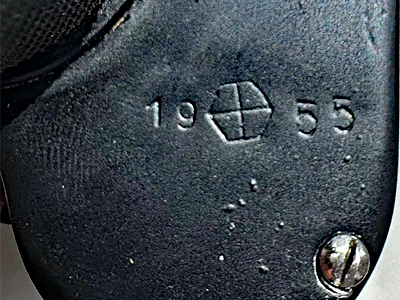
Soviet Russian 6×30 Standardized Model B-6 military service binoculars, production serial number, N37589, heavy, made of brass, manufactured in 1941 by the Izyum Factory of Optical Glass (Изюм завод Оптического Стекла, ИЗОС), of Izyum, Ukraine (Изюм, Украина). Left prism cover marked with “6×30” at the top, over a single line showing “1941” (production year), the Soviet hammer, sickle, and star insignia, and the production serial number, N37589, over the manufacturer’s trademark logo at the bottom. Right prism cover stamped with “1955” and a repair and maintenance depot symbol, showing that these military service binoculars were refurbished at a repair and maintenace facility in 1955. The Izyum Factory of Optical Glass, established in 1940, was based in Izyum, Ukraine, 1940-1941, until evacuated to Tomsk, Siberia, 1941-1943, following the German invasion of Russia. |
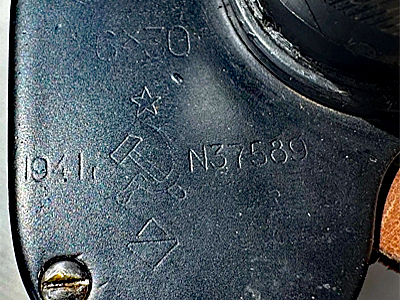
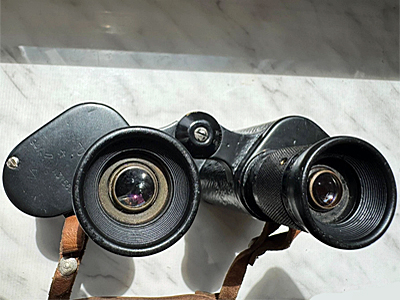
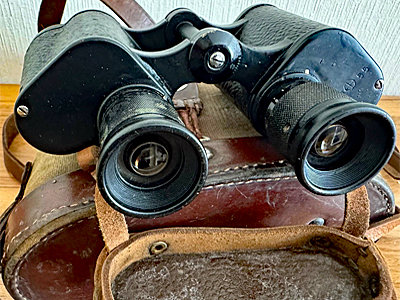
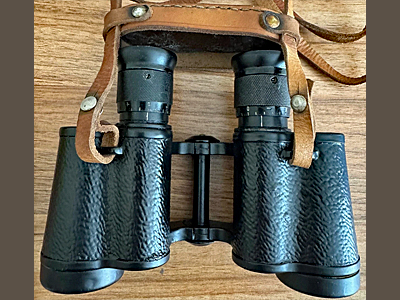
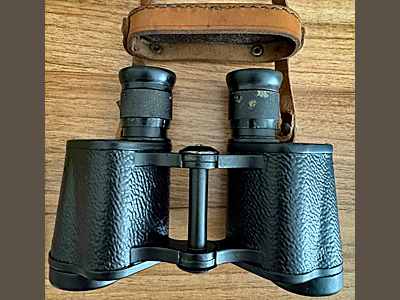
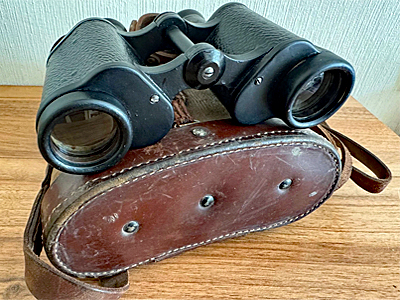
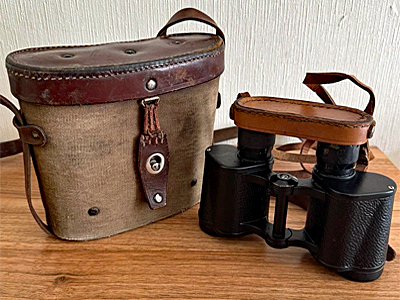
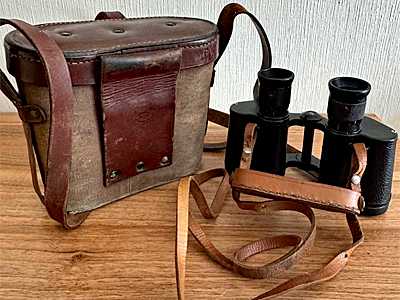
These 6×30 Standardized Model B-6 military service binoculars are accompanied by the original brown leather carrying strap, brown leather eye piece protector, and tan canvas-covered fabric and brown leather case, with brown leather carrying strap.
From late 1941 to 1945, the capital letter N preceded the last two numbers of the production year (41, 42, 43, 44, 45) as the first two numbers of the production serial number.
Izyum Factory of Optical Glass (IZOS)
6×30 Standarized Model B-6, 1941, N41382, Izyum, Ukraine
|
|
Soviet Russian 6×30 Standardized Model B-6 military service binoculars, production serial number, N41382, heavy, made of brass, manufactured in 1941 by the Izyum Factory of Optical Glass (Изюм завод Оптического Стекла, ИЗОС), of Izyum, Ukraine (Изюм, Украина). Left prism cover marked with “6×30” at the top, over a single line showing “1941” (production year), the Soviet hammer, sickle, and star insignia, and the production serial number, N41382, over the manufacturer’s trademark logo at the bottom. The Izyum Factory of Optical Glass, established in 1940, was based in Izyum, Ukraine, 1940-1941, until evacuated to Tomsk, Siberia, 1941-1943, following the German invasion of Russia. |
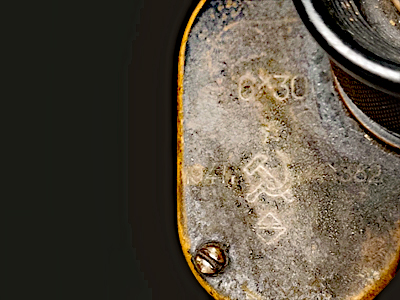
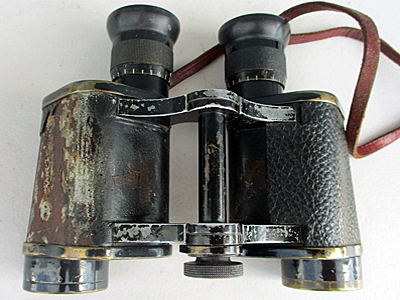
These 6×30 Standardized Model B-6 military service binoculars are accompanied by the original brown leather carrying strap.
From late 1941 to 1945, the capital letter N preceded the last two numbers of the production year (41, 42, 43, 44, 45) as the first two numbers of the production serial number.
Izyum Factory of Optical Glass (IZOS)
6×30 Standarized Model B-6, 1941, N43695, Izyum, Ukraine
|
|
Soviet Russian 6×30 Standardized Model B-6 military service binoculars, production serial number, N43695, heavy, made of brass, manufactured in 1941 by the Izyum Factory of Optical Glass (Изюм завод Оптического Стекла, ИЗОС), of Izyum, Ukraine (Изюм, Украина). These Russian military service binoculars are marked on the left prism cover in white characters stamped from top to bottom with 6×30 at the top, over a single line showing the four digit production year 1941, the Soviet hammer, sickle, and star insignia, and the production serial number, N43695, over the manufacturer’s trademark logo at the bottom. From late 1941 to 1945, the capital letter N preceded the last two numbers of the production year (41, 42, 43, 44, 45) as the first two numbers of the production serial number. These 6×30 Standardized Model B-6 military binoculars are accompanied by the original brown leather carrying strap. The Izyum Factory of Optical Glass, established in 1940, was based in Izyum, Ukraine, 1940-1941, until evacuated to Tomsk, Siberia, 1941-1943, following the German invasion of Russia. |


Izyum Factory of Optical Glass (IZOS)
6×30 Standardized Model B-6, 1941, N57461, Izyum, Ukraine
|
|
Soviet Russian 6×30 Standardized Model B-6 military service binoculars, production serial number N57461, heavy, made of brass, manufactured in 1941 by the Izyum Factory of Optical Glass (Изюм завод Оптического Стекла, ИЗОС), of Izyum, Ukraine (Изюм, Украина). These Russian military service binoculars are marked on the left prism cover in white characters stamped from top to bottom with 6×30 at the top, over a single line showing the four digit production year 1941, the Soviet hammer, sickle, and star insignia, and the production serial number, N57461, over the manufacturer’s trademark logo at the bottom. These 6×30 Standardized Model B-6 military binoculars are accompanied by the original brown leather carrying strap, brown leather eye piece protector, and brown leather case with brown leather carrying strap. The Izyum Factory of Optical Glass, established in 1940, was based in Izyum, Ukraine, 1940-1941, until evacuated to Tomsk, Siberia, 1941-1943, following the German invasion of Russia. |


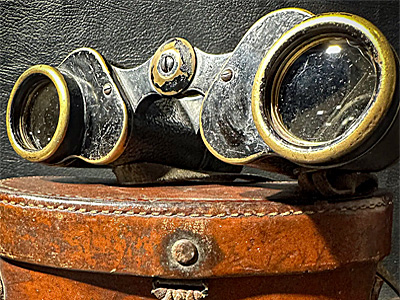

Izyum Factory of Optical Glass (IZOS)
6×30 Standarized Model B-6, 1941, N57472, Izyum, Ukraine
|
|
Soviet Russian 6×30 Standardized Model B-6 military service binoculars, production serial number, N57472, heavy, made of brass, manufactured in 1941 by the Izyum Factory of Optical Glass (Изюм завод Оптического Стекла, ИЗОС), of Izyum, Ukraine (Изюм, Украина). These Russian military service binoculars are marked on the left prism cover in white characters stamped from top to bottom with 6×30 at the top, over a single line showing the four digit production year 1941, the Soviet hammer, sickle, and star insignia, and the production serial number, N57472, over the manufacturer’s trademark logo at the bottom. These 6×30 Standardized Model B-6 military binoculars are accompanied by the original brown leather carrying strap. The Izyum Factory of Optical Glass, established in 1940, was based in Izyum, Ukraine, 1940-1941, until evacuated to Tomsk, Siberia, 1941-1943, following the German invasion of Russia. |


Izyum Factory of Optical Glass (IZOS)
6×30 Standardized Model B-6, 1941, N71344, Izyum, Ukraine
|
|
Soviet Russian 6×30 Standardized Model B-6 military service binoculars, production serial number N71344, heavy, made of brass, manufactured in 1941 by the Izyum Factory of Optical Glass (Изюм завод Оптического Стекла, ИЗОС), of Izyum, Ukraine (Изюм, Украина). These Russian military service binoculars are marked on the left prism cover in white characters stamped from top to bottom with 6×30 at the top, over a single line showing the four digit production year 1941, the Soviet hammer, sickle, and star insignia, and the production serial number, N71344, over the manufacturer’s trademark logo at the bottom. These 6×30 Standardized Model B-6 military binoculars are accompanied by the original brown leather carrying strap, brown leather eye piece protector, and brown leather case with brown leather carrying strap. The Izyum Factory of Optical Glass, established in 1940, was based in Izyum, Ukraine, 1940-1941, until evacuated to Tomsk, Siberia, 1941-1943, following the German invasion of Russia. |


Izyum Factory of Optical Glass (IZOS)
6×30 Standardized Model B-6, 1941, N4174327, Izyum, Ukraine
|
|
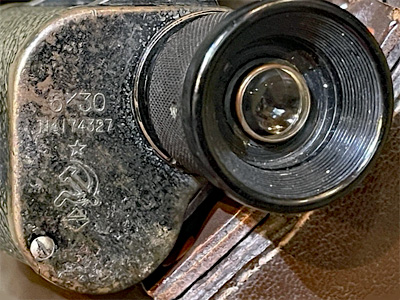
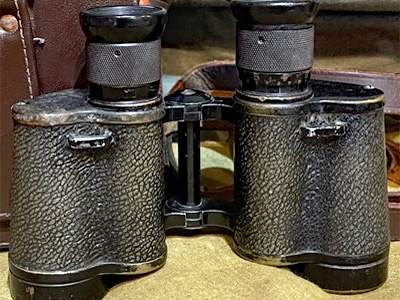
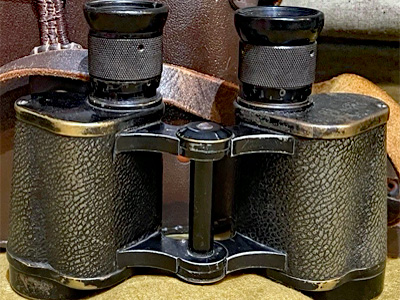
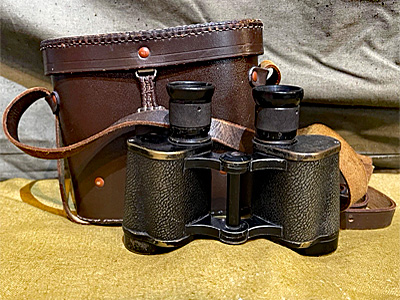
Soviet Russian 6×30 Standardized Model B-6 military service binoculars, production serial number N4174327, heavy, made of brass, manufactured in 1941 by the Izyum Factory of Optical Glass (Изюм завод Оптического Стекла, ИЗОС), of Izyum, Ukraine (Изюм, Украина). These Russian military service binoculars are marked on the left prism cover in white characters stamped from top to bottom with 6×30 at the top, over the production serial number, N4174327, over the Soviet hammer, sickle, and star insignia, over the manufacturer’s trademark logo at the bottom. These 6×30 Standardized Model B-6 military binoculars are accompanied by the original brown leather case with brown leather carrying strap. The Izyum Factory of Optical Glass, established in 1940, was based in Izyum, Ukraine, 1940-1941, until evacuated to Tomsk, Siberia, 1941-1943, following the German invasion of Russia. |




Izyum Factory of Optical Glass (IZOS)
6×30 Standardized Model B-6, 1942, N4201911, Tomsk, Siberia
|
|
Soviet Russian 6×30 Standardized Model B-6 military service binoculars, production serial number N4201911, heavy, made of brass, manufactured in 1942 by the Izyum Factory of Optical Glass (Изюм завод Оптического Стекла, ИЗОС), of Tomsk, Siberia (Tomsk, Сибирь). These Russian military service binoculars are marked on the left prism cover in white characters stamped from top to bottom with 6×30 at the top, over the production serial number, N4201911, over the Soviet hammer, sickle, and star insignia, over the manufacturer’s trademark logo at the bottom. From late 1941 to 1945, the capital letter N preceded the last two numbers of the production year (41, 42, 43, 44, 45) as the first two numbers of the production serial number. |


Izyum Factory of Optical Glass (IZOS)
6×30 Standardized Model B-6, 1942, N4204990, Tomsk, Siberia
|
|
Soviet Russian 6×30 Standardized Model B-6 military service binoculars, production serial number N4204990, heavy, made of brass, manufactured in 1942 by the Izyum Factory of Optical Glass (Изюм завод Оптического Стекла, ИЗОС), of Tomsk, Siberia (Tomsk, Сибирь). These Russian military service binoculars are marked on the left prism cover in white characters stamped from top to bottom with 6×30 at the top, over the production serial number, N4204990, over the Soviet hammer, sickle, and star insignia, over the manufacturer’s trademark logo at the bottom. These 6×30 Standardized Model B-6 military service binoculars are accompanied by the original brown leather carrying strap, brown leather eye piece protector, and tan canvas and brown leather case with tan canvas carrying strap. From 1940 to early 1941, the capital letter N preceded the production serial number. From late 1941 to 1945, the capital letter N preceded the last two numbers of the production year (41, 42, 43, 44, 45) as the first two numbers of the production serial number. |


Izyum Factory of Optical Glass (IZOS)
6×30 Standardized Model B-6, 1942, N4269770, Tomsk, Siberia
|
|
Soviet Russian 6×30 Standardized Model B-6 military service binoculars, production serial number N4269770, heavy, made of brass, manufactured in 1942 by the Izyum Factory of Optical Glass (Изюм завод Оптического Стекла, ИЗОС), of Tomsk, Siberia (Tomsk, Сибирь). These Russian military service binoculars are marked on the left prism cover in white characters stamped from top to bottom with 6×30 at the top, over the production serial number, N4269770, over the Soviet hammer, sickle, and star insignia, over the manufacturer’s trademark logo at the bottom. From late 1941 to 1945, the capital letter N preceded the last two numbers of the production year (41, 42, 43, 44, 45) as the first two numbers of the production serial number. These 6×30 Standardized Model B-6 military binoculars are accompanied by the original brown leather carrying strap. |


Izyum Factory of Optical Glass (IZOS)
6×30 Standardized Model B-6, 1942, N4287704, Tomsk, Siberia
|
|
Soviet Russian 6×30 Standardized Model B-6 military service binoculars, production serial number N4287704, heavy, made of brass, manufactured in 1942 by the Izyum Factory of Optical Glass (Изюм завод Оптического Стекла, ИЗОС), of Tomsk, Siberia (Tomsk, Сибирь). These Russian military service binoculars are marked on the left prism cover in white characters stamped from top to bottom with 6×30 at the top, over the production serial number, N4287704, over the Soviet hammer, sickle, and star insignia, over the manufacturer’s trademark logo at the bottom. From late 1941 to 1945, the capital letter N preceded the last two numbers of the production year (41, 42, 43, 44, 45) as the first two numbers of the production serial number. These 6×30 Standardized Model B-6 military binoculars are accompanied by the original brown leather carrying strap. |


Izyum Factory of Optical Glass (IZOS)
6×30 Standardized Model B-6, 1943, N4362406, Tomsk, Siberia
|
|
Soviet Russian 6×30 Standardized Model B-6 military service binoculars, production serial number N4362406, heavy, made of brass, manufactured in 1943 by the Izyum Factory of Optical Glass (Изюм завод Оптического Стекла, ИЗОС), of Tomsk, Siberia (Tomsk, Сибирь). These Russian military service binoculars are marked on the left prism cover in white characters stamped from top to bottom with 6×30 at the top, over the production serial number, N4362406, over the Soviet hammer, sickle, and star insignia, over the manufacturer’s trademark logo at the bottom. From late 1941 to 1945, the capital letter N preceded the last two numbers of the production year (41, 42, 43, 44, 45) as the first two numbers of the production serial number. These 6×30 Standardized Model B-6 military binoculars are accompanied by the original brown leather carrying strap. |


Izyum Factory of Optical Glass (IZOS)
6×30 Standardized Model B-6, 1943, N4384056, Tomsk, Siberia
|
|
Soviet Russian 6×30 Standardized Model B-6 military service binoculars, production serial number N4384056, heavy, made of brass, manufactured in 1943 by the Izyum Factory of Optical Glass (Изюм завод Оптического Стекла, ИЗОС), of Tomsk, Siberia (Tomsk, Сибирь). These Russian military service binoculars are marked on the left prism cover in white characters stamped from top to bottom with 6×30 at the top, over the production serial number, N4384056, over the Soviet hammer, sickle, and star insignia, over the manufacturer’s trademark logo at the bottom. From late 1941 to 1945, the capital letter N preceded the last two numbers of the production year (41, 42, 43, 44, 45) as the first two numbers of the production serial number. These 6×30 Standardized Model B-6 military binoculars are accompanied by the original brown leather carrying strap. |

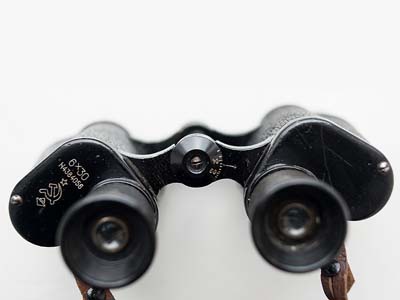

Izyum Factory of Optical Glass (IZOS)
4×45 Galilean, 1941-1943, A-N 29407, Tomsk, Siberia
|
|
Soviet Russian 4×45 Galilean military service binoculars, production serial number A-N 29407, manufactured in 1941-1943, likely by the Izyum Factory of Optical Glass (Изюм завод Оптического Стекла, ИЗОС), of Tomsk, Siberia (Tomsk, Сибирь). From 1941 to 1943, IZOS produced 4×45 Galilean binoculars. These Russian military service binoculars are marked in white characters on the left side of the bridge with 4×45 over the production serial number A-N 29407 within a triangle. This marking was not used with any other binoculars. No surviving 4×45 binoculars with IZOS factory markings are known. These 4×45 Galilean binoculars have a unique rubber covering with big dots that was used on late production IZOS binoculars up to mid-1942, and later by ZOMZ. These 4×45 Galilean military binoculars are accompanied by the original brown leather carrying strap. |


The Izyum Factory of Optical Glass (Изюм завод Оптического Стекла, ИЗОС) was established in Izyum, Ukraine in 1940. When these binoculars were produced in 1942, the factory had been evacuated from Izyum, Ukraine to Tomsk, Siberia (Tomsk, Сибирь).
On Sunday, June 22, 1941, Nazi dictator Adolph Hitler launched Operation Barbarossa, the explosive German invasion of Russia. The operation, named Barbarossa (“red beard”) after the Holy Roman Emperor Frederick Barbarossa, initiated Nazi Germany’s intent to eradicate Communism and conquer the Soviet Union.
Adolph Hitler’s ideological goal was to conquer the Soviet Union and repopulate western Russia with Germans. Sucessfully executing Generalplan Ost would result in the extermination, enslavement, genocide, and mass deportation of the native Slavic peoples to Siberia.
The German blitzkrieg spread so rapidly and widely into western Russia, with such devastating impact, that it surprised and stunned Josef Stalin and the Russian supreme command.
The overwhelming devastation of German firepower and the lightning encirclement and destruction of entire Russian armies resulted in the catastrophic collapse of Russian resistance during the first six months of the German invasion.
The lightning German assault, rampaging through western Russia, led to the emergency evacuation and relocation of Russian industrial factories from the onrushing, spreading, ever expanding combat zone.
Many Russian factories were hurredly dismantled and relocated far to the east, for safety beyond the Ural Mountains, to protect them from being overrun by the rapidly advancing German blitzkrieg.
By December 5, 1941, the German offensive had reached its closest approach to Moscow, before grinding to a halt. By that time, the IZOS factory had been evacuated from Kharkiv in eastern Ukraine to Tomsk in Siberia.
Now, safely on the eastern side of the Ural Mountains, many evacuated Russian industrial factories were no longer in immediate danger of being overrun by German troops.
The IZOS factory was able to resume production of binoculars, rifle scopes, aerial reconnaissance cameras, and other military optical equipment for the armed forces of the Soviet Union.
T2. Factory of the optical glass No.353 NKV (IZOS),
(Izyum – 1940-1941, Tomsk – 1941-1943). Изюм завод Оптического Стекла (IZOS) – Izyum Factory of Optical Glass
The Izyum Factory of Optical Glass (Изюм завод Оптического Стекла – IZOS) started the production of 6×30 standardized B-6 military binoculars in 1940. In the Autumn of 1941, because of the German invasion of Russia, the factory was evacuated to Tomsk, Siberia, where it continued production to 1943.
In 1943, optical production was moved to Factory No. 355 NKV (the Zagorsk Optical-Mechanical Factory), which was also relocated to Tomsk, because of the German invasion of Russia.
In late 1943, Factory No. 355 was returned to its original location in Zagorsk, and started the production of military binoculars under its own logo.
During 1940-1941, binoculars were marked with the full four digit production year, but after late 1941 to 1943, the year of production was coded with the two first numbers of the serial number (41, 42, 43).
After the evacuation of factories from western Russia to locations east, beyond the Ural Mountains, because of the German invasion, some simplifications were introduced to the construction of binoculars.
The simplifications were not so serious as the KOMZ factory simplifications. Some brass parts were temporarily replaced with aluminum parts. A limited number of binoculars were fitted with steel prizm covers, while the majority of binoculars continued to be fitted with brass prizm covers).
In 1942, the pattern of rubber body covering was changed from the prewar pattern. In 1943, the rubber body covering was changed again.
From 1941 to 1943, IZOS produced 4×45 Galilean binoculars. No surviving 4×45 binoculars with IZOS factory markings are known. Some 4×45 Galilean binoculars have a unique style of marking (a triangle with the manufacturer’s name and 4×45 and the production serial number). This marking was not used with any other binoculars.
Some of these 4×45 Galilean binoculars have a rubber finish with a pattern that was used by IZOS up to mid-1942. This rubber pattern, with big dots, is unique to late production IZOS binoculars, and was later also used by ZOMZ, with the likely possibility that these binoculars were actually produced by IZOS.
The Soviet hammer, sickle and star was adopted in 1923 and finalized in the 1924 Soviet Constitution.
Izium (Ізюм in Ukrainian) or Izyum (Изюм in Russian) is a city on the Donets River in Kharkiv Oblast, in eastern Ukraine. It is about 120 km (75 miles) southeast of the city of Kharkiv, the Kharkiv Oblast administrative center.
Izium and Soviet Ukraine suffered a manmade famine, known as the Holodomor, that was purposely caused by Soviet dictator Joseph Stalin between 1932 and 1933, in which 2,761 people died.
During the Second World War, Izium, Ukraine was the site of numerous crucial battles. One of the most expensive learning errors of the Red Army occurred when a Russian salient was cut off and destroyed by counterattacking German forces during the Second Battle of Kharkiv, Ukraine.
Izium was occupied by the German Army on June 24, 1942. The Germans operated a Nazi prison in the city. Izium was liberated by the Red Army on February 5, 1943. In mid-March 1943, German troops again attacked Izium, but the attack was unsuccessful, according to Soviet sources. More clashes occurred near Izium in the summer of 1943, during the Izyum–Barvenkovo offensive.
Tomsk (Томск) is a city with a population currently of about 500,000 people. It is the administrative center of Tomsk Oblast in Russia, on the Tom River. Founded in 1604, Tomsk is one of the oldest cities in Siberia. It has six universities, with over 100,000 students, including Tomsk State University, the oldest university in Siberia.
In 1804, the Imperial Russian government selected Tomsk as the seat of the new Tomsk Governorate, which would include the modern cities of Novosibirsk, Kemerovo, and Krasnoyarsk, as well as the territories now in Eastern Kazakhstan. The new status brought development and the city grew quickly.
The discovery of gold in 1830 brought further development to Tomsk in the 19th century. However, the Trans-Siberian Railway bypassed the city in favor of the village of Novonikolayevsk (Novosibirsk), and development began to move south to connect with the railway. In time, Novosibirsk would surpass Tomsk in importance.
In the mid-19th century one fifth of the city’s residents were exiles. However, within a few years, the city reinvented itself as the educational center of Siberia with the establishment of Tomsk State University, founded in 1880, and Tomsk Polytechnic University, founded in 1896. By World War II, every twelfth resident of the city was a student, giving rise to the city’s nickname, the Siberian Athens.
After the October Revolution of 1917, the city became a notable center of the White movement, led by Anatoly Pepelyayev and Maria Bochkareva, among others. After the victory of the Red Army in the 1920s, Soviet authorities incorporated Tomsk into the West Siberian Krai and later into Novosibirsk Oblast.
Like many Siberian cities, Tomsk became the new home for many factories relocated away from the war zone in 1941. The resulting growth of the city led the Soviet government to establish the new Tomsk Oblast, with Tomsk serving as the administrative center.
zzzzzzzzzzzzzzzzzzzzzzzzzzzzzzzzzzzzzzzzzzzzzzzzzzzzzzzzzzz
xxxxxxxxxxxxxxxxxxxxxxxxxxxxxxxxxxxxxxxxxxxxxxxxxxxxxxxx
The Second World War
The event that began the Second World War was the invasion of Poland by Nazi Germany on September 1, 1939. In the two years leading up to the invasion of Poland, Adolf Hitler, Führer und Reichskanzler of Nazi Germany, and Joseph Stalin, leader of the Soviet Union, secretly conspired together to take control of other countries in Central and Eastern Europe.
Adolf Hitler and Joseph Stalin quietly negotiated with each other regarding German and Soviet spheres of influence among the unsuspecting countries of Central and Eastern Europe that each intended to overpower and control in the near future, and how they would divide those countries between them without getting in each other’s way.
On August 24, 1939, Nazi Germany and the Soviet Union signed the Molotov–Ribbentrop Pact, a non-aggression agreement between Nazi Germany and the Soviet Union, with a secret protocol establishing Soviet and German spheres of influence across Central and Eastern Europe.
Seven days after signing the Molotov–Ribbentrop non-aggression pact, and one day after the Supreme Soviet (the highest body of state authority) of the Soviet Union had approved the pact, both countries, Nazi Germany and the Soviet Union, had conspired and agreed to invade Poland.
On September 1, 1939, Nazi Germany invaded Poland from the north, south, and west. On September 17, 1939, the Soviet Union invaded Poland from the east. Within a month, the Polish armed forces were overwhelmed, and the campaign was ended on October 6, 1939. Germany and the Soviet Union then divided and annexed between them the whole of Poland under the terms of the German–Soviet Frontier Treaty.
The Winter War
In the years leading up to the Soviet Union’s invasion of Finland in November 1939, the Soviet Union demanded that Finland cede substantial border territories in exchange for land elsewhere, claiming security concerns, primarily the protection of Leningrad, 32 km (20 miles) from the Finnish border. Finland refused to allow the Soviets to simply demand and steal parts of Finland’s homeland.
On November 30, 1939, just 75 days after the Soviet Union had invaded Poland, the Soviet Union invaded Finland, beginning the Winter War. The war ended three and a half months later, on March 13, 1940, with the Moscow Peace Treaty.
The Finnish armed forces, despite being severely outnumbered and outgunned, especially in tanks and aircraft, fought bravely and brilliantly, and inflicted severe losses on the Soviet armed forces. The Soviet invasion of Finland made little progress. The League of Nations condemned the Soviet Union, declared the Soviet attack illegal, and expelled the Soviet Union from the League of Nations.
For more than two months, Finland successfully repelled Soviet assaults, inflicting substantial losses on the Russians in temperatures as low as −43 °C (−45 °F). The battles were fought mainly in Taipale, along the Karelian Isthmus, in Kollaa, in Ladoga Karelia, and on the Raate-Suomussalmi Road, in Kainuu. Battles were also fought in North Karelia and Lapland.
Following their initial failures, the Soviets reduced their strategic objectives. The Soviet military reorganized and adopted different tactics, renewed their offensive in February 1940, and eventually overcame the Finnish defenses on the Karelian Isthmus.
This left the Finnish army in the main theater of war near the breaking point, with a retreat seemingly inevitable. Finnish commander-in-chief Carl Gustaf Emil Mannerheim urged a peace deal with the Soviets, while the Finns still retained some bargaining power.
Hostilities were ceased in March 1940 with the signing of the Moscow Peace Treaty. Finland was forced to surrender 9% of its sovereign territory to the Soviet Union, especially substantial territories along Lake Ladoga and further north. Soviet gains actually exceeded their pre-war demands.
Finland retained its sovereignty and enhanced its international reputation. The international reputation of the Soviet Union declined significantly.
Soviet losses in manpower, equipment, and reputation were heavy. The poor performance of the Red Army confirmed negative Western opinions of the Soviet armed forces. This perceived weakness of the Soviet Union led German Führer und Reichskanzler Adolf Hitler to believe that an attack on the Soviet Union would be successful. Hitler convinced himself that Nazi Germany should invade the Soviet Union.
In the meantime, the Soviet Union looked around for another weaker country to exploit, and issued an ultimatum to Romania on June 26, 1940, threatening the use of force in another land grab act of aggression.
Two days later, the Soviet Union began the occupation of Bessarabia and Northern Bukovina between June 28 and July 3, 1940, simply absorbing these parts of Romania into the Soviet Union. On October 26, 1940, the Soviet armed forces also grabbed six Romanian islands on the Chilia branch of the Danube River.
Initially, the Soviet Union had planned a full-scale invasion to annex these parts of Romania, but the Romanian government, responding to the Soviet ultimatum of June 26, 1940, agreed to withdraw from their own sovereign territory to avoid military conflict with the Soviet Union.
Following the Soviet occupation of Romanian territory between June and October 1940, Adolf Hitler saw his opportunity to do the same thing to Russia, and the German High Command began planning for the invasion of the Soviet Union, which Hitler approved in December 1940.
Operation Barbarossa
On June 22, 1941, Nazi Germany and its European allies, Finland, Romania, Hungary, Italy, and Slovakia, initiated Operation Barbarossa, the invasion of the Soviet Union. This is the event that began the Great Patriotic War for the Soviet Union, and the Second World War for the rest of humanity.
Operation Barbarossa, named after the Holy Roman Emperor, Frederick Barbarossa (Redbeard), opened the Eastern Front, the largest and deadliest land theater of war in human history, and brought the Soviet Union into the Second World War as one of the Allied powers.
More than 3.8 million Axis troops invaded the western Soviet Union along a 2,900-kilometer (1,800 mile) front. The attack became the largest and costliest military offensive in human history. Around 10 million combatants took part in the opening phase, and there were over 8 million casualties by the end of the operation on December 5, 1941.
Operation Barbarossa launched an explosive German and Axis air and ground assault into western Russia that surprised and stunned Soviet leader Joseph Stalin and the Russian high command.
Although Stalin had accurate intelligence earlier in 1941 about the imminent German attack, he refused to believe it, and did not order a mobilization of the Red Army, fearing that it might provoke Germany. As a result, the understrength and out of position Soviet forces were caught completely unprepared when the massive German air and ground assault began.
The overwhelming German firepower and the lightning encirclement and destruction of entire Russian armies resulted in the catastrophic devastation and collapse of Soviet resistance during the first five months of the German and Axis invasion of Russia.
Operation Barbarossa initiated Generalplan Ost, Nazi dictator Adolf Hitler’s ideological goals for German territorial expansion into Central and Eastern Europe. After Hitler’s rise to power, the concept of Lebensraum became a high priority ideological principle of Nazism that provided justification for German territorial expansion into Central and Eastern Europe, especially Russia.
Generalplan Ost planned for the conquest of the Soviet Union, the eradication of Communism, the extermination of the native Slavic peoples by enslavement, genocide, and mass deportation to Siberia.
Adolf Hitler intended to simply confiscate the western Soviet Union and repopulate the land with Germans to fulfill his Nazi ideological principle of Lebensraum (living space) for future generations of Germans in his expected Thousand Year Reich.
The material targets of the invasion were the agricultural and mineral resources of Ukraine and Byelorussia and oil fields in the Caucasus.
Ultimately, the rampaging German armed forces captured five million Soviet Red Army troops in Russia and deliberately starved to death or otherwise killed 3.3 million Russian prisoners of war, as well as millions of Russian civilians. Mass shootings and gassing operations, carried out by German paramilitary death squads and collaborators, murdered over a million Soviet Jews as part of the Holocaust.
The lightning German assault through western Russia led to the emergency evacuation and relocation of Russian industrial factories located in western Russia far to the east, beyond the Ural Mountains, to protect them from being overrun by the rapidly advancing German blitzkrieg.
On July 11, 1941, just 19 days after the opening shots of Operation Barbarossa, USSR State Defense Decree No. GKO-99ss was issued to begin the emergency evacuation of industrial factories from western Russia to Siberia in the east, beyond the Ural Mountains, to protect them from capture by advancing German armed forces. Many industrial plants and factories in western Russia were relocated east of the Ural Mountains.
The Siege of Leningrad
The siege of Leningrad was a military blockade by the Axis powers against the city of Leningrad (Saint Petersburg) in the Soviet Union on the Eastern Front of World War II from 1941 to 1944. Leningrad, Russia’s second largest city, was besieged by Germany and Finland for 872 days, but never captured.
The siege was the most destructive in history, causing an estimated 1.5 million deaths. It was not classified as a war crime at the time, but some historians have since classified it as a genocide due to the intentional destruction of the city and the systematic starvation of its civilian population.
In August 1941, German Army Group North reached the suburbs of Leningrad and Finnish forces encircled the city from the north. Land routes from Leningrad to the rest of the Soviet Union were cut off on September 8, 1941, beginning the siege.
The German High Command ordered the Luftwaffe to bomb Leningrad to starve its people into submission, rather than attempt to capture it. Many thousands of Russian families and individuals died of starvation during the winter of 1941–1942.
Supplies were delivered to the city by air, and by ship over Lake Ladoga, when it was free of ice, and over the Road of Life that was built on the lake when it was frozen. A Red Army offensive opened a narrow land corridor to Leningrad on January 18, 1943, but the siege was not fully broken until January 27, 1944.
When the German and Finnish offensive reached Leningrad in August 1941, part of the GOMZ factory was evacuated to Kazan, and was subsequently included within the structure of the Kazan Optical-Mechanical Factory.
Technically, production of GOMZ military binoculars ended in Autumn 1941, but during the initial production period in Kazan, the relocated GOMZ factory continued to use its stylized “pentagon-ray of light” GOMZ logo.
The hammer, sickle, and star marking that was used during the company’s 1940-1941 production in Leningrad, was discontinued during the company’s 1941 and later post-evacuation production in Kazan.
In early 1942, GOMZ factory production markings were moved from the left lens cover to the bridge. Also, in early 1942, the factory again started to use the stylized “pentagon-ray of light” GOMZ logo on its binoculars.
During 1940-1944, the production year was coded as the two first numbers of the production serial number (40, 41, 42, 43, 44). Starting in mid-1944 and later, the full year marking under the serial number was used.
After its evacuation from Leningrad to Kazan, the factory introduced many simplifications to the construction of binoculars. In late 1941 and early 1942, lens covers made of silicium (a cast aluminum alloy) was introduced. Sometimes, cast aluminum alloy lens covers were mixed with older design brass lens covers on binoculars.
Later in 1942, silicium cast aluminum alloy lens covers were replaced with steel lens covers. In 1944, the steel lens covers were replaced with copper plated steel lens covers.
Brass eyepiece diopter adjustment sleeves were also replaced with silicium cast aluminum alloy sleeves. Silicium cast aluminum alloy eyepiece sleeves remained in production up to 1945. Silicium cast aluminum alloy was also used in the production of other parts. In addition, the brass caps of objective (front) lens assemblies were replaced with steel caps.
Early war and mid war KOMZ binoculars are very difficult to find with their original silicium cast aluminum alloy manufactured parts. Over time these cast alloy parts became brittle and broke in use, and had to be replaced with other parts made of different metals.
In early 1942, the rubber covering on lens tubes was eliminated. The tubes were instead painted only with black paint. By late 1942 until the end of the war, the use of rubber covering on lens tubes was resumed. The prewar pattern was changed to the unique KOMZ dot pattern.
After the War
In 1946, the prewar pattern brass body construction and use of brass parts was resumed. The location of the markings were moved from the bridge to the left lens cover. The Soviet hammer, sickle, and star marking, adopted in 1923 and finalized in the 1924 Soviet Constitution, was used again on the left lens cover.
xxxxxxxxxxxxxxxxxxxxxxxxxxxxxxxxxxxxxxxxxxxxxxxxxxxxxxxxxxx
1. State optical-mechanical factory (GOMZ), Leningrad (1940-1941);
Optical-mechanical factory No. 237 NKV (KOMZ), Kazan (since late 1941) .
The GOMZ factory produced binoculars in the 1920’s-1930’s, it stopped production of their own design B-1 6×30 model in 1936. In 1940 it restored binocular production, but this time it produced the standardized B-6 6×30 model. Production continued until the Autumn of 1941, when due to the German and Finn offensive on Leningrad, part of the GOMZ factory was evacuated to Kazan, and included into the structure of Kazan optical-mechanical factory. Technically, production of GOMZ binoculars ended in Autumn 1941, but during the initial production period in Kazan, the factory still used the GOMZ logo (stylized ray of light).
The post-evacuation marking is missing the hammer and sickle, which were used during 1940-1941 production in Leningrad. In early 1942, the factory marking was moved to the bridge instead of the left plate. Also, in early 1942, the factory finally started to use the GOMZ logo on binoculars (also a stylized ray of light). During 1940-1944, the production year was coded into the two first letters of the serial number (40, 41, and so on), starting in mid 1944 and later, a full year marking under the serial number was used.
After evacuation factory introduced many simplifications to construction. Late 1941 – early 1942 binoculars had plates made from silicium – aluminum alloy (sometime alloy plates are mixed with old design brass plates at one binoculars), later in 1942 alloy plates were replaced with steel plates, and steel plates in 1944 were replaced with copper plated steel plates. Also in early 1942 was eliminated rubber finish on the tubes (tubes were painted only with black paint), brass eyepiece diopter adjustment sleeves were replaced with cast sleeves also made from the silicium – aluminum alloy, also alloy was used in production of the other parts instead of brass, brass caps of the objective lens assemblies were replaced with steel caps. Because of these reason original condition early-mid war KOMZ binoculars are very difficult to find, alloy became very brittle after some use, and many of these binoculars had replaced parts.
In 1943 (possibly late 1942) rubber finish of the tubes was returned to production (prewar pattern was changed to unique to KOMZ dot pattern), cast alloy eyepiece sleeves remained in production up to 1945. In 1946 was returned into production prewar pattern with brass parts, also was changed style of the markings – they were moved to the left pate, and hammer and sickle marking was used again.
6×30 model (B-6 modification)
1.1. GOMZ factory marking, 1940-1941 (pre evacuation period).
Novosibirsk Instrument-making Plant (NPZ)
A brief history of the company is that they were founded in 1905 as factory #19 in Krasnogorsk (aka factory #69 as of 1933, aka NKOP (НКОП), aka Krasnogorsk factory) but was moved to it’s final location in Novosibirsk.
Examples of their serial numbers are prefixed with N, NA ,NB and then the production number. I believe they started over the prefixes for each year of producing the PE model 1931 (PE) scope. Meaning you can have a 1933 scope with a serial prefixed by N, NA and NB as well as a 1934, 1935, 1936 dated scopes with serials prefixed by N, NA and NB
Their original logo was the basic pentagon shape.

However when used on optics it appears elongated and pointing in towards the Soviet coat of arms at an angle.

Progress
In 1936 the Soviets contracted with Karl Zeiss in Jena, Germany, to set up a microscope production plant in Leningrad. That firm was called Progress, and they were quite successful.
Examples of their serial numbers are prefixed with either Nº, №A- or №Б- and then the production number.
Their logo was a flat-convex lens.

Kharkov Machine-Building Plant (FED)
This is their military logo which appears as a “broken” lens

All examples I have seen are dated 1940


Kazan Optical-Mechanical Factory (KOMZ)
History of KOMZ can be read at About Company • English version • KOMZ
Their logo is a polygon which represents a lens/mirror and an arrow which represents light being reflected.

Examples of their serial numbers exist with the two digit year of manufacture as the prefix followed by the production number.


Unlike the rifle scopes, KOMZ binoculars did have the coat of arms as well as the full year of production marked.
1946 and 1947 6×30’s


Another KOMZ 6×30 shows no date and it’s serial is prefixed with the letter B. Did KOMZ use prefixes prior to marking the date of manufacture? Or did they start using prefixes after marking the year of manufacture? If someone knows please let me know.

Krasnogorsk Mechanical Plant (KMZ)
Good history of KMZ can be found here ACP – Introduction to KMZ
Their logo is a stylized Dove prism

They are the makers of the rare aluminum PU scope.
Their serial numbers are prefixed with N and then the production number. I have seen one example have the year 1941 under the serial number but the photo is poor quality to verify if it is genuine.


KMZ binoculars show the year of mfg and the serial number. Two examples of 6×30 binoculars, only 1 year apart. Both are marked on the right hand side where as most Russian binoculars are marked on the left hand side. First shows the Russian coat of arms and date, 19[Coat of Arms]45r with a serial number prefixed with №. The 1946 mfg binoculars is free of the coat of arms and no prefix to the serial. Would this be a non military produced 6×30?


Factory 297 located in Yoshkar-Ola.
Their logo, like NPZ’s, utilized a pentagon except the coat of arms is inside the pentagon.
Examples of their serial numbers are prefixed with either the first two digits of the year of mfg and then the production number. Other example shows the full year of manufacture with a serial number prefixed by N and then the production number.


State Optical-mechanical Plant (GOMZ)
Founded in 1932 near Leningrad, the GOMZ factory is one of the oldest of Soviet optical companies.
Their logo also uses the popular pentagon and arrow representing a ray of light being reflected.


Traceability on their binoculars is prefixed with N and what I believe is the two digits representing the year of mfg followed by the production number.
In the case of these 6×30 it would be 1941


Zagorsk Optical Mechanical Plant (ZOMZ)
They were located in present day Sergiev Posad, formerly known as Zagorsk.
History can be found at “ñàéò îàî çîìç”
Their logo is a joining of the three lenses

Maker’s of the widely used TR 4 periscope that the snipers used.
A pristine example of the maker’s mark on eckmann’s 1942 TR 4

Note: The opinions expressed herein or statements made in the article below are solely those of the author, and do not necessarily reflect the views of the Military Surplus Collectors Forums, or the ownership and moderation group of this site. MILSURPS.COM accepts no legal liability or responsibility for any claims made or opinions expressed herein. Also, please note that MILSURPS.COM recommends that any member of these forums, or a reader of this article, try this type of experimentation without the proper knowledge, equipment and training.
This article was originally published in forum thread: Guide to Russian Optics Manufacturers started by Badger View original post
Categories:
2. Factory of the optical glass No.353 NKV (IZOS),
(1940-1941 – Izyum, 1941-1943 – Tomsk).
Factory started production of the standardized B-6 6×30 model in 1940. At Autumn 1941 because of the German offensive it was evacuated to Tomsk, where it continued production up to 1943. In 1943 optics production capacities were moved to the factory No.355 NKV (Zagorsk optical-mechanical factory, which was located in Tomsk because of the evacuation also). In late 1943 factory No.355 was returned to its original location in Zagorsk, and started binoculars production under with their own logo.
During 1940-1941 binoculars were marked with full production year, since late 1941 up to 1943 it was coded with two first letters of the serial number (41, 42, 43).
After evacuation factory introduced some simplifications to construction. They were not so serious like KOMZ factory simplifications, but some brass parts were replaced with aluminum parts (temporary), also in limited number were used steel plates (while the majority of the used plates were still made from brass). In 1942 pattern of the rubber finish was changed comparing to prewar patter, in 1943 it was changed again.
Also in 1941-1943 factory produced 4×45 Galilean binoculars. But so far none of the survived 4×45 binoculars are known with IZOS marking. However, some known 4×45 binoculars have unique style of marking that was not used at any other binoculars (triangular with model name 4×45 and serial number). Some of these binoculars have rubber finish with patter that was used by IZOS up to mid 1942, same have unique to late IZOS binoculars (later was used by ZOMZ) rubber finish pattern (big dots). With high possibility these binoculars were produced by IZOS.
6×30 model (B-6 modification)
2.1. IZOS factory B-6 6×30 binoculars, 1941.
Prewar pattern of marking


2.2. IZOS factory B-6 6×30 binoculars, 1942.
Prewar pattern of rubber finish, production year is coded with two first numbers of the serial number.


2.3. IZOS factory B-6 6×30 binoculars, late 1942.
New patetrn of the rubber finish.


2.4. IZOS factory B-6 6×30 binoculars, 1943.
Plates and objective caps are made from steel.


2.5. IZOS factory B-6 6×30 binoculars, 1943.
Late pattern of rubber finish (oval dots)


4×45 model
2.6. Likely IZOS factory manufactured 4×45 binoculars.


3. Optical mechanical factory No.355 NKV (ecacuated from Zagosrk), ZOMZ
(1943 – Tomsk, late 1943 and after – Zagorsk).
LZOS
LZOS (Лыткаринский завод Оптического Стекла) is based in Lytkarino, 100 kilometers north of Moscow. It was a KMZ satellite plant: it was included in KMZ’s PO (production union). LZOS stands for Lytkarino Optical Glass Factory, and that is what they’re most famous for: for manufacturing various lenses for KMZ cameras.
ИЗОС, ИПЗ
Изюмский завод оптического стекла, Изюмский приборостроительный завод им. Дзержинского, №353 — Изюм, Украина.
 | Призма и кристалл, образующие букву «i». Знак ИЗОС. ———————————— Prism and crystal forming the letter “i”. ISOS sign. |
 | Буква «И» и линзы. Знак ИПЗ. ———————————– Letter “I” and lenses. IPZ sign. |