


Казанский оптико-механический завод №237 (KOMЗ) • Kazan Optical-Mechanical Factory No. 237 (KOMZ)
Kazan, Tartarstan, Russia (Казань, Татарстан, Россия) 1940-1945
In the Russian armed forces, military service binoculars are marked to identify them as government property.
Military service binoculars are issued to soldiers with specialized functions. For example, a group leader or an artillery observer was issued a set of binoculars to perform his duties.
The most common type of Soviet Russian military service binoculars used during the Second World War — the Great Patriotic War, as Stalin called it — was the 6×30 Standardized Model B-6 military service binoculars.
The 6×30 Standardized B-6 model was created in 1931 on the base of the older B-1 model, as part of a series of binoculars produced by the GOMZ factory, the main optical manufacturer during the prewar period.
The production of the Standardized B-6 model was part of a broader range of models, including the 8×30, 8×40, 7×50, and 4×45 (or 4×50). The Standardized B-6 model was produced in a military version, with a rangefinding scale, and a civil version, without a rangefinding scale.
The number “6” identifies the magnification power of the binoculars. In this case, “6” indicates that objects appear six times closer than their actual distance.
The number “30” identifies the diameter in millimeters of the front (objective) lenses — the light gathering lenses — in this case 30 millimeters in diameter.
Каzan Optical-Mechanical Factory No. 237 (KOMZ)
6×30 Standardized Model B-6, 1940, 019820, Kazan, Tartarstan
|
|
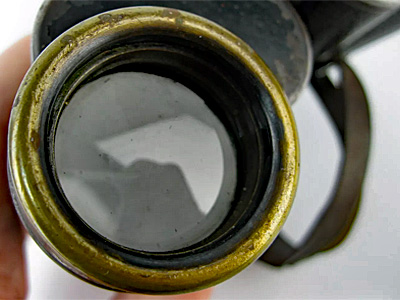
Soviet Russian 6×30 Standardized Model B-6 military service binoculars, production serial number, 019820, heavy, made of brass, manufactured in 1940 by the Kazan Optical-Mechanical Factory No. 237 (KOMZ), Казанский оптико-механический завод №237 (KOMЗ), of Kazan, Tartarstan. These Russian military service binoculars are marked in white characters stamped on the left prism cover with 6×30 at the top, followed by the production serial number, 019820, then by the manufacturer’s trademark logo. These 6×30 Standardized Model B-6 military service binoculars are accompanied by the original brown leather carrying strap. The Kazan Optical-Mechanical Factory (KOMZ), Казанский оптико-механический завод (KOMЗ), established in 1940, was a company based in Kazan, Russia. |



Каzan Optical-Mechanical Factory No. 237 (KOMZ)
6×30 Standardized Model B-6, 1941, N41048860, Kazan, Tartarstan
|
|
Soviet Russian 6×30 Standardized Model B-6 military service binoculars, production serial number, N41048860, heavy, made of brass, manufactured in 1941 by the State Optical-Mechanical Factory (GOMZ), Gosudarstvennyi Optiko-Mekhanicheskii Zavod №237 (ГОМЗ), of Tomsk, Siberia. These Russian military service binoculars are marked in white characters stamped on the left prism cover with 6×30 at the top, followed by the Soviet hammer, sickle, and star insignia, then by the manufacturer’s trademark logo, and finally by the production serial number, N41048860. The first two numbers, 41, indicate year of manufacture. These 6×30 Standardized Model B-6 military service binoculars are accompanied by the original brown leather carrying strap. The State Optical-Mechanical Factory No. 237 (GOMZ), Gosudarstvennyi Optiko-Mekhanicheskii Zavod №237 (ГОМЗ), established in 1940 in Leningrad, was evacuated in Autumn 1941, to Tomsk, Siberia. |

Каzan Optical-Mechanical Factory No. 237 (KOMZ)
6×30 Standardized Model B-6, 1944, 44156364, Kazan, Tartarstan
|
|
Soviet Russian 6×30 Standardized Model B-6 military service binoculars, production serial number, 44156364, heavy, made of brass, manufactured in 1944 by the Kazan Optical-Mechanical Factory No. 237 (KOMZ), Казанский оптико-механический завод №237 (KOMЗ), of Kazan, Tartarstan. Usually, Russian military service binoculars are marked with the manufacturer’s trademark logo, production serial number, and year of manufacture on the left prism cover. On some binoculars, the first two numbers of the production serial number (40, 41, 42, 43, 44) indicated the year of production. In early 1942, the markings of some factories were moved from the left prism cover to the back of the bridge. In this case, these markings are stamped with white characters on the back of the binoculars bridge. Left bridge arm: 6×30 over manufacturer’s trademark logo. Right bridge arm: production serial number, 44156364. The first two numbers, 44, of the production serial number indicate the year of manufacture. These 6×30 Standardized Model B-6 military service binoculars are accompanied by the original dark brown leather carrying strap, dark brown leather eye piece protector, and dark brown leather case with dark brown leather carrying strap. |


Каzan Optical-Mechanical Factory No. 237 (KOMZ)
6×30 Standardized Model B-6, 1945, 000004, Kazan, Tartarstan
|
|
Soviet Russian 6×30 Standardized Model B-6 military service binoculars, production serial number, 000004, heavy, made of brass, manufactured in 1945 by the Kazan Optical-Mechanical Factory No. 237 (KOMZ), Казанский оптико-механический завод №237 (KOMЗ), of Kazan, Tartarstan. Usually, Russian military service binoculars are marked with the manufacturer’s trademark logo, production serial number, and year of manufacture on the left prism cover. On some binoculars, the first two numbers of the production serial number (40, 41, 42, 43, 44) indicated the year of production. In early 1942, the markings of some factories were moved from the left prism cover to the back of the bridge. In this case, these markings are stamped with white characters on the back of the binoculars bridge. Left bridge arm: 6×30 over manufacturer’s trademark logo. Right bridge arm: production serial number, 000004, over year of manufacture, 1945. The right prism cover is stamped in white with the mark of a repair depot, a triangle enclosing the number 1 over the capital letter P, and “P6 — 47” indicating 1947, the year of repair, stamped without any color into the right prism cover. These 6×30 Standardized Model B-6 military service binoculars are accompanied by the original brown leather carrying strap, brown leather eye piece protector, and dark brown leather case with brown leather carrying strap. These binoculars came from Kyiv (Київ), the capital city of Ukraine. |


Military service binoculars eventually require repairs after intensive and severe use in the field. After being rebuilt at a repair depot, refurbished binoculars may have mismatched parts, tubes from a different manufacturer, plates with markings from another manufacturer, or may have factory markings completely removed.
Some military service binoculars, that have been repaired and maintained during prewar and wartime years, may still remain substantially in their original factory configuration.
Some repair depots may attempt to reproduce original factory markings, but with different styles and locations than the original factory markings. In some cases, refurbished binoculars may be repainted with repair depot markings stamped on them, even though otherwise in their original factory configuration.
Каzan Optical-Mechanical Factory No. 237 (KOMZ)
6×30 Standardized Model B-6, 1945, 108964, Kazan, Tartarstan
|
|
Soviet Russian 6×30 Standardized Model B-6 military service binoculars, production serial number, 108964, heavy, made of brass, manufactured in 1945 by the Kazan Optical-Mechanical Factory No. 237 (KOMZ), Казанский оптико-механический завод №237 (KOMЗ), of Kazan, Tartarstan. Usually, Russian military service binoculars are marked with the manufacturer’s trademark logo, production serial number, and year of manufacture on the left prism cover. On some binoculars, the first two numbers of the production serial number (40, 41, 42, 43, 44) indicated the year of production. In early 1942, the markings of some factories were moved from the left prism cover to the back of the bridge. In this case, these markings are stamped with white characters on the back of the binoculars bridge. Left bridge arm: 6×30 over manufacturer’s trademark logo. Right bridge arm: production serial number, 108964, over year of manufacture, 1945. These 6×30 Standardized Model B-6 military service binoculars are accompanied by the original dark brown leather carrying strap, dark brown leather eye piece protector, and dark brown leather case with dark brown leather carrying strap. |


Каzan Optical-Mechanical Factory No. 237 (KOMZ)
6×30 Standardized Model B-6, 1945, 109335, Kazan, Tartarstan
|
|
Soviet Russian 6×30 Standardized Model B-6 military service binoculars, production serial number, 109335, heavy, made of brass, manufactured in 1945 by the Kazan Optical-Mechanical Factory No. 237 (KOMZ), Казанский оптико-механический завод №237 (KOMЗ), of Kazan, Tartarstan. Usually, Russian military service binoculars are marked with the manufacturer’s trademark logo, production serial number, and year of manufacture on the left prism cover. On some binoculars, the first two numbers of the production serial number (40, 41, 42, 43, 44) indicated the year of production. In early 1942, the markings of some factories were moved from the left prism cover to the back of the bridge. In this case, these markings are stamped with white characters on the back of the binoculars bridge. Left bridge arm: 6×30 over manufacturer’s trademark logo. Right bridge arm: production serial number, 109335, over year of manufacture, 1945. These 6×30 Standardized Model B-6 military service binoculars are accompanied by the original dark brown leather carrying strap, dark brown leather eye piece protector, and light brown leather case with light brown fabric carrying strap. These binoculars came from Kyiv (Київ), the capital city of Ukraine. |


Каzan Optical-Mechanical Factory No. 237 (KOMZ)
6×30 Standardized Model B-6, 1945, 117974, Kazan, Tartarstan
|
|
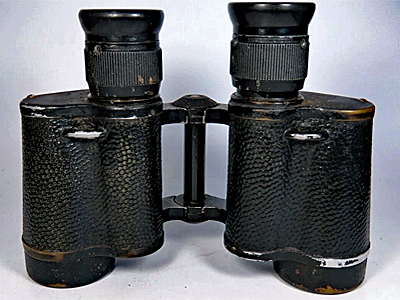
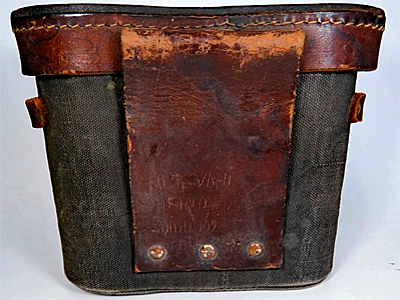
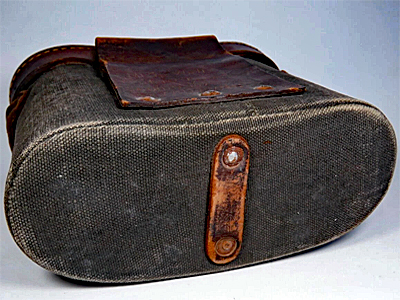
Soviet Russian 6×30 Standardized Model B-6 military service binoculars, production serial number, 117974, heavy, made of brass, manufactured in 1945 by the Kazan Optical-Mechanical Factory No. 237 (KOMZ), Казанский оптико-механический завод №237 (KOMЗ), of Kazan, Tartarstan. Usually, Russian military service binoculars are marked with the manufacturer’s trademark logo, production serial number, and year of manufacture on the left prism cover. On some binoculars, the first two numbers of the production serial number (40, 41, 42, 43, 44) indicated the year of production. In early 1942, the markings of some factories were moved from the left prism cover to the back of the bridge. In this case, these markings are stamped with white characters on the back of the binoculars bridge. Left bridge arm: 6×30 over manufacturer’s trademark logo. Right bridge arm: production serial number, 117974, over year of manufacture, 1945. These 6×30 Standardized Model B-6 military service binoculars are accompanied by the original brown leather and dark gray canvas case. The case cover underside is stamped in brown ink on tan fabric with “ФАБРИКА” (FACTORY) over “КОЖИЗДЕЛИЙ” (LEATHER PRODUCTS) over (illegible name of city) “CCCP” (USSR) over “№ 9” followed by (illegible word) over unknown date “19xx” then “г.” (г. is abbreviation of “года” year of manufacture) These binoculars came from Kyiv (Київ), the capital city of Ukraine. |




Каzan Optical-Mechanical Factory No. 237 (KOMZ)
6×30 Standardized Model B-6, 1945, 129375, Kazan, Tartarstan
|
|
Soviet Russian 6×30 Standardized Model B-6 military service binoculars, production serial number, 129375, heavy, made of brass, manufactured in 1945 by the Kazan Optical-Mechanical Factory No. 237 (KOMZ), Казанский оптико-механический завод №237 (KOMЗ), of Kazan, Tartarstan. Usually, Russian military service binoculars are marked with the manufacturer’s trademark logo, production serial number, and year of manufacture on the left prism cover. On some binoculars, the first two numbers of the production serial number (40, 41, 42, 43, 44) indicated the year of production. In early 1942, the markings of some factories were moved from the left prism cover to the back of the bridge. In this case, these markings are stamped with white characters on the back of the binoculars bridge. Left bridge arm: 6×30 over manufacturer’s trademark logo. Right bridge arm: production serial number, 129375, over year of manufacture, 1945. These 6×30 Standardized Model B-6 military service binoculars are accompanied by the original dark brown leather carrying strap, dark brown leather eye piece protector, and dark brown leather case with dark brown fabric carrying strap. These binoculars came from Kyiv (Київ), the capital city of Ukraine. |


Каzan Optical-Mechanical Factory No. 237 (KOMZ)
6×30 Standardized Model B-6, 1945, 129526, Kazan, Tartarstan
|
|
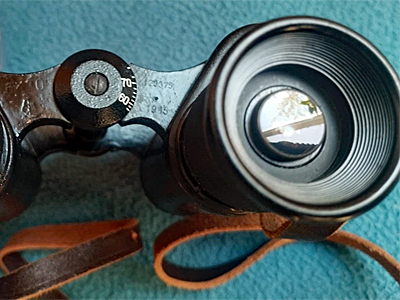
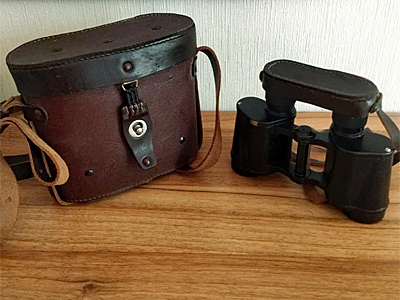
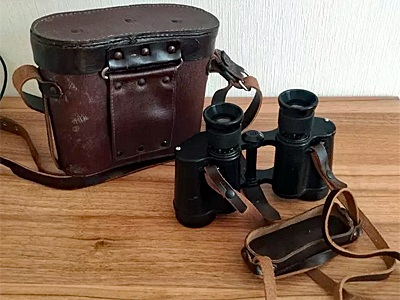
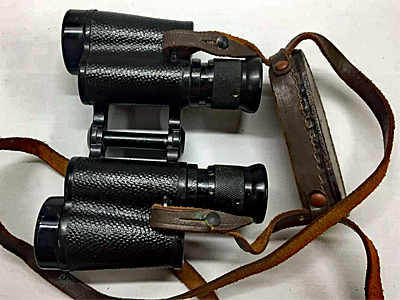
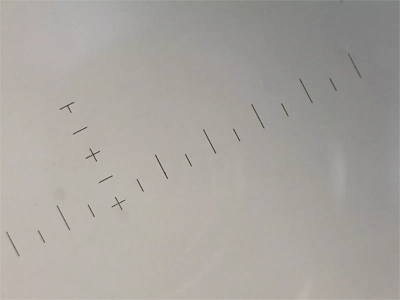
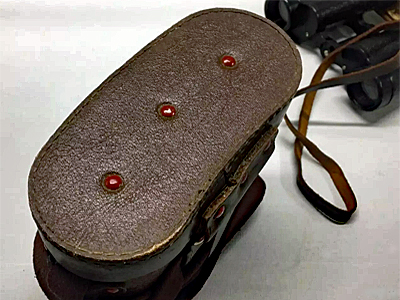
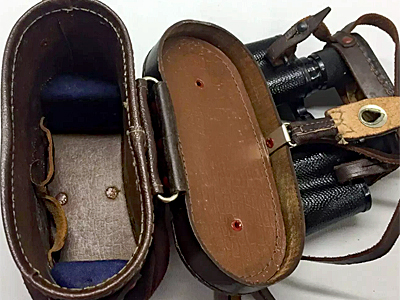
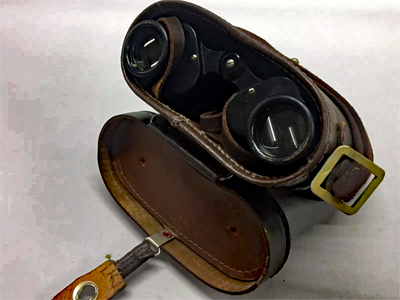
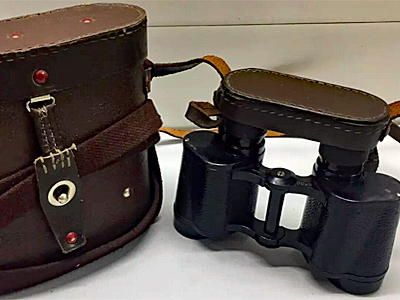
Soviet Russian 6×30 Standardized Model B-6 military service binoculars, production serial number, 129526, heavy, made of brass, manufactured in 1945 by the Kazan Optical-Mechanical Factory No. 237 (KOMZ), Казанский оптико-механический завод №237 (KOMЗ), of Kazan, Tartarstan. Usually, Russian military service binoculars are marked with the manufacturer’s trademark logo, production serial number, and year of manufacture on the left prism cover. On some binoculars, the first two numbers of the production serial number (40, 41, 42, 43, 44) indicated the year of production. In early 1942, the markings of some factories were moved from the left prism cover to the back of the bridge. In this case, these markings are stamped with white characters on the back of the binoculars bridge. Left bridge arm: 6×30 over manufacturer’s trademark logo. Right bridge arm: production serial number, 129556, over year of manufacture, 1945. These 6×30 Standardized Model B-6 military service binoculars are accompanied by the original dark brown leather carrying strap, dark brown leather eye piece protector, and dark brown leather case with dark brown fabric carrying strap. These binoculars came from Cherkasy (Черкаси], the administrative center of Cherkasy Oblast, in central Ukraine on the east bank of the Dnieper (Дніпро) River at the Kremenchuk (Кременчук) Reservoir, about 200 km (124 miles) south of Kyiv (Київ), the capital city of Ukraine. The Kazan Optical-Mechanical Factory (KOMZ), Казанский оптико-механический завод (KOMЗ), established in 1940, was a company based in Kazan, Russia. |







Каzan Optical-Mechanical Factory No. 237 (KOMZ)
6×30 Standardized Model B-6, 1945, 133240, Kazan, Tartarstan
|
|
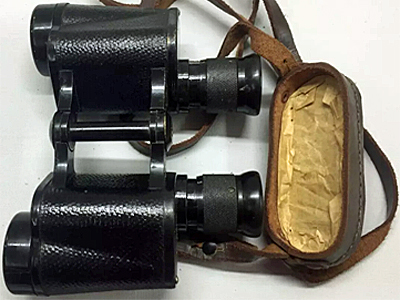
Soviet Russian 6×30 Standardized Model B-6 military service binoculars, production serial number, 133240, heavy, made of brass, manufactured in 1945 by the Kazan Optical-Mechanical Factory No. 237 (KOMZ), Казанский оптико-механический завод №237 (KOMЗ), of Kazan, Tartarstan. Usually, Russian military service service binoculars are marked with the manufacturer’s trademark logo, production serial number, and year of manufacture on the left prism cover. On some binoculars, the first two numbers of the production serial number (40, 41, 42, 43, 44) indicated the year of production. In early 1942, the markings of some factories were moved from the left prism cover to the back of the bridge. In this case, these markings are stamped with white characters on the back of the binoculars bridge. Left bridge arm: 6×30 over manufacturer’s trademark logo. Right bridge arm: production serial number, 133240, over year of manufacture, 1945. These binoculars came from Kyiv (Київ), the capital city of Ukraine. The Kazan Optical-Mechanical Factory (KOMZ), Казанский оптико-механический завод (KOMЗ), established in 1940, was a company based in Kazan, Russia. |


Каzan Optical-Mechanical Factory No. 237 (KOMZ)
6×30 Standardized Model B-6, 194x, unknown serial number, Kazan, Tartarstan
|
|
Soviet Russian 6×30 Standardized Model B-6 military service binoculars, production serial number, unknown, heavy, made of brass, manufactured in 194x by the Kazan Optical-Mechanical Factory No. 237 (KOMZ), Казанский оптико-механический завод №237 (KOMЗ), of Kazan, Tartarstan. Usually, Russian military service service binoculars are marked with the manufacturer’s trademark logo, production serial number, and year of manufacture on the left prism cover. On some binoculars, the first two numbers of the production serial number (40, 41, 42, 43, 44) indicated the year of production. In early 1942, the markings of some factories were moved from the left prism cover to the back of the bridge. In this case, these markings are stamped with white characters on the back of the binoculars bridge. Left bridge arm: 6×30 over manufacturer’s trademark logo. Right bridge arm: production serial number, unknown (appears to be obliterated), over the capital letter, P, evidently a code for the year of manufacture. These 6×30 Standardized Model B-6 military service binoculars are accompanied by the original brown leather carrying strap, and brown leather eye piece protector. These military service binoculars came from the small village of Veresneve, in Rivne Oblast, 172.98 km (107.49 miles) northeast of the city of L’viv, in western Ukraine. The Kazan Optical-Mechanical Factory (KOMZ), Казанский оптико-механический завод (KOMЗ), established in 1940, was a company based in Kazan, Russia. |


Каzan Optical-Mechanical Factory No. 237 (KOMZ)
6×30 Standardized Model B-6, 1946, 7581, Kazan, Tartarstan
|
|
Soviet Russian 6×30 Standardized Model B-6 military service binoculars, production serial number, 7581, heavy, made of brass, manufactured in 1946 by the Kazan Optical-Mechanical Factory No. 237 (KOMZ), Казанский оптико-механический завод №237 (KOMЗ), of Kazan, Russia. These Russian military service binoculars are marked in white characters stamped on the left prism cover with 6×30 at the top, followed by the Soviet hammer, sickle, and star insignia, then by the manufacturer’s trademark logo, then by the production serial number, 7581, and finally by the year of manufacture, 1946. These 6×30 Standardized Model B-6 military service binoculars are accompanied by the original brown leather carrying strap. The Kazan Optical-Mechanical Factory No. 237 (KOMZ), Казанский оптико-механический завод №237 (KOMЗ), established in 1940, was a company based in Kazan, Russia. |

Каzan Optical-Mechanical Factory No. 237 (KOMZ)
6×30 Standardized Model B-6, 1946, 11254, Kazan, Tartarstan
|
|
Soviet Russian 6×30 Standardized Model B-6 military service binoculars, production serial number, 11254, heavy, made of brass, manufactured in 1946 by the Kazan Optical-Mechanical Factory No. 237 (KOMZ), Казанский оптико-механический завод №237 (KOMЗ), of Kazan, Russia. These Russian military service binoculars are marked in white characters stamped on the left prism cover with 6×30 at the top, followed by the Soviet hammer, sickle, and star insignia, then by the manufacturer’s trademark logo, then by the production serial number, 11254, and finally by the year of manufacture, 1946. These 6×30 Standardized Model B-6 military service binoculars are accompanied by the original canvas and brown leather case. The Kazan Optical-Mechanical Factory No. 237 (KOMZ), Казанский оптико-механический завод №237 (KOMЗ), established in 1940, was a company based in Kazan, Russia. |


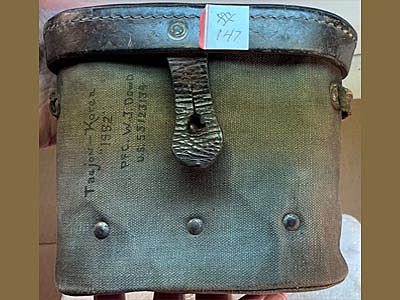
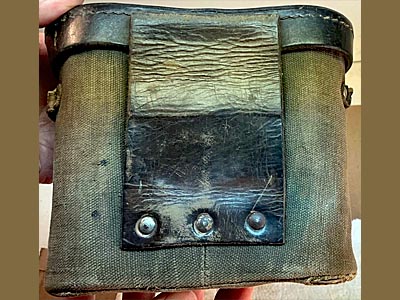

These Russian 6×30 Standardized Model B-6 military service binoculars were acquired by a U. S. Army soldier, PFC W. F. Dowd, U.S. 55123134, in Taejon, South Korea in 1952.
Taejon, now known as Daejeon, is a city in South Korea that was the site of the Battle of Taejon during the Korean War. The battle, which took place from July 16 to 20, 1950, involved U.S. forces attempting to defend the headquarters of the U.S. 24th Infantry Division against the Korean People’s Army (KPA).
The 24th Infantry Division was overwhelmed by the numerically superior North Korean forces, resulting in significant casualties and the loss of the city. The battle was a strategic setback for U.S. forces, but it provided valuable time for other American divisions to establish a defensive perimeter around Pusan.
Daejeon is currently a major metropolitan city in west-central South Korea, known for its technology and research center, as well as its close relationship with the natural environment. The city, which serves as a transportation hub, is approximately 50 minutes southwest of Seoul by high-speed rail.
Каzan Optical-Mechanical Factory No. 237 (KOMZ)
6×30 Standardized Model B-6, 1946, B 10274, Kazan, Tartarstan
|
|
Soviet Russian 6×30 Standardized Model B-6 military service binoculars, production serial number, B 10274, heavy, made of brass, manufactured in 1946 by the Kazan Optical-Mechanical Factory No. 237 (KOMZ), Казанский оптико-механический завод №237 (KOMЗ), of Kazan, Russia. Left prism cover marked in white with 6×30 at the top, followed by the Soviet hammer, sickle, and star insignia, then by the manufacturer’s trademark logo, and finally by the production serial number, B 10274. These 6×30 Standardized Model B-6 military service binoculars are accompanied by the original brown leather carrying strap, brown leather eye piece protector, and original light brown fabric-covered leather case with brown leather carrying strap. Leather belt loop on back of case marked with Leaping Stag / “МОСКВА” (MOSCOW) / “ФКА” (abbreviation of “ФАБРИКА” (FACTORY) / “КОЖИЗДЕЛИЙ” (LEATHER PRODUCTS) trademark logo of case manufacturer. |


Inside the lid of the carrying case of the 6×30 Standardized Model B-6 military service binoculars, production serial number B 10274, manufactured by KOMZ in 1946, is a paper label, translated from Russian to English, that provides a description of the contents of the binoculars case as it was packed, inspected, and shipped from the factory.
|
|
ОписЬ вложения на бинокль 6×30 1. Бинокль 6×30 с дождевнком н шеӥиЫм ремнем . . . 1 ШТ. 2. Светофетнльтры . . . 2 ШТ. 3. Глазная раковина . . . 1 ШТ. 4. Салфетка 200х200 мм . . . 1 ШТ. У nакобку nроберuл: (подписано инспектором) List of contents for binoculars 6×30 1. Binoculars 6×30 with rain cover and neck strap . . . 1 PC. 2. Light filters . . . 2 PCS. 3. Eye cup . . . 1 PC. 4. Napkin 200×200 mm . . . 1 PC. The package was checked by: (signed by the inspector) |

Каzan Optical-Mechanical Factory No. 237 (KOMZ)
6×30 Standardized Model B-6, 1946, B 12911, Kazan, Tartarstan
|
|
Soviet Russian 6×30 Standardized Model B-6 military service binoculars, production serial number, B 12911, heavy, made of brass, manufactured in 1946 by the Kazan Optical-Mechanical Factory No. 237 (KOMZ), Казанский оптико-механический завод №237 (KOMЗ), of Kazan, Russia. These Russian military service binoculars are marked in white characters stamped on the left prism cover with 6×30 at the top, followed by the Soviet hammer, sickle, and star insignia, then by the manufacturer’s trademark logo, and finally by the production serial number, B 12911. These 6×30 Standardized Model B-6 military service binoculars are accompanied by the original dark brown leather carrying strap, and dark brown leather eye piece protector. These 6×30 Standardized Model B-6 military service binoculars came from Ukraine. |




Каzan Optical-Mechanical Factory No. 237 (KOMZ)
6×30 Standardized Model B-6, 1946, B 17000, Kazan, Tartarstan
|
|
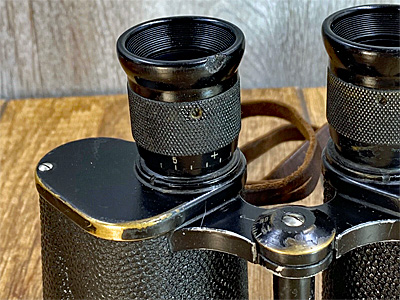
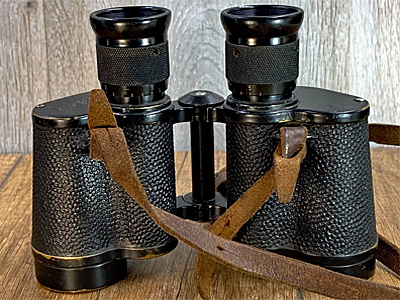
Soviet Russian 6×30 Standardized Model B-6 military service binoculars, production serial number, B 17000, heavy, made of brass, manufactured in 1946 by the Kazan Optical-Mechanical Factory No. 237 (KOMZ), Казанский оптико-механический завод №237 (KOMЗ), of Kazan, Russia. These Russian military service binoculars are marked in white characters stamped on the left prism cover with 6×30 at the top, followed by the Soviet hammer, sickle, and star insignia, then by the manufacturer’s trademark logo, and finally by the production serial number, B 17000. These 6×30 Standardized Model B-6 military service binoculars are accompanied by the original dark brown leather carrying strap. |

Каzan Optical-Mechanical Factory No. 237 (KOMZ)
6×30 Standardized Model B-6, 1947, 25765, Kazan, Tartarstan
|
|
Soviet Russian 6×30 Standardized Model B-6 military service binoculars, production serial number, 25765, heavy, made of brass, manufactured in 1947 by the Kazan Optical-Mechanical Factory No. 237 (KOMZ), Казанский оптико-механический завод №237 (KOMЗ), of Kazan, Russia. These Russian military service binoculars are marked in white characters stamped on the left prism cover with 6×30 at the top, followed by the Soviet hammer, sickle, and star insignia, then by the manufacturer’s trademark logo, then by the production serial number, 25765, and finally by the year of manufacture, 1947. These 6×30 Standardized Model B-6 military service binoculars are accompanied by the original brown leather carrying strap. The Kazan Optical-Mechanical Factory No. 237 (KOMZ), Казанский оптико-механический завод №237 (KOMЗ), established in 1940, was a company based in Kazan, Russia. |

The Beginning
In 1917, Kazan became one of the centers of revolution in Russia. In 1918, Kazan was the capital of the Idel-Ural State, which was suppressed by the Bolshevik government. In the Kazan Operation of August 1918, Kazan was briefly occupied by Czechoslovak Legions.
In 1920, Kazan became the center of the Tatar Autonomous Soviet Socialist Republic. After the Treaty of Rapallo (1922) until 1933, the German army and the Russian army together operated the Kama tank school in Kazan.
In 1935, the Central Committee of the Communist Party of the Soviet Union (Коммунистическая партия Советского Союза) and the Council of People’s Commissars (Совет народных комиссаров), the highest executive authorities of the Soviet Union and the Soviet republics from 1917 to 1946, decided to build a new large optical-mechanical plant in the Volga region as a backup to the State Optical-Mechanical Plant No. 349 (GOMZ) in Leningrad. A commission was created to select a site for the construction of the new plant.
On October 11, 1936, the Council of Labor and Defense (Совет труда и обороны), the agency responsible for the central management of the economy and the production of military materiel in the Soviet Union, adopted a resolution for the construction of the new optical-mechanical plant. The site chosen was a former wagon-building plant, Vagonstroy, 18 km (11.2 miles) from Kazan, in the Tatar Autonomous Soviet Socialist Republic (Татарская Автономная Советская Социалистическая Республика).
The Kazan area was chosen because it had a large, well-trained labor force, and several technical universities that were training a well qualified specialized workforce. The city of Kazan was connected with established railway and water communications, and had an already prepared construction site (Vagonstroy) to build the new factory.
Kazan, the largest city and capital of Tatarstan, is located at the confluence of the Volga and the Kazanka Rivers. The city of Kazan is about 435 miles east of Moscow in the Autonomous Republic of Tatars, a semiautonomous republic within Russia located in Eastern Europe. The republic has a strong economy, primarily driven by oil production and petrochemical industries. It is also home to significant natural resources, including oil and natural gas.
The city of Kazan covers an area of 425.3 square kilometres (164.2 square miles), with a population of over 1.3 million residents, and up to nearly two million residents in the greater metropolitan area. Kazan is the fifth-largest city in Russia, being the most populous city on the Volga, as well as within the Volga Federal District.
With the design of the plant established, the State Optical-Mechanical Factory No. 349 (GOMS), Государственный оптико-механический завод №349 (ГOMЗ) in Leningrad was tasked with providing the administrative management and workforce training for the new factory.
On February 3, 1937, plans were in place for the construction of Kazan Optical-Mechanical Factory No. 237 (KOMZ), Казанский оптико-механический завод №237 (KOMЗ) to begin in June 1937. The construction of adobe barracks, two-story wooden houses, and School No. 101 also began.
In December 1939, Building 7 (Mechanical Shop No. 7) was commissioned, in which 25 units of equipment for the production of periscope tubes were installed.
On February 8, 1940, the USSR People’s Commissariat for Finance (Народный комиссариат финансов) declared the Kazan Optical-Mechanical Factory No. 237 operational. February 8, 1940 is considered the founding day of the factory.
The Second World War
On June 22, 1941, Nazi Germany invaded Soviet Russia, beginning the Great Patriotic War in Russia, and the Second World War for the rest of the world.
On July 11, 1941, USSR State Defense Decree No. GKO-99ss was issued to begin the emergency evacuation of industrial factories from western Russia to Siberia in the east, beyond the Ural Mountains, to protect them from capture by German armed forces.
During the Second World War, many industrial plants and factories in western Russia were relocated east to Kazan, making Kazan a major center of Soviet military industry, producing tanks and planes. After the Second World War, Kazan had become a major industrial and scientific center in the Soviet Union.
One of the major industrial companies in western Russia that was relocated east to Kazan was GOMZ in Leningrad. Production at GOMZ continued until the autumn of 1941. In the face of the German and Finnish offensive on Leningrad, most of the engineers and production workers of the State Optical-Mechanical Factory (GOMZ) were evacuated to Kazan, and blended into the structure of the Kazan Optical-Mechanical Factory (KOMZ).
The State Optical-Mechanical Factory No. 349 (GOMZ) in Leningrad was evacuated to the site of the Kazan Optical-Mechanical Factory No. 237 (KOMZ), then under construction in Kazan, as determined by the People’s Commissariat of Armaments in the Tatar Autonomous Soviet Socialist Republic.
From July to August 1941, seven waves of people and equipment from the State Optical-Mechanical Factory No. 349 (GOMZ) in Leningrad arrived at the Kazan Optical-Mechanical Factory No. 237 (KOMZ) in Kazan, including 1,284 workers and 327 engineering and technical workers with their families.
On August 31, 1941, the last wave of the State Optical-Mechanical Factory No. 349 (GOMZ) workers and equipment arrived in Kazan. The combined staff of factory workers at the Kazan Optical-Mechanical Factory No. 237, including existing workers and evacuees, was about 3,500 people.
Two months after the arrival of the first wave of Factory No. 349 (GOMZ) workers, Factory No. 237 (KOMZ) was the first among all the evacuated factories in the optical industry to produce its first products for the Soviet armed forces at the front. Factory No. 237 (KOMZ) produced 5,000 military service binoculars assembled from unfinished production parts brought from Leningrad.
Technically, the production of GOMZ military binoculars ended in the Autumn of 1941. However, during the initial production period in Kazan, the GOMZ factory continued to use its GOMZ pentagram and ray of light logo on its binoculars.
The hammer, sickle, and star marking, which was used by GOMZ during the 1940-1941 production years in Leningrad, was discontinued during the post-evacuation period in Kazan.
From 1940 to 1944, the first two numbers of the production serial number (40, 41, 42, 43, 44) indicated the year of production. In early 1942, the GOMZ factory markings were moved from the left prism cover to the back of the bridge. From mid-1944 and later, GOMZ once again marked its binoculars with the full year of manufacture under the production serial number.
After the 1941 evacuation, GOMZ and KOMZ began to introduce many simplifications to the construction of binoculars. Silicium aluminum alloy prism covers were used on some late 1941-1942 binoculars, and aluminum alloy prism covers were sometimes mixed with earlier design brass prism covers.
In early 1942, the rubber body covering on lens tubes was eliminated, and lens tubes were painted instead with black paint. Steel objective lens caps replaced brass objective lens caps. Silicium cast aluminum alloy eyepiece diopter adjustment sleeves replaced brass eyepiece diopter adjustment sleeves. Silicium aluminum alloy, instead of brass, also replaced other parts.
Later in 1942, steel prism covers replaced aluminum alloy prism covers. In 1944, steel prism covers were replaced with copper plated steel prism covers.
Because of the use of these lesser quality substitute metals, original condition 1942-1944 GOMZ and KOMZ binoculars can be difficult to find, because the aluminum alloy parts became very brittle in use, and many of these cast aluminum parts had to be replaced.
In 1943 (possibly in late 1942), the rubber body covering on lens tubes was returned to production. The prewar pattern rubber body covering was changed to a unique KOMZ dot pattern. Cast aluminum alloy eyepiece sleeves remained in production up to 1945. In 1946, prewar brass parts were returned to production.
The style of marking was also changed. Markings were removed from the bridge, and returned to the left prism cover. The hammer, sickle, and star marking was also used again on the left prism cover.
On September 16, 1941, in accordance with NKVD (People’s Commissariat for Internal Affairs, Народный комиссариат внутренних дел) order No. 451, the GOMZ factory and the KOMZ factory were officially merged, and the new combined factory in Kazan was designated as Optical-Mechanical Factory No. 349. As part of NKVD order No. 451, Andrey Fedorovich Soloviev was appointed director of the combined factory.
The People’s Commissariat for Internal Affairs (NKVD), Народный комиссариат внутренних дел (НКВД) was the interior ministry and secret police of the Soviet Union from 1934 to 1946.
On October 4, 1941, the chief designer of the factory developed the first trademark logo of Kazan Optical-Mechanical Factory No. 237.
The chief designer created a half-pentaprism – half of the GOMZ pentaprism trademark – with a ray of light passing through the prism, and a hint of the letter “K” encrypted within the emblem, mirrored in the vertical axis.
This trademark design, registered in the Bureau of Registration of Trademarks of the USSR Ministry of Trade (Certificate No. 2999, dated October 17, 1946), is the oldest trademark of the Kazan Optical-Mechanical Factory No. 237 (KOMZ).
In December 1941, the factory supplied the front with mortar and tank sights, and from the beginning of 1942, the Hertz PG artillery panoramic sight, which became the plant’s signature product throughout the years of the Great Patriotic War.
As of January 1, 1942, the Optical-Mechanical Factory No. 349 in Kazan employed 3,960 people, and accounted 1,574 units of equipment, including 1,292 machines from Leningrad
On July 21, 1942, by order of the NKVD, the KOMZ factory was redesignated as the Optical-Mechanical Factory No. 237, under which it was built. The GOMZ factory in Leningrad retained its designation as Optical-Mechanical Factory No. 349.
By the end of 1942, the production of binoculars at the factory was increased to 15,000 pieces per month.
In 1943, the factory was already producing 43 types of products, 10 of which were in large quantities, including binoculars, marine rangefinders, photographic lenses, photo control devices, mortar and tank sights, including the Goertz artillery panorama “PG”, and sights for dive bombers PBL-2, and simulators.
On February 10, 1943, the factory staff collected a donation from workers’ personal savings, and transferred 1,004,000 rubles for the purchase of “Stalin artillery” Katyusha (Катю́ша) multiple rocket launchers.
The Katyusha (Катю́ша) is a type of rocket artillery first built and fielded by the Soviet Union in the Second World War. Multiple rocket launchers deliver explosives on a target area more intensively than conventional artillery, but with lower accuracy and requiring a longer time to reload. They are fragile compared to artillery guns, but are cheap, easy to produce, and usable on almost any truck chassis.
German troops coined the nickname “Stalin’s organ” (Stalinorgel), after Soviet leader Joseph Stalin, comparing the visual resemblance of the launch array to a pipe organ, and the distinctive howling sound of the weapon’s rocket motors that terrified German troops, adding a psychological warfare aspect to their use.
On October 12, 1943, the NKVD order of the day noted the exemplary work of Factory No. 237, working on schedule, exceeding production from month to month. In 1944, the factory fulfilled two and a half times the production of 1942.
By the end of the war, thanks to the introduction of the first overhead conveyor in the USSR for assembling binoculars with a given production rhythm, the output of binoculars was increased to 25,000 pieces per month.
At the beginning of 1945, 5,663 people worked at the factory, 50.6% of whom were under 18 years of age.
During the war, the factory was awarded the Red Challenge Banner of the Central Committee of the All-Union Communist Party (Bolsheviks) and the State Defense Committee 17 times. In 1946 the factory was awarded forever, and 198 factory workers were awarded orders and a large group were awarded medals.
In total, during the war, the factory sent 700,000 binoculars, 30,000 gun, mortar, and tank sights, and about 1,000 bomb sights to the front.
On August 5, 1945, by Decree of the Presidium of the Supreme Soviet of the USSR, 45 plant workers received awards for the development of new types of artillery, tank and aviation optical devices, and the successful fulfillment of the State Defense Committee task to increase their output for the front.
On September 16, 1945, by Decree of the Presidium of the Supreme Soviet (Президиум Верховного Совета) of the USSR, the highest state authority in the Soviet Union, the factory was awarded the Order of Lenin for outstanding services in the uninterrupted supply of optical equipment to field artillery, navy, and aviation.
Also, on September 16, 1945, by Decree, 38 individual factory workers received awards for the successful fulfillment of State Defense Committee tasks to create new types of weapons and provide the Red Army with artillery, small arms, and military optical devices.

After the War
In the post-war years, the range of products changed significantly, and the production of military equipment was significantly reduced.
In 1946-47, 6×30 binoculars, several types of magnifying glasses, and lenses were produced. The factory excelled in the production of interferometers, astronomical and projection devices, photocontrol aerial photography equipment for the Air Force, filming equipment, refractometers, microfilming and electrophotographic equipment.
During the late 1980s, KOMZ greatly diversified its product range and also began to manufacture laser rangefinders, depth gauges, laser spectrometers, and medical instruments.
Today, the Kazan Optical-Mechanical Factory Production Association is one of the largest optical manufacturing companies in Russia. KOMZ develops and produces a wide range of specialized optical devices for the Russian defense industry, including optical-electronic and optical-mechanical instruments, submarine periscopes, aerial cameras, satellite cameras, laser rangefinders, binoculars and night-vision instruments.
For the consumer market, the company manufactures a wide variety of 35mm RF and SLR accessory lenses, slide projectors, underwater camera housings, laboratory equipment, and civilian binoculars.
KOMZ is well known for developing and manufacturing binoculars and monoculars under the Baigish brand. The signature brand name “Baigish” is marked on optical equipment manufactured by KOMZ.
Каzan Optical-Mechanical Factory No. 237 (KOMZ)
6×30 Standardized Model B-6, 1945, 109335, Kazan, Tartarstan
|
|
Soviet Russian 6×30 Standardized Model B-6 military binoculars, production serial number 109335, heavy, made of brass, manufactured in 1945 by the Kazan Optical-Mechanical Factory (Казанский оптико-механический завод, KOMZ), of Kazan, Russia. Usually, Russian military binoculars are marked with manufacturer’s trademark logo, production serial number, and date of manufacture on the left prizm cover. In this case, these markings are stamped with white characters on the back of the binoculars bridge. These 6×30 Standardized Model B-6 military binoculars are accompanied by the original dark brown leather carrying strap, dark brown leather eye piece protector, and light brown leather case with light brown fabric carrying strap. The Kazan Optical-Mechanical Factory (Казанский оптико-механический завод, KOMZ), established in 1940, was a company based in Kazan, Russia. |
Каzan Optical-Mechanical Factory No. 237 (KOMZ)
6×30 Standardized Model B-6, 1945, 129526, Kazan, Tartarstan
|
|
Soviet Russian 6×30 Standardized Model B-6 military binoculars, production serial number 129526, heavy, made of brass, manufactured in 1945 by the Kazan Optical-Mechanical Factory (Казанский оптико-механический завод, KOMZ), of Kazan, Russia. Usually, Russian military binoculars are marked with manufacturer’s trademark logo, production serial number, and date of manufacture on the left prizm cover. In this case, these markings are stamped with white characters on the back of the binoculars bridge. These 6×30 Standardized Model B-6 military binoculars are accompanied by the original dark brown leather carrying strap, dark brown leather eye piece protector, and dark brown leather case with dark brown fabric carrying strap. These binoculars came from Cherkasy (Черкаси], the administrative center of Cherkasy Oblast, in central Ukraine on the east bank of the Dnieper (Дніпро) River at the Kremenchuk (Кременчук) Reservoir, about 200 km (124 miles) south of Kyiv (Київ), Ukraine’s capital city. The Kazan Optical-Mechanical Factory (Казанский оптико-механический завод, KOMZ), established in 1940, was a company based in Kazan, Russia. |
Каzan Optical-Mechanical Factory No. 237 (KOMZ)
6×30 Standardized Model B-6, 1946, 7581, Kazan, Tartarstan
|
|
Soviet Russian 6×30 Standardized Model B-6 military binoculars, production serial number 7581, heavy, made of brass, manufactured in 1946 by the Kazan Optical-Mechanical Factory (Казанский оптико-механический завод, KOMZ), of Kazan, Russia. These Russian military binoculars are marked with white characters stamped on the left prizm cover with 6×30 at the top, followed by the Soviet hammer, sickle, and star insignia, then by the manufacturer’s trademark logo, and finally by the production serial number, 7581. These 6×30 Standardized Model B-6 military binoculars are accompanied by the original brown leather carrying strap. The Kazan Optical-Mechanical Factory (Казанский оптико-механический завод, KOMZ), established in 1940, was a company based in Kazan, Russia. |
Каzan Optical-Mechanical Factory No. 237 (KOMZ)
6×30 Standardized Model B-6, 1946, 25765, Kazan, Tartarstan
|
|
Soviet Russian 6×30 Standardized Model B-6 military binoculars, production serial number 25765, heavy, made of brass, manufactured in 1946 by the Kazan Optical-Mechanical Factory (Казанский оптико-механический завод, KOMZ), of Kazan, Russia. These Russian military binoculars are marked with white characters stamped on the left prizm cover with 6×30 at the top, followed by the Soviet hammer, sickle, and star insignia, then by the manufacturer’s trademark logo, and finally by the production serial number, 25765. These 6×30 Standardized Model B-6 military binoculars are accompanied by the original brown leather carrying strap. The Kazan Optical-Mechanical Factory (Казанский оптико-механический завод, KOMZ), established in 1940, was a company based in Kazan, Russia. |
The Great Patriotic War
During the Second World War, the Great Patriotic War, as Stalin called it, several Soviet optical factories were evacuated to safer locations to continue their production.
One notable example is Plant No. 217 (Ural Optical-Mechanical Plant), which was evacuated in October 1941 from Moscow to Sverdlovsk (modern Yekaterinburg) in the Ural Mountains. Nearly 10,000 production-line employees followed the plant to the Urals, contributing to making Sverdlovsk and Novosibirsk the new centers of Russia’s optical equipment industry.
Another significant factory was the Kazan Optical and Mechanical Plant (KOMZ), which began operations in February 1940. During the Second World War, KOMZ produced a wide range of optical instruments, including military service binoculars, photographic lenses, photo controlling devices, marine range finders, and dive-bomber scopes.
- KOMZ (Казанский оптико-механический завод): Located in Kazan, this factory produced various optical instruments during the war, contributing to the Soviet military effort.
- Plant No. 217 (Ural Optical-Mechanical Plant): Evacuated from Moscow to Sverdlovsk (modern Yekaterinburg), this plant played a crucial role in increasing the output of military products by 75% during the war years.
- ZOMZ (Загорский оптико-механический завод): Located in Zagorsk (now Sergiev Posad), this factory was known for producing the Jupiter-3 and the Mir-1 lenses until their production was transferred to Vologda.
- VOMZ (Вологодский оптико-механический завод): Located in Vologda, this factory contributed to the Soviet optics industry during the war.
These factories were vital in ensuring the Soviet Union’s ability to produce necessary optical equipment for the war effort.