| Kältefettmarkierungen (Cold Resistant Grease Markings)
The beginning of World War II in September 1939, and the subsequent shortage of petroleum in Germany, initiated intense interest to develop synthetic petroleum lubricants. The war on the Ostfront between Germany and the Soviet Union prompted an immediate emergency research effort to find alternative lubricants, which led to the first experimentation and manufacture of synthetic petroleum products to be used by the German armed forces. Germany’s attack on the Soviet Union (Operation Barbarossa) in June 1941 arose from Nazi ideological desire to conquer the western Soviet Union, repopulate it with Germans, seize the oil of the Caucasus and the agricultural resources of Ukraine, and use the Slavic people as slave labor for the Axis war effort. The war on the Eastern Front turned out to be the largest military disaster in human history. Four years of brutal warfare fought with unprecedented violence and destruction resulted in the deaths of more people on the Eastern Front than in all other fighting across the earth during World War II. Germany’s defeat in the war changed the history of the world, creating a political vacuum in the eastern half of Europe that was filled by the Soviet Union seizure of Bulgaria, Romania, Hungary, Poland, Czechoslovakia, and the eastern half of Germany that divided Europe into Eastern and Western blocs for nearly 50 years. The crushing German defeat in the Battle of Stalingrad (August 1942 – February 1943) demonstrated the inadequate performance of German petroleum products in extremely cold weather when lubricants used in tanks, aircraft, and other military vehicles gelled, so that the engines could not be started. The extreme stress of intense, brutal warfare conducted in bitterly cold winter weather on the Ostfront also began to reveal the inadequacy of grease used in German military and naval optical equipment. Immediately, the German chemical industry began to develop several types of cold resistant greases for use in optical equipment of the German armed forces. The first improvements of cold resistant lubricants were introduced in May 1940 and continued throughout the war. Special synthetic cold resistant greases were developed to make it possible for German optical equipment to function properly in the bitterly cold extremes of Russian winters. Estimating Dates Using Kältefettmarkierungen (Cold Resistant Grease Markings) Production records of German optical equipment manufacturers (except for some serial number series of the Carl Zeiss firm of Jena) were destroyed during World War II, so there is no way to accurately match serial numbers with date of manufacture for most German optical equipment produced during the war. One way to estimate the approximate year of manufacture and likely service history of German military and naval optical equipment is by their cold resistant grease markings. The German chemical industry experimented with cold resistant greases in response to German combat experience in extraordinarily bitter cold operating conditions in Russia. Four distinct cold resistant greases were developed from early to late in the war, each identified by a unique mark that was applied to each individual piece of optical equipment at the time of manufacture or when the equipment was returned to a support facility for maintenance, repair, or regreasing.
“K.F.” or “KF” (1940 – 1941) “K.F.” or “KF” — kältebeständiges Fett (cold resistant grease) — “Invarol” (also known as Busch “Calypsol W 11 fest” (“Calypsol W 11 hard”), “C-fette”, (“C-grease”) — marked in weißer Schrift (white letters) “K.F.” or “KF” on Dienstgläser (Service glasses) manufactured (or returned to a support facility for maintenance, repair, or re-greasing) during 1940 and 1941, introduced May 27, 1940. According to Allgemeine Heeresmitteilungen (General Army Releases), the cold resistant grease “Invarol” was introduced May 27, 1940, and was certified to be fully operational for use on equipment to -20° Celsius (-4° Fahrenheit). In the United States War Department Technical Manual TM 30-506 : GERMAN-ENGLISH MILITARY DICTIONARY, dated 20 MAY 1944, “Invarol” was described simply as a cold resistant (kältebeständig) grease.
“O” (1942) “O” — kältebeständiges Fett (cold resistant grease) — “Vakuumfett 1416” (“Vaccuum Grease 1416”), also known simply as “Vacuum” — marked with a hellblaue Kreis (light blue circle) “O” on Dienstgläser (Service glasses) manufactured (or returned to a support facility for maintenance, repair, or regreasing) during 1942. According to Allgemeine Heeresmitteilungen (General Army Releases), the cold resistant grease “Vakuumfett 1416” was introduced no later than January 26, 1942, and was certified to be fully operational for use on equipment to -40° Celsius (-40° Fahrenheit). The earliest document referring to “Vakuumfett 1416” — “O” — is the German Taschenbuch für den Winterkrieg” (Manual for Winter Warfare), first version dated August 5, 1942.
“+” 1942 – 1944 (mainly in 1943) “+” — kältebeständiges Fett (cold resistant grease) — “Instrumentenfett 1442” (“Instrument Grease 1442”) — marked with a hellblaue Kreuz (light blue cross) “+” on Dienstgläser (Service glasses) manufactured (or returned to a support facility for maintenance, repair, or re-greasing) during 1942 and 1943. According to Allgemeine Heeresmitteilungen (General Army Releases), the cold resistant grease “Instrumentenfett 1442” was introduced no later than August 6, 1942, and was certified to be fully operational for use on equipment to -40° Celsius (-40° Fahrenheit). The earliest document referring to “Instrumentenfett 1442” — “+” — is the German Taschenbuch für den Winterkrieg” (Manual for Winter Warfare), revised version dated November 1, 1942. Evidently, Vakuumfett 1416 soon turned out to be unsatisfactory in actual field use. In the revised version of the “Taschenbuch für den Winterkrieg” dated November 1, 1942, the “O” marking is not mentioned, and the “+” marking is introduced without explanation, with the statement that optical equipment marked with a “+” is perfectly serviceable to -40 degrees Celsius, and “in Zukunft wird das gesamte Beobachtungs und Vermessungsgerät des Heeres nur mit Instrumentenfett 1442 gefettet” (in the future, all observation and surveying instruments of the Army will be only lubricated with instrument grease 1442″.
“Δ” 1943 – 1945 (mainly in 1944) “Δ” — kältebeständiges Fett (cold resistant grease) — “Instrumentenfett 6009” (“Instrument Grease 6009”) — marked with a hellblaue Dreieck (light blue triangle “Δ”) on Dienstgläser (Service glasses) manufactured (or returned to a support facility for maintenance, repair, or re-greasing) from 1943 to 1945. Although no document exists referring to “Instrumentenfett 6009” — “Δ” — it is believed that this final cold resistant grease was introduced in late 1943 or early 1944, and was certified to be fully operational for use on equipment between -40° and -50° Celsius (-40° and -58° Fahrenheit).
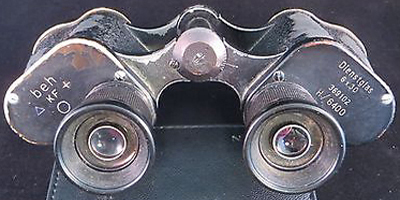 Here is an example of a Dienstglas bearing all four cold resistant grease markings KF, O, +, and Δ. The manufacturer code “beh” shows that this Dienstglas was manufactured in Germany by the Ernst Leitz firm of Wetzlar, Hesse. The cold resistant grease markings tell the story that this particular Dienstglas was manufactured (or returned to a support facility for maintenance, repair, or re-greasing) sometime in 1940 – 1941 (KF), then returned to a support facility and re-greased in 1942 (O), again sometime in 1942 – 1944 (+), and finally sometime in 1943 – 1945 (Δ). The chronology of the markings is known, although the timing of events is inexact. The exact date when cold resistant greases were used at various factories (or support facilities) in Germany and occupied countries in Europe is inexact, and varied according to when supplies of existing greases were used up at each individual factory, and when shipments of new greases arrived at a factory for continued use in the stream of production. However, it is clear that the four different cold resistant greases were introduced into service and used in a known chronological order.
Cold resistant grease markings were applied at the factories when optical equipment was manufactured, and were also added later when instruments were returned to the factories or support facilities for maintenance, repair, and re-greasing. It is common to see German optical equipment bearing two or more cold resistant grease markings. A reasonable estimate of the year of manufacture of individual items of German optical equipment, and their maintenance, repair, and re-greasing history, can be inferred according to the cold resistant grease markings stamped on them. Knowing the order and time frame in which cold resistant grease markings were introduced and used in service provides a basic time frame for estimating an item’s likely service history. |
|||||||||||||||
 Military and Naval Binoculars