


Sublime Ottoman State contract
Carl Zeiss, Jena, Thuringia, Germany, 1913
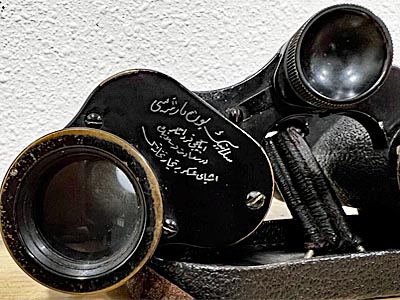
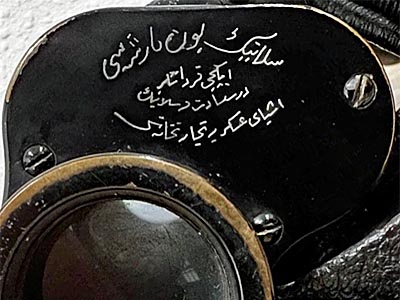
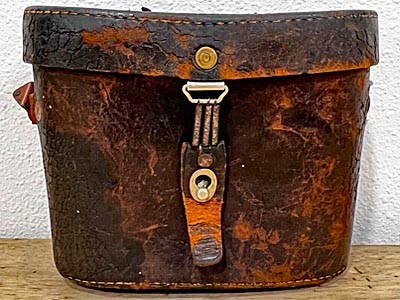
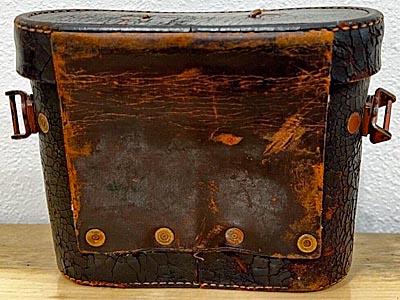
In the Sublime Ottoman State armed forces, military service binoculars were marked to identify them as government military property.
Military service binoculars were issued to soldiers with specialized functions. For example, group leaders and artillery observers were issued military service binoculars to perform their duties.
The most common type of service glass used by the armed forces of the Sublime Ottoman State during the First World War was the 8×(30).
The number “8” identifies the magnification power (in this case, “8” indicates that objects appear eight times closer than their actual distance).
The number “30” identifies the diameter in millimeters of the front (objective) lenses — the light gathering lenses — in this case 30 millimeters in diameter.
“Vulkanite” schwarzes Kunstleder (black synthetic leather) Körperbedeckung (body covering)
 In Germany in the 1930s, an early type of black plastic synthetic leather called “Vulkanite” was used as the body covering of military and commercial Dienstgläser (service glasses) manufactured before World War II.
This “Vulkanite” schwarzes Kunstleder (black synthetic leather) Körperbedeckung (body covering) was the most common Dienstglas body covering used by the German armed forces (and also by most of the other armed forces of Europe) during the early years of the Second World War.
TM 30-506, WAR DEPARTMENT TECHNICAL MANUAL, GERMAN-ENGLISH MILITARY DICTIONARY, WAR DEPARTMENT, 20 MAY I944
The TM 30-506 manual describes “Vulkanite” schwarzes Kunstleder (black synthetic leather) Körperbedeckung (body covering) as “Kunstleder n” artificial leather.
Schwarz „Reis“ Raulack (black “rice” rough lacquer) Körperbedeckung (body covering)
 Early in the Second World War, a black Rauhlack (rough lacquer) body covering called schwarz „Reis“ Körperbedeckung (black “rice” body covering) also became a common Dienstglas body finish.
This new Dienstglas body covering began to replace the black “Vulkanite” (synthetic, leather-like, early plastic) body covering material on the housings of German field glasses.
The particular consistency of this schwarz „Reis“ (black “rice”) Rauhlack (rough lacquer) Körperbedeckung (body covering) was achieved by mixing crushed rice or finely granulated cork meal with black lacquer paint.
This schwarz „Reis“ Rauhlack Körperbedeckung (black “rice” rough lacquer body covering) became the most common Dienstglas body covering as the war progressed through 1942 and 1943.
This is a list of production serial numbers, observed in collections and recorded from sources online, of 6×30 military service binoculars, manufactured by Carl Zeiss, Jena, (coded “rln”), for the armed forces of Germany from 1943 to 1945, during the Second World War.
Carl Zeiss Sublime Ottoman State Contract
D.F. 8x Production Serial Number Series
Carl Zeiss Sublime Ottoman State contract
D.F. 8x, 1913, 331725, Jena, Thuringia, Germany
|
|
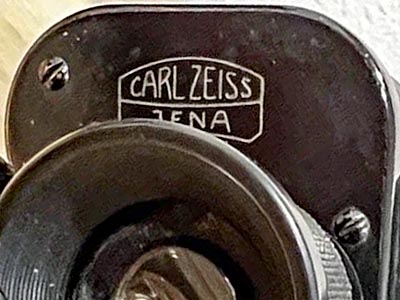
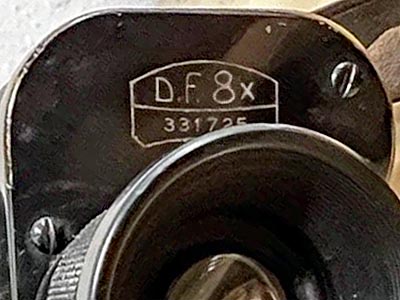
Sublime Ottoman State D.F. 8x military service binoculars, with Strichplatte (graduated range finding scale) in right lens, production serial number, 331725, heavy construction, made of brass, black “Vulkanite” schwarzes Kunstleder (black synthetic leather) Körperbedeckung (body covering), brass fittings, manufactured in February 1913 by Carl Zeiss, Jena, Germany for the armed forces of the Sublime Ottoman State. Left prism cover marked in white with “CARL ZEISS / JENA” trademark logo. Right prism cover marked in white with “D.F. 8x” (Doppelfernrohr, Binoculars, 8x) over production serial number, 331725, within a Carl Zeiss trademark border. This Carl Zeiss 8×30 serial number, 331725, appears to be produced about February 1913, within the serial number sequence of the original Carl Zeiss production serial number series established in 1894. |




Carl Zeiss NEDINSCO Kingdom of Sweden contract
6×30 Dienstglas, 1931, 1585734, Ksp:2854g, Venlo, Netherlands
|
|
Kingdom of Sweden 6×30 military service binoculars, with reticul (graduated range finding scale) in right lens, production serial number, 1585734, light construction, made of aluminum alloy, black “Vulkanite” schwarzes Kunstleder (black synthetic leather) Körperbedeckung (body covering), aluminum alloy fittings, manufactured in December 1931 by Carl Zeiss, NEDINSCO, of Venlo, Netherlands for the armed forces of the Kingdom of Sweden. Left prism cover marked in white characters with Systeem (System) over NEDINSCO (Nederlandse Instrumenten Compagnie, Netherlands Instruments Company), CARL ZEISS / JENA trademark logo, sGravenhage, over production serial number 1585734. Right prism cover marked in white characters with Kingdom of Sweden crown, over 6×30, over Ksp:2854g (Kingdom of Sweden armed forces property number). This Carl Zeiss 6×30 serial number, 1585734, appears to be produced about December 1931, within the serial number sequence of the original Carl Zeiss production serial number series established in 1894. |


Carl Zeiss Kingdom of Sweden contract
6×30 Silvamar, 1941, 2100740, Nr. 6540, 1942, Jena, Thuringia, Germany
|
|
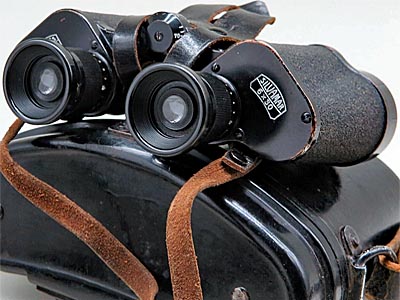
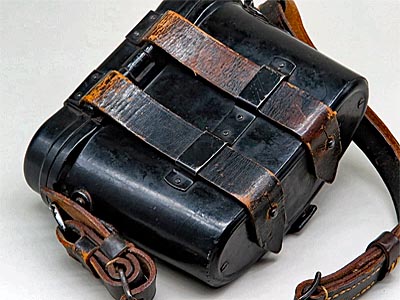
Kingdom of Sweden 6×30 military service binoculars, with reticul (graduated range finding scale) in right lens, production serial number, 2100740, light construction, made of aluminum alloy, schwarz „Reis“ Rauhlack Körperbedeckung (black “rice” rough lacquer body covering), aluminum alloy fittings, manufactured in September 1941 by Carl Zeiss of Jena, Thuringia, Germany for the armed forces of the Kingdom of Sweden. Left prism cover marked in white characters with CARL ZEISS / JENA trademark logo. Right prism cover marked in white with SILVAMAR / 6×30 logo. Left front prism cover marked in white characters with 6×30, over Kingdom of Sweden crown, over Nr. 6540 (Kingdom of Sweden armed forces property number), over 1942 (Kingdom of Sweden armed forces property year of acceptance). This Carl Zeiss 6×30 serial number, 2100740, appears to be produced about September 1941, within the serial number sequence of the original Carl Zeiss production serial number series established in 1894. |


Carl Zeiss Kingdom of Sweden contract
6×30 Silvamar, 1942, 217xxxx, Nr. 1115, 1942, Jena, Thuringia, Germany
|
|
Kingdom of Sweden 6×30 military service binoculars, with reticul (graduated range finding scale) in right lens, production serial number is not visible (painted over with black paint), light construction, made of aluminum alloy, schwarz „Reis“ Rauhlack Körperbedeckung (black “rice” rough lacquer body covering), aluminum alloy fittings, unknown date of manufacture by Carl Zeiss of Jena, Thuringia, Germany for the armed forces of the Kingdom of Sweden. Left prism cover marked in white characters with CARL ZEISS / JENA trademark logo. Right prism cover marked in white with SILVAMAR / 6×30 logo. Left front prism cover marked in white characters with 6×30, over Kingdom of Sweden crown, over Nr. 1115 (Kingdom of Sweden armed forces property number), over 1942 (Kingdom of Sweden armed forces property year of acceptance). This Carl Zeiss 6×30 serial number is unknown, would likely be 217xxxx (Oct, Nov, Dec 1942), within the serial number sequence of the original Carl Zeiss production serial number series established in 1894. |


Carl Zeiss Kingdom of Sweden contract
6×30 Silvamar, 1942, 2175423, Nr. 1833, 1942, Jena, Thuringia, Germany
|
|
Kingdom of Sweden 6×30 military service binoculars, with reticul (graduated range finding scale) in right lens, production serial number, 2175423, light construction, made of aluminum alloy, schwarz „Reis“ Rauhlack Körperbedeckung (black “rice” rough lacquer body covering), aluminum alloy fittings, manufactured in November 1942 by Carl Zeiss of Jena, Thuringia, Germany for the armed forces of the Kingdom of Sweden. Left prism cover marked in white characters with CARL ZEISS / JENA trademark logo. Right prism cover marked in white with SILVAMAR / 6×30 logo. Left front prism cover marked in white characters with 6×30, over Kingdom of Sweden crown, over Nr. 1833 (Kingdom of Sweden armed forces property number), over 1942 (Kingdom of Sweden armed forces property year of acceptance). This Carl Zeiss 6×30 serial number, 2175423, appears to be produced about November 1942, within the serial number sequence of the original Carl Zeiss production serial number series established in 1894. |


Carl Zeiss Kingdom of Sweden contract
6×30 Silvamar, 1942, 2179756, Nr. 4906, 1942, Jena, Thuringia, Germany
|
|
Kingdom of Sweden 6×30 military service binoculars, with reticul (graduated range finding scale) in right lens, production serial number, 2179756, light construction, made of aluminum alloy, schwarz „Reis“ Rauhlack Körperbedeckung (black “rice” rough lacquer body covering), aluminum alloy fittings, manufactured in December 1942 by Carl Zeiss of Jena, Thuringia, Germany for the armed forces of the Kingdom of Sweden. Left prism cover marked in white characters with CARL ZEISS / JENA trademark logo. Right prism cover marked in white with SILVAMAR / 6×30 logo. Left front prism cover marked in white characters with 6×30, over Kingdom of Sweden crown, over Nr. 4906 (Kingdom of Sweden armed forces property number), over 1942 (Kingdom of Sweden armed forces property year of acceptance). This Carl Zeiss 6×30 serial number, 2179756, appears to be produced about December 1942, within the serial number sequence of the original Carl Zeiss production serial number series established in 1894. |




The Ottoman Empire

The Ottoman Empire was an imperial realm that controlled much of Southeast Europe, West Asia, and North Africa from the 14th to early 20th centuries.
It also controlled parts of southeastern Central Europe, between the early 16th and early 18th centuries.
One of the largest and longest lasting empires in history, the Ottoman Empire was ruled by ethnic Turkic peoples and for most of its history the seat of power was at Constantinople (modern-day Istanbul).
It was also known as the Turkish Empire. While Islamic, the empire included large populations of other faiths and non-Turkic ethnicities in territories under its control.
In the 19th and early 20th centuries, persecution of Muslims during the Ottoman contraction and in the Russian Empire resulted in large-scale loss of life and mass migration into modern-day Turkey from the Balkans, Caucasus, and Crimea.
The Ottoman Empire entered the First World War on the side of the Central Powers. It struggled with internal dissent, especially the Arab Revolt, and engaged in genocide against Armenians, Assyrians, and Greeks.
In the aftermath of the First World War, the victorious Allied Powers occupied and partitioned the Ottoman Empire, which lost its southern territories to the United Kingdom and France. The successful Turkish War of Independence, led by Mustafa Kemal Atatürk against the occupying Allies, led to the emergence of the Republic of Turkey and the abolition of the sultanate in 1922.
The First World War

The Ottoman Empire entered the First World War on the side of the Central Powers and was ultimately defeated.
The Ottoman participation in the war began with the combined German-Ottoman surprise attack on the Black Sea coast of the Russian Empire on October 29, 1914. Following the attack, the Russian Empire (November 2, 1914) and its allies France (November 5, 1914) and the British Empire (November 5, 1914) declared war on the Ottoman Empire.
Also on November 5, 1914, the British government changed the status of the Khedivate of Egypt and Cyprus, which were de jure Ottoman territories prior to the war, to British protectorates.
The Ottomans successfully defended the Dardanelles strait during the Gallipoli campaign (1915–1916) and achieved initial victories against British forces in the first two years of the Mesopotamian campaign, such as the Siege of Kut (1915–1916)
The Arab Revolt (1916–1918) turned the tide against the Ottomans in the Middle East. In the Caucasus campaign, however, the Russian forces had the upper hand from the beginning, especially after the Battle of Sarikamish (1914–1915).
Russian forces advanced into northeastern Anatolia and controlled the major cities there until retreating from World War I with the Treaty of Brest-Litovsk following the Russian Revolution in 1917.
Genocides

In 1915, the Ottoman government and Kurdish tribes in the region started the extermination of its ethnic Armenian population, resulting in the deaths of up to 1.5 million Armenians in the Armenian genocide.
The Armenian genocide was the result of the Ottoman government’s deportation and ethnic cleansing policies regarding its Armenian citizens after the Battle of Sarikamish (1914–1915) and the collapse of the Caucasus Front against the Imperial Russian Army and Armenian volunteer units during the First World War.
The genocide was carried out during and after the First World War, and was implemented in two phases: the wholesale killing of the able-bodied male population through massacre and subjection of army conscripts to forced labour, followed by the deportation of women, children, the elderly and infirm on death marches leading to the Syrian desert.
Driven forward by military escorts, the deportees were deprived of food and water and subjected to periodic robbery, rape, and systematic massacre.
Large-scale massacres were also committed against the Empire’s Greek and Assyrian minorities as part of the same campaign of ethnic cleansing.
The Arab Revolt
The Arab Revolt began in 1916 with British support. It turned the tide against the Ottomans on the Middle Eastern front, where they seemed to have the upper hand during the first two years of the war.
On the basis of the McMahon–Hussein Correspondence, an agreement between the British government and Hussein bin Ali, Sharif of Mecca, the revolt was officially initiated at Mecca on June 10, 1916. The Arab nationalist goal was to create a single unified and independent Arab state stretching from Aleppo, Syria, to Aden, Yemen, which the British promised to recognize.
The Sharifian Army, led by Hussein and the Hashemites, with military backing from the British Egyptian Expeditionary Force, successfully fought and expelled the Ottoman military presence from much of the Hejaz and Transjordan. The rebellion eventually took Damascus and set up a short-lived monarchy led by Faisal, a son of Hussein.
Following the terms of the 1916 Sykes–Picot Agreement, the British and French later partitioned the Middle East into mandate territories. There was no unified Arab state, much to Arab nationalists’ anger. Palestine, Iraq, Lebanon and Syria became British and French mandates.
Treaty of Sèvres and Turkish War of Independence
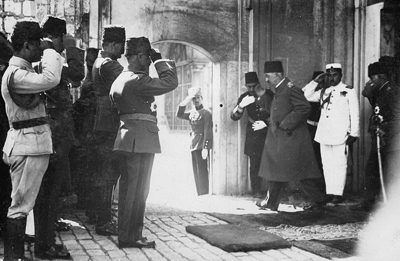
Defeated in World War I, the Ottoman Empire signed the Armistice of Mudros on October 30, 1918. Istanbul was occupied by combined British, French, Italian, and Greek forces. In May 1919, Greece also took control of the area around Smyrna (now İzmir).
The partition of the Ottoman Empire was finalized under the terms of the 1920 Treaty of Sèvres. This treaty, as designed in the Conference of London, allowed the Sultan to retain his position and title. Anatolia’s status was problematic given the occupied forces.
A nationalist opposition arose in the Turkish national movement. It won the Turkish War of Independence (1919–1923) under the leadership of Mustafa Kemal (later given the surname “Atatürk”).
The sultanate was abolished on November 1, 1922, and the last sultan, Mehmed VI (reigned 1918–1922), left the country on November 17, 1922. The Republic of Turkey was established in its place on October 29, 1923, in the new capital city of Ankara. The caliphate was abolished on March 3, 1924.