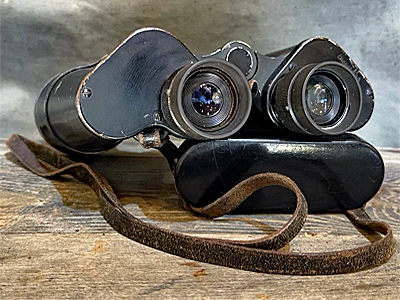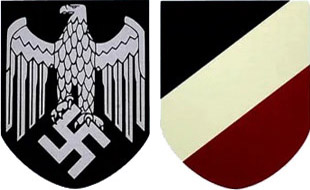

Carl Zeiss (rln), Jena, Thuringia, Germany, 1943-1945
In the German armed forces, Doppelfernrohr (binoculars) were marked with the word Dienstglas (service glass) to identify them as government military property.
A Dientglas was issued to soldiers with specialized functions. For example, a Gruppenführer (group leader), or an Artilleriebeobachter (artillery observer), was issued a Dienstglas to perform his duties.
A widely used type of service glass used by the German armed forces during the Second World War was the 10×50 Dienstglas, based on the Carl Zeiss 10×50 civilian Dekaris Weitwinkelfernglas mit 70° Sehfeld (wide-angle binoculars with 70° field of view), that first appeared in 1929. Production of the 10×50 Dekaris was halted in 1990.
The number “10” identifies the magnification power of the Dienstglas (in this case, “10” indicates that objects appear ten times closer than their actual distance).
The number “50” identifies the diameter in millimeters of the front (objective) lenses — the light gathering lenses — in this case 50 millimeters in diameter.
From November 1940, German military service binoculars were marked with a three-digit letter code to protect the location of manufacturers’ factories from Allied bombing.
Military service binoculars manufactured by Carl Zeiss Jena were initially coded “blc” in November 1940. The later “rln” code seems to have been introduced in early 1943.
“O” Kältefettmarkierungen (cold resistant grease marking)
“O” (1942)
marked with a hellblaue Kreisfläche (light blue circle) “O”
introduced before August 5, 1942
“O” — kältebeständiges Fett (cold resistant grease) — “Vakuumfett 1416” (“Vaccuum Grease 1416”), also known simply as “Vacuum” — marked with a hellblaue Kreis (light blue circle) “O” on Dienstgläser (Service glasses) manufactured (or returned to a support facility for maintenance, repair, or regreasing) during 1942.
According to Allgemeine Heeresmitteilungen (General Army Releases), the cold resistant grease “Vakuumfett 1416” was introduced no later than January 26, 1942, and was certified to be fully operational for use on equipment to -40° Celsius (-40° Fahrenheit).
The earliest document referring to “Vakuumfett 1416” — “O” — was the German Taschenbuch für den Winterkrieg (Manual for Winter Warfare), first version dated August 5, 1942.
“+” Kältefettmarkierungen (cold resistant grease marking)
“+” 1942 – 1944 (mainly in 1943)
marked with a hellblaues Kreuz (light blue cross) “+”
introduced before November 1, 1942
“+” — kältebeständiges Fett (cold resistant grease) — “Instrumentenfett 1442” (“Instrument Grease 1442”) — marked with a hellblaues Kreuz (light blue cross) “+” on Dienstgläser (Service glasses) manufactured (or returned to a support facility for maintenance, repair, or regreasing) during 1942 and 1943.
According to Allgemeine Heeresmitteilungen (General Army Releases), the cold resistant grease “Instrumentenfett 1442” was introduced no later than August 6, 1942, and was certified to be fully operational for use on equipment to -40° Celsius (-40° Fahrenheit).
The earliest document referring to “Instrumentenfett 1442” — “+” — was the German Taschenbuch für den Winterkrieg (Manual for Winter Warfare), revised version dated November 1, 1942.
Evidently, soon after it was introduced, “Vakuumfett 1416” turned out to be unsatisfactory in actual field use. In the revised version of the Taschenbuch für den Winterkrieg (Manual for Winter Warfare), dated November 1, 1942, the “O” marking was not mentioned, and the “+” marking was introduced without explanation, with the statement that optical equipment marked with a “+” was perfectly serviceable to -40 degrees Celsius, and “in Zukunft wird das gesamte Beobachtungs und Vermessungsgerät des Heeres nur mit Instrumentenfett 1442 gefettet” (in the future, all observation and surveying instruments of the Army will be only lubricated with Instrument grease 1442″.
“Δ” Kältefettmarkierungen (cold resistant grease marking)
“Δ” 1943 – 1945 (mainly in 1944)
marked with a hellblaue Dreieck (light blue triangle) “Δ”
introduced late 1943 or early 1944
“Δ” — kältebeständiges Fett (cold resistant grease) — “Instrumentenfett 6009 (“Instrument Grease 6009”) — marked with a hellblaue Dreieck (light blue triangle “Δ”) on Dienstgläser (Service glasses) manufactured (or returned to a support facility for maintenance, repair, or regreasing) from 1943 to 1945.
Although no document exists referring to “Instrumentenfett 6009” — “Δ” — it is believed that this final cold resistant grease was introduced in late 1943 or early 1944, and was certified to be fully operational for use on equipment between -40° and -50° Celsius (-40° and -58° Fahrenheit).
 Schwarz „Reis“ Körperbedeckung (black “rice” body covering)
Early in the Second World War, a black Rauhlack (rough lacquer) body covering called schwarz „Reis“ Körperbedeckung (black “rice” body covering) also became a common Dienstglas body finish.
This new Dienstglas body covering began to replace the black “Vulkanite” (synthetic, leather-like, early plastic) body covering material on the housings of German field glasses.
The particular consistency of this black „Reis“ (“rice”) Rauhlack (rough lacquer) body covering was achieved by mixing crushed rice or finely granulated cork meal with black lacquer paint.
This black „Reis“ (“rice”) Rauhlack (rough lacquer) body covering became the most common Dienstglas body covering as the war progressed through 1942 and 1943.
This is a list of production serial numbers, observed in collections and recorded from sources online, of 10×50 military service binoculars, manufactured by Carl Zeiss, Jena, (coded “rln”), for the armed forces of Germany from 1943 to 1945, during the Second World War.
(rln) 1943-1945 New Production Serial Number Series
Carl Zeiss (rln)
10×50 Dienstglas, 1943, 25386, Jena, Thuringia, Germany
“+” (Kältefettmarkierungen, cold resistant grease marking, 1942-1944)
|
|
German 10×50 Dienstglas military service binoculars, with Strichplatte (graduated range finding scale) in right lens, production serial number, 25386, light construction, made of aluminum alloy, black “rice” body covering, aluminum alloy fittings, manufactured in 1943 by Carl Zeiss (rln), of Jena, Thuringia, Germany. Left prism cover blank, right prism cover marked “Dienstglas” (service glass) over “10×50” over production serial number “25386” over “rln” (manufacturer’s optical code) and “+” (Kältefettmarkierungen, cold resistant grease marking, 1942-1944), mainly in 1943. These 10×50 military service binoculars are accompanied by the original brown leather Trageriemen (carrying strap). These 10×50 military service binoculars came from Seevetal, Germany This Carl Zeiss (rln) 10×50 serial number, 25386, appears to be part of a new production serial number series established in 1943. |


Carl Zeiss (rln)
10×50 Dienstglas, 1943, 31430, Jena, Thuringia, Germany
“+” (Kältefettmarkierungen, cold resistant grease marking, 1942-1944)
|
|
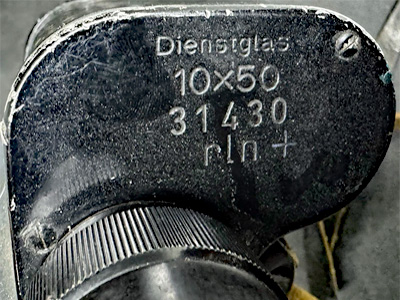
German 10×50 Dienstglas military service binoculars, with Strichplatte (graduated range finding scale) in right lens, production serial number, 31430, light construction, made of aluminum alloy, dark gray paint over bare metal body, aluminum alloy fittings, manufactured in 1943 by Carl Zeiss (rln), of Jena, Thuringia, Germany. Left prism cover blank, right prism cover marked “Dienstglas” (service glass) over “10×50” over production serial number “31430” over “rln” (manufacturer’s optical code) and “+” (Kältefettmarkierungen, cold resistant grease marking, 1942-1944), mainly in 1943. These 10×50 military service binoculars are accompanied by the original brown leather Trageriemen (carrying strap). This Carl Zeiss (rln) 10×50 serial number, 31430, appears to be part of a new production serial number series established in 1943. |



Carl Zeiss (rln)
10×50 Dienstglas, 1943, 87791, Jena, Thuringia, Germany
“+” (Kältefettmarkierungen, cold resistant grease marking, 1942-1944)
|
|
German 10×50 Dienstglas military service binoculars, with Strichplatte (graduated range finding scale) in right lens, production serial number, 87791, light construction, made of aluminum alloy, dark gray paint over bare metal body, aluminum alloy fittings, manufactured in 1943 by Carl Zeiss (rln), of Jena, Thuringia, Germany. Left prism cover blank, right prism cover marked “Dienstglas” (service glass) over “10×50” over production serial number “87791” over “rln” (manufacturer’s optical code) and “+” (Kältefettmarkierungen, cold resistant grease marking, 1942-1944), mainly in 1943. These 10×50 military service binoculars are accompanied by the original black leather Trageriemen (carrying strap). This Carl Zeiss (rln) 10×50 serial number, 87791, appears to be part of a new production serial number series established in 1943. |


Carl Zeiss (rln)
10×50 Dienstglas, 1943, 88075, Jena, Thuringia, Germany
“+” (Kältefettmarkierungen, cold resistant grease marking, 1942-1944)
|
|
German 10×50 Dienstglas military service binoculars, with Strichplatte (graduated range finding scale) in right lens, production serial number, 88075, light construction, made of aluminum alloy, dark gray paint over bare metal body, aluminum alloy fittings, manufactured in 1943 by Carl Zeiss (rln), of Jena, Thuringia, Germany. Left prism cover blank, right prism cover marked “Dienstglas” (service glass) over “10×50” over production serial number “88075” over “rln” (manufacturer’s optical code) and “+” (Kältefettmarkierungen, cold resistant grease marking, 1942-1944), mainly in 1943. These 10×50 military service binoculars are accompanied by the original black leather Trageriemen (carrying strap). This Carl Zeiss (rln) 10×50 serial number, 88075, appears to be part of a new production serial number series established in 1943. |


Carl Zeiss (rln)
10×50 Dienstglas, 1943, 89317, Jena, Thuringia, Germany
“+” (Kältefettmarkierungen, cold resistant grease marking, 1942-1944)
|
|
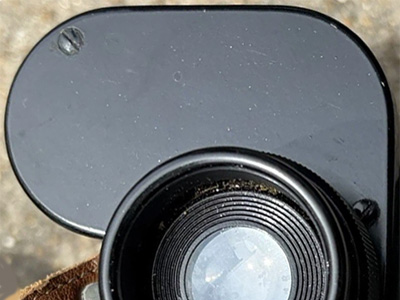
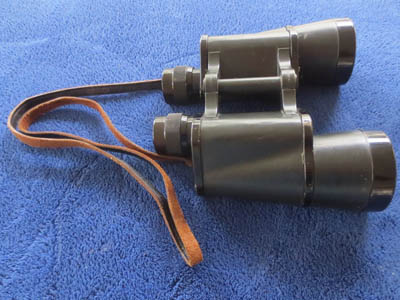
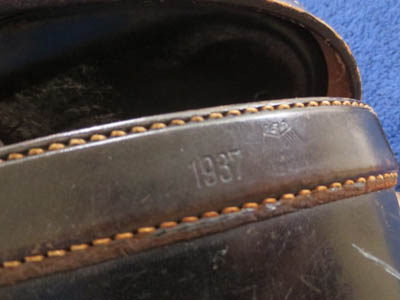
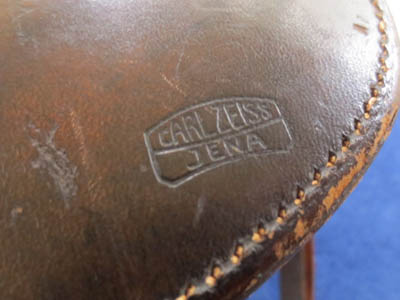
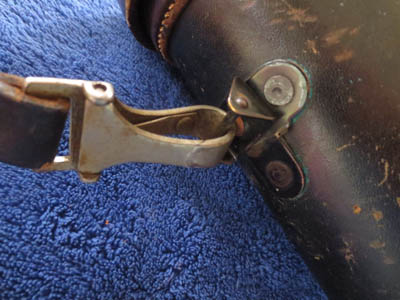
German 10×50 Dienstglas military service binoculars, with Strichplatte (graduated range finding scale) in right lens, production serial number, 89317, light construction, made of aluminum alloy, dark gray paint over bare metal body, aluminum alloy fittings, manufactured in 1943 by Carl Zeiss (rln), of Jena, Thuringia, Germany. Left prism cover blank, right prism cover marked “Dienstglas” (service glass) over “10×50” over production serial number “89317” over “rln” (manufacturer’s optical code) and “+” (Kältefettmarkierungen, cold resistant grease marking, 1942-1944), mainly in 1943. These 10×50 military service binoculars are accompanied by the original black leather Trageriemen (carrying strap) and original black leather Behalter or Köcher (case) with carrying strap. This Carl Zeiss (rln) 10×50 serial number, 89317, appears to be part of a new production serial number series established in 1943. |




Carl Zeiss (rln)
10×50 Dienstglas, 1943, 90739, Jena, Thuringia, Germany
“+” (Kältefettmarkierungen, cold resistant grease marking, 1942-1944)
|
|
German 10×50 Dienstglas military service binoculars, with Strichplatte (graduated range finding scale) in right lens, production serial number, 90739, light construction, made of aluminum alloy, dark gray paint over bare metal body, aluminum alloy fittings, manufactured in 1943 by Carl Zeiss (rln), of Jena, Thuringia, Germany. Left prism cover blank, right prism cover marked “Dienstglas” (service glass) over “10×50” over production serial number “90739” over “rln” (manufacturer’s optical code) and “+” (Kältefettmarkierungen, cold resistant grease marking, 1942-1944), mainly in 1943. These 10×50 military service binoculars are accompanied by the original brown leather Behalter or Köcher (case) with carrying strap. This Carl Zeiss (rln) 10×50 serial number, 90739, appears to be part of a new production serial number series established in 1943. |
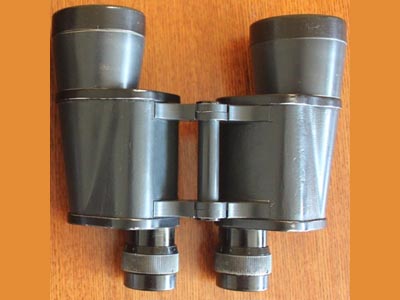


Carl Zeiss (rln)
10×50 Dienstglas, 1943, 91237, Jena, Thuringia, Germany
“+” (Kältefettmarkierungen, cold resistant grease marking, 1942-1944)
|
|
German 10×50 Dienstglas military service binoculars, with Strichplatte (graduated range finding scale) in right lens, production serial number, 91237, light construction, made of aluminum alloy, dark gray paint over bare metal body, aluminum alloy fittings, manufactured in 1943 by Carl Zeiss (rln), of Jena, Thuringia, Germany. Left prism cover blank, right prism cover marked “Dienstglas” (service glass) over “10×50” over production serial number “91237” over “rln” (manufacturer’s optical code) and “+” (Kältefettmarkierungen, cold resistant grease marking, 1942-1944), mainly in 1943. These 10×50 military service binoculars are accompanied by the original black leather Trageriemen (carrying strap), rubber Okularshutz (eye piece protector), attached to the Tragereimen straps, to keep dirt out of the rear lenses, black leather Aknöpflasche (button tab), and black leather Behalter or Köcher (case) with carrying strap. These 10×50 military service binoculars came from Liepaja, Latvia. This Carl Zeiss (rln) 10×50 serial number, 91237, appears to be part of a new production serial number series established in 1943. |


Carl Zeiss (rln)
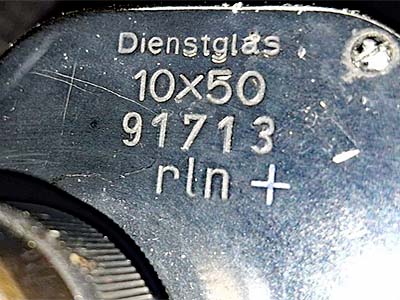
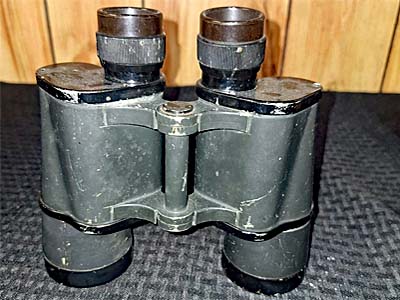
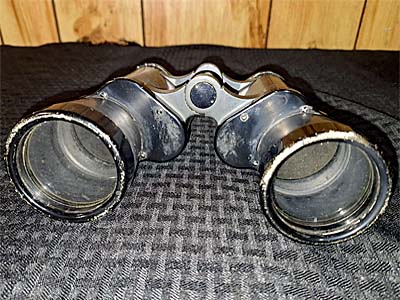
10×50 Dienstglas, 1943, 91713, Jena, Thuringia, Germany
“+” (Kältefettmarkierungen, cold resistant grease marking, 1942-1944)
|
|
German 10×50 Dienstglas military service binoculars, with Strichplatte (graduated range finding scale) in right lens, production serial number, 91713, light construction, made of aluminum alloy, dark gray paint over bare metal body, aluminum alloy fittings, manufactured in 1943 by Carl Zeiss (rln), of Jena, Thuringia, Germany. Left prism cover blank, right prism cover marked “Dienstglas” (service glass) over “10×50” over production serial number “91713” over “rln” (manufacturer’s optical code) and “+” (Kältefettmarkierungen, cold resistant grease marking, 1942-1944), mainly in 1943. This Carl Zeiss (rln) 10×50 serial number, 91713, appears to be part of a new production serial number series established in 1943. |



Carl Zeiss (rln)
10×50 Dienstglas, 1943, 91983, Jena, Thuringia, Germany
“+” (Kältefettmarkierungen, cold resistant grease marking, 1942-1944)
|
|
German 10×50 Dienstglas military service binoculars, with Strichplatte (graduated range finding scale) in right lens, production serial number, 91983, light construction, made of aluminum alloy, dark gray paint over bare metal body, aluminum alloy fittings, manufactured in 1943 by Carl Zeiss (rln), of Jena, Thuringia, Germany. Left prism cover blank, right prism cover marked “Dienstglas” (service glass) over “10×50” over production serial number “91983” over “rln” (manufacturer’s optical code) and “+” (Kältefettmarkierungen, cold resistant grease marking, 1942-1944), mainly in 1943. These 10×50 military service binoculars are accompanied by the original brown leather Trageriemen (carrying strap) and original brown leather Behalter or Köcher (case) with carrying strap. This Carl Zeiss (rln) 10×50 serial number, 91983, appears to be part of a new production serial number series established in 1943. |


Carl Zeiss (rln)
10×50 Dienstglas, 1943, 92644, Jena, Thuringia, Germany
“+” (Kältefettmarkierungen, cold resistant grease marking, 1942-1944)
|
|
German 10×50 Dienstglas military service binoculars, with Strichplatte (graduated range finding scale) in right lens, production serial number, 92644, light construction, made of aluminum alloy, dark gray paint over bare metal body, aluminum alloy fittings, manufactured about 1943 by Carl Zeiss (rln), of Jena, Thuringia, Germany. Left prism cover blank, right prism cover marked “Dienstglas” (service glass) over “10×50” over production serial number “92644” over “rln” (manufacturer’s optical code) and “+” (Kältefettmarkierungen, cold resistant grease marking, 1942-1944), mainly in 1943. This Carl Zeiss (rln) 10×50 serial number, 92644, appears to be part of a new production serial number series established in 1943. |


Carl Zeiss (rln)
10×50 Dienstglas, 1943, 98094, Jena, Thuringia, Germany
“+” (Kältefettmarkierungen, cold resistant grease marking, 1942-1944)
|
|
German 10×50 Dienstglas military service binoculars, with Strichplatte (graduated range finding scale) in right lens, production serial number, 98094, light construction, made of aluminum alloy, dark gray paint over bare metal body, aluminum alloy fittings, manufactured about 1943 by Carl Zeiss (rln), of Jena, Thuringia, Germany. Left prism cover blank, right prism cover marked “Dienstglas” (service glass) over “10×50” over production serial number “98094” over “rln” (manufacturer’s optical code) and “+” (Kältefettmarkierungen, cold resistant grease marking, 1942-1944), mainly in 1943. These 10×50 military service binoculars came from Germany. This Carl Zeiss (rln) 10×50 serial number, 98094, appears to be part of a new production serial number series established in 1943. |


Carl Zeiss (rln)
10×50 Dienstglas, 1943, 99241, Jena, Thuringia, Germany
“+” (Kältefettmarkierungen, cold resistant grease marking, 1942-1944)
|
|
German 10×50 Dienstglas military service binoculars, with Strichplatte (graduated range finding scale) in right lens, production serial number, 99241, light construction, made of aluminum alloy, dark gray paint over bare metal body, aluminum alloy fittings, manufactured about 1943 by Carl Zeiss (rln), of Jena, Thuringia, Germany. Left prism cover blank, right prism cover marked “Dienstglas” (service glass) over “10×50” over production serial number “99241” over “rln” (manufacturer’s optical code) and “+” (Kältefettmarkierungen, cold resistant grease marking, 1942-1944), mainly in 1943. These 10×50 military service binoculars came from Liepaja, Latvia. This Carl Zeiss (rln) 10×50 serial number, 99241, appears to be part of a new production serial number series established in 1943. |