
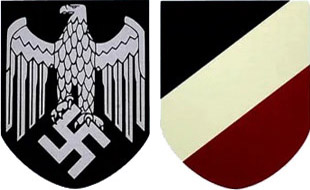

Carl Zeiss (blc), Jena, Thuringia, Germany, 1940-1945
In the German armed forces, Doppelfernrohr (binoculars) were marked with the word Dienstglas (service glass) to identify them as government military property.
A Dientglas was issued to soldiers with specialized functions. For example, a Gruppenführer (group leader), or an Artilleriebeobachter (artillery observer), was issued a Dienstglas to perform his duties.
A widely used type of service glass used by the German armed forces during the Second World War was the 10×50 Dienstglas, based on the Carl Zeiss 10×50 civilian Dekaris Weitwinkelfernglas mit 70° Sehfeld (wide-angle binoculars with 70° field of view), that first appeared in 1929. Production of the 10×50 Dekaris was halted in 1990.
The number “10” identifies the magnification power of the Dienstglas (in this case, “10” indicates that objects appear ten times closer than their actual distance).
The number “50” identifies the diameter in millimeters of the front (objective) lenses — the light gathering lenses — in this case 50 millimeters in diameter.
From November 1940, German military service binoculars were marked with a three-digit letter code to protect the location of manufacturers’ factories from Allied bombing.
Military service binoculars manufactured by Carl Zeiss Jena were initially coded “blc” in November 1940. The later “rln” code seems to have been introduced in early 1943.
“O” Kältefettmarkierungen (cold resistant grease marking)
“O” (1942)
marked with a hellblaue Kreisfläche (light blue circle) “O”
introduced before August 5, 1942
“O” — kältebeständiges Fett (cold resistant grease) — “Vakuumfett 1416” (“Vaccuum Grease 1416”), also known simply as “Vacuum” — marked with a hellblaue Kreis (light blue circle) “O” on Dienstgläser (Service glasses) manufactured (or returned to a support facility for maintenance, repair, or regreasing) during 1942.
According to Allgemeine Heeresmitteilungen (General Army Releases), the cold resistant grease “Vakuumfett 1416” was introduced no later than January 26, 1942, and was certified to be fully operational for use on equipment to -40° Celsius (-40° Fahrenheit).
The earliest document referring to “Vakuumfett 1416” — “O” — was the German Taschenbuch für den Winterkrieg (Manual for Winter Warfare), first version dated August 5, 1942.
“+” Kältefettmarkierungen (cold resistant grease marking)
“+” 1942 – 1944 (mainly in 1943)
marked with a hellblaues Kreuz (light blue cross) “+”
introduced before November 1, 1942
“+” — kältebeständiges Fett (cold resistant grease) — “Instrumentenfett 1442” (“Instrument Grease 1442”) — marked with a hellblaues Kreuz (light blue cross) “+” on Dienstgläser (Service glasses) manufactured (or returned to a support facility for maintenance, repair, or regreasing) during 1942 and 1943.
According to Allgemeine Heeresmitteilungen (General Army Releases), the cold resistant grease “Instrumentenfett 1442” was introduced no later than August 6, 1942, and was certified to be fully operational for use on equipment to -40° Celsius (-40° Fahrenheit).
The earliest document referring to “Instrumentenfett 1442” — “+” — was the German Taschenbuch für den Winterkrieg (Manual for Winter Warfare), revised version dated November 1, 1942.
Evidently, soon after it was introduced, “Vakuumfett 1416” turned out to be unsatisfactory in actual field use. In the revised version of the Taschenbuch für den Winterkrieg (Manual for Winter Warfare), dated November 1, 1942, the “O” marking was not mentioned, and the “+” marking was introduced without explanation, with the statement that optical equipment marked with a “+” was perfectly serviceable to -40 degrees Celsius, and “in Zukunft wird das gesamte Beobachtungs und Vermessungsgerät des Heeres nur mit Instrumentenfett 1442 gefettet” (in the future, all observation and surveying instruments of the Army will be only lubricated with Instrument grease 1442″.
“Δ” Kältefettmarkierungen (cold resistant grease marking)
“Δ” 1943 – 1945 (mainly in 1944)
marked with a hellblaue Dreieck (light blue triangle) “Δ”
introduced late 1943 or early 1944
“Δ” — kältebeständiges Fett (cold resistant grease) — “Instrumentenfett 6009 (“Instrument Grease 6009”) — marked with a hellblaue Dreieck (light blue triangle “Δ”) on Dienstgläser (Service glasses) manufactured (or returned to a support facility for maintenance, repair, or regreasing) from 1943 to 1945.
Although no document exists referring to “Instrumentenfett 6009” — “Δ” — it is believed that this final cold resistant grease was introduced in late 1943 or early 1944, and was certified to be fully operational for use on equipment between -40° and -50° Celsius (-40° and -58° Fahrenheit).
 Schwarz „Reis“ Körperbedeckung (black “rice” body covering)
Early in the Second World War, a black Rauhlack (rough lacquer) body covering called schwarz „Reis“ Körperbedeckung (black “rice” body covering) also became a common Dienstglas body finish.
This new Dienstglas body covering began to replace the black “Vulkanite” (synthetic, leather-like, early plastic) body covering material on the housings of German field glasses.
The particular consistency of this black „Reis“ (“rice”) Rauhlack (rough lacquer) body covering was achieved by mixing crushed rice or finely granulated cork meal with black lacquer paint.
This black „Reis“ (“rice”) Rauhlack (rough lacquer) body covering became the most common Dienstglas body covering as the war progressed through 1942 and 1943.
This is a list of production serial numbers, observed in collections and recorded from sources online, of 10×50 military service binoculars, manufactured by Carl Zeiss, Jena, (coded “rln”), for the armed forces of Germany from 1943 to 1945, during the Second World War.
(blc) 1940-1945 New Production Serial Number Series
Carl Zeiss (blc)
10×50 Dienstglas, 1940, 2175, Jena, Thuringia, Germany
“+” (Kältefettmarkierungen, cold resistant grease marking, 1942-1944)
|
|
German 10×50 Dienstglas military service binoculars, with Strichplatte (graduated range finding scale) in right lens, production serial number, 2175, light construction, made of aluminum alloy, black “rice” body covering, aluminum alloy fittings, manufactured in 1940 by Carl Zeiss (blc), of Jena, Thuringia, Germany. Left prism cover blank, right prism cover marked “Dienstglas” (service glass) over “10×50” over production serial number “2175” over “blc” (manufacturer’s optical code) and “+” (Kältefettmarkierungen, cold resistant grease marking, 1942-1944), mainly in 1943. These 10×50 military service binoculars are accompanied by the original black leather Behalter or Köcher (case). This Carl Zeiss (blc) 10×50 serial number, 2175, appears to be part of a new production serial number series established in November 1940. |


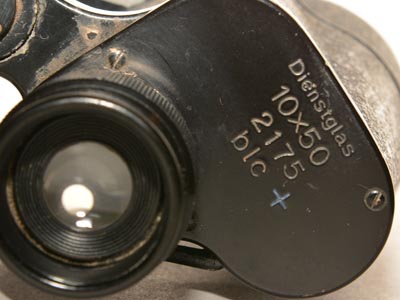


Carl Zeiss (blc)
10×50 Dienstglas, 1941, 15882, Jena, Thuringia, Germany
“+” (Kältefettmarkierungen, cold resistant grease marking, 1942-1944)
|
|
German 10×50 Dienstglas military service binoculars, with Strichplatte (graduated range finding scale) in right lens, production serial number, 15882, light construction, made of aluminum alloy, black “rice” body covering, aluminum alloy fittings, manufactured in 1941 by Carl Zeiss (blc), of Jena, Thuringia, Germany. Left prism cover blank, right prism cover marked “Dienstglas” (service glass) over “10×50” over production serial number “15882” over “blc” (manufacturer’s optical code) and “+” (Kältefettmarkierungen, cold resistant grease marking, 1942-1944), mainly in 1943. These 10×50 military service binoculars are accompanied by the original brown leather Trageriemen (carrying strap) and original black leather Behalter or Köcher (case). This Carl Zeiss (blc) 10×50 serial number, 15882, appears to be part of a new production serial number series established in November 1940. |


Carl Zeiss (blc)
10×50 Dienstglas, 1942, 2180711, Jena, Thuringia, Germany
“O” (Kältefettmarkierungen, cold resistant grease marking, 1942)
|
|
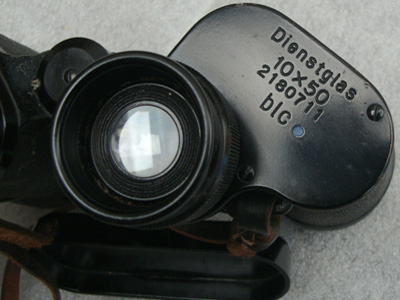
German 10×50 Dienstglas military service binoculars, with Strichplatte (graduated range finding scale) in right lens, production serial number, 2180711, light construction, made of aluminum alloy, black “rice” body covering, aluminum alloy fittings, manufactured in 1942 by Carl Zeiss (blc), of Jena, Thuringia, Germany. Left prism cover blank, right prism cover marked “Dienstglas” (service glass) over “10×50” over production serial number “2180711” over “blc” (manufacturer’s optical code) and “O” (Kältefettmarkierungen, cold resistant grease marking, 1942). These 10×50 military service binoculars are accompanied by the original black leather Trageriemen (carrying strap) and Okularshutz (eye piece protector) or Regenschutzdeckel (rain protection cover) or Benutzerkappe (user cap). This Carl Zeiss (blc) 10×50 serial number, 2180711, appears to be part of a new production serial number series established in November 1940. |



Carl Zeiss (blc)
10×50 Dienstglas, 1942, 2183235, Jena, Thuringia, Germany
“O” (Kältefettmarkierungen, cold resistant grease marking, 1942)
|
|
German 10×50 Dienstglas military service binoculars, with Strichplatte (graduated range finding scale) in right lens, production serial number, 2183235, light construction, made of aluminum alloy, black “rice” body covering, aluminum alloy fittings, manufactured in 1942 by Carl Zeiss (blc), of Jena, Thuringia, Germany. Left prism cover blank, right prism cover marked “Dienstglas” (service glass) over “10×50” over production serial number “2183235” over “blc” (manufacturer’s optical code) and “O” (Kältefettmarkierungen, cold resistant grease marking, 1942). These 10×50 military service binoculars are accompanied by the original black leather Trageriemen (carrying strap) and original black leather Behalter or Köcher (case). This Carl Zeiss (rln) 10×50 serial number, 2183235, appears to be part of a new production serial number series established in November 1940. |


Carl Zeiss (blc)
10×50 Dienstglas, 1943, 2211832, Jena, Thuringia, Germany
“+” (Kältefettmarkierungen, cold resistant grease marking, 1942-1944)
|
|
German 10×50 Dienstglas military service binoculars, with Strichplatte (graduated range finding scale) in right lens, production serial number, 2211832, light construction, made of aluminum alloy, black “rice” body covering, aluminum alloy fittings, manufactured in 1943 by Carl Zeiss (blc), of Jena, Thuringia, Germany. Left prism cover blank, right prism cover marked “Dienstglas” (service glass) over “10×50” over production serial number “2211832” over “blc” (manufacturer’s optical code) and “+” (Kältefettmarkierungen, cold resistant grease marking, 1942-1944), mainly in 1943. These 10×50 military service binoculars are accompanied by the original brown leather Trageriemen (carrying strap). This Carl Zeiss (rln) 10×50 serial number, 2211832, appears to be part of a new production serial number series established in November 1940. |
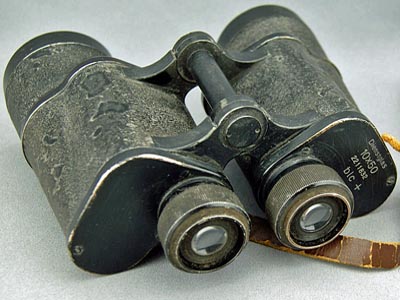


Carl Zeiss (blc)
10×50 Dienstglas, 1943, 2231874, Jena, Thuringia, Germany
“+” (Kältefettmarkierungen, cold resistant grease marking, 1942-1944)
|
|
German 10×50 Dienstglas military service binoculars, with Strichplatte (graduated range finding scale) in right lens, production serial number, 2231874, light construction, made of aluminum alloy, Sandgelb (sand yellow) paint over bare metal body, aluminum alloy fittings, manufactured in 1943 by Carl Zeiss (blc), of Jena, Thuringia, Germany. Left prism cover blank, right prism cover marked “Dienstglas” (service glass) over “10×50” over production serial number “2231874” over “blc” (manufacturer’s optical code) and “+” (Kältefettmarkierungen, cold resistant grease marking, 1942-1944), mainly in 1943. These 10×50 military service binoculars are accompanied by the original brown leather Behalter or Köcher (case) with carrying strap. This Carl Zeiss (rln) 10×50 serial number, 2231874, appears to be part of a new production serial number series established in November 1940. The original black leather Trageriemen (carrying strap) is no longer included, although the black leather Anknöpflasche (button flap) remains. |


Fälschungen “blc” 10×50, 2231874 “Manipulated” Forgery
This Dienstglas (“blc” 10×50, 2231874) is a “manipulated” forgery. This is an example of a genuine Dienstglas, manufactured by the firm of Carl Zeiss, Jena, Thuringia (“blc”), that was originally manufactured with a black “rice” body covering, and more recently has been intentionally manipulated (stripped to bare metal and painted) to portray instead a Dienstglas with a Sandgelb (sand yellow) painted body.
Original : Black “rice” body covering, black anodized aluminum fittings, black anodized aluminum and black Bakelit (Bakelite) rear lens fittings, left prism cover blank, right prism cover marked “Dienstglas” over “10×50” over “2231874” production serial number over “blc” and “+” (cold resistant grease marking, 1942 – 1944), black leather Trageriemen (carrying strap), black leather Anknöpflasche (button flap).
Manipulated Forgery : This Dienstglas (“blc” 10×50, 2231874) was originally manufactured with a black “rice” body covering, that has since been stripped to bare metal, then painted with a modern application of Sandgelb (sand yellow) paint. The forger did not distress or darken this Dienstglas to look old and well used in active military service.
In September 1943, the Reichsluftfahrt Ministerium (German Ministry of Aviation) designated “Paint, RLM-79, SANDGELB (sand-yellow),” as einheitsfarbe Europa (single color Europe), and ordered this paint to be used on all military equipment of the German armed forces, including tanks, trucks, other vehicles, artillery, and all kinds of smaller equipment, including Dienstgläser, and other optical equipment. This does not appear to be the case with this particular service glass (“blc” 10×50, 2231874).
This Dienstglas (“blc” 10×50, 2231874) is a manipulated forgery. In this clearly documented case, seeing the photographic evidence of counterfeiting makes the deception seem obvious. Unfortunately, fakes like this are often recognized only after seeing “before and after” photos of changes made to service glasses with known serial numbers. The ultimate defense against being deceived by this kind of forgery is learning by experience — meeting enough fakes to know when you see the next one. These 10×50 military service binoculars are accompanied by the original black leather Trageriemen (carrying strap) and the black leather Anknöpflasche (button flap).
Carl Zeiss (blc)
10×50 Dienstglas, 1943, 2234852, Jena, Thuringia, Germany
“+” (Kältefettmarkierungen, cold resistant grease marking, 1942-1944)
|
|
German 10×50 Dienstglas military service binoculars, with Strichplatte (graduated range finding scale) in right lens, production serial number, 2234852, light construction, made of aluminum alloy, dark gray paint over bare metal body, aluminum alloy fittings, manufactured in 1943 by Carl Zeiss (blc), of Jena, Thuringia, Germany. Left prism cover blank, right prism cover marked “Dienstglas” (service glass) over “10×50” over production serial number “2234852” over “blc” (manufacturer’s optical code) and “+” (Kältefettmarkierungen, cold resistant grease marking, 1942-1944), mainly in 1943. These 10×50 military service binoculars are accompanied by the original black leather Trageriemen (carrying strap), rubber Okularshutz (eye piece protector), attached to the Tragereimen straps, to keep dirt out of the rear lenses, black leather Aknöpflasche (button tab), and black leather Behalter or Köcher (case) with carrying strap. This Carl Zeiss (rln) 10×50 serial number, 2234852, appears to be part of a new production serial number series established in November 1940. |


Carl Zeiss (blc)
10×50 Dienstglas, 1943, 2236992, Jena, Thuringia, Germany
“+” (Kältefettmarkierungen, cold resistant grease marking, 1942-1944)
|
|
German 10×50 Dienstglas military service binoculars, with Strichplatte (graduated range finding scale) in right lens, production serial number, 2236992, light construction, made of aluminum alloy, dark gray paint over bare metal body, aluminum alloy fittings, manufactured in 1943 by Carl Zeiss (blc), of Jena, Thuringia, Germany. Left prism cover blank, right prism cover marked “Dienstglas” (service glass) over “10×50” over production serial number “2236992” over “blc” (manufacturer’s optical code) and “+” (Kältefettmarkierungen, cold resistant grease marking, 1942-1944), mainly in 1943. This Carl Zeiss (rln) 10×50 serial number, 2236992, appears to be part of a new production serial number series established in November 1940. |


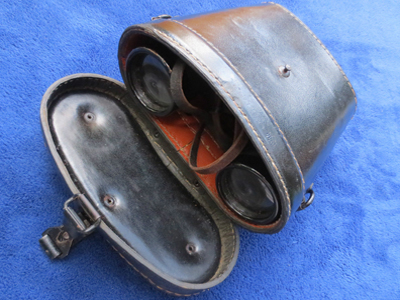

Carl Zeiss (rln)
10×50 Dienstglas, 1943, 91983, Jena, Thuringia, Germany
“+” (Kältefettmarkierungen, cold resistant grease marking, 1942-1944)
|
|
German 10×50 Dienstglas military service binoculars, with Strichplatte (graduated range finding scale) in right lens, production serial number, 91983, light construction, made of aluminum alloy, dark gray paint over bare metal body, aluminum alloy fittings, manufactured in 1943 by Carl Zeiss (rln), of Jena, Thuringia, Germany. Left prism cover blank, right prism cover marked “Dienstglas” (service glass) over “10×50” over production serial number “91983” over “rln” (manufacturer’s optical code) and “+” (Kältefettmarkierungen, cold resistant grease marking, 1942-1944), mainly in 1943. These 10×50 military service binoculars are accompanied by the original brown leather Trageriemen (carrying strap) and original brown leather Behalter or Köcher (case) with carrying strap. This Carl Zeiss (rln) 10×50 serial number, 91983, appears to be part of a new production serial number series established in 1943. |


Carl Zeiss (rln)
10×50 Dienstglas, 1943, 92644, Jena, Thuringia, Germany
“+” (Kältefettmarkierungen, cold resistant grease marking, 1942-1944)
|
|
German 10×50 Dienstglas military service binoculars, with Strichplatte (graduated range finding scale) in right lens, production serial number, 92644, light construction, made of aluminum alloy, dark gray paint over bare metal body, aluminum alloy fittings, manufactured about 1943 by Carl Zeiss (rln), of Jena, Thuringia, Germany. Left prism cover blank, right prism cover marked “Dienstglas” (service glass) over “10×50” over production serial number “92644” over “rln” (manufacturer’s optical code) and “+” (Kältefettmarkierungen, cold resistant grease marking, 1942-1944), mainly in 1943. This Carl Zeiss (rln) 10×50 serial number, 92644, appears to be part of a new production serial number series established in 1943. |


Carl Zeiss (rln)
10×50 Dienstglas, 1943, 98094, Jena, Thuringia, Germany
“+” (Kältefettmarkierungen, cold resistant grease marking, 1942-1944)
|
|
German 10×50 Dienstglas military service binoculars, with Strichplatte (graduated range finding scale) in right lens, production serial number, 98094, light construction, made of aluminum alloy, dark gray paint over bare metal body, aluminum alloy fittings, manufactured about 1943 by Carl Zeiss (rln), of Jena, Thuringia, Germany. Left prism cover blank, right prism cover marked “Dienstglas” (service glass) over “10×50” over production serial number “98094” over “rln” (manufacturer’s optical code) and “+” (Kältefettmarkierungen, cold resistant grease marking, 1942-1944), mainly in 1943. These 10×50 military service binoculars came from Germany. This Carl Zeiss (rln) 10×50 serial number, 98094, appears to be part of a new production serial number series established in 1943. |


Carl Zeiss (rln)
10×50 Dienstglas, 1943, 99241, Jena, Thuringia, Germany
“+” (Kältefettmarkierungen, cold resistant grease marking, 1942-1944)
|
|
German 10×50 Dienstglas military service binoculars, with Strichplatte (graduated range finding scale) in right lens, production serial number, 99241, light construction, made of aluminum alloy, dark gray paint over bare metal body, aluminum alloy fittings, manufactured about 1943 by Carl Zeiss (rln), of Jena, Thuringia, Germany. Left prism cover blank, right prism cover marked “Dienstglas” (service glass) over “10×50” over production serial number “99241” over “rln” (manufacturer’s optical code) and “+” (Kältefettmarkierungen, cold resistant grease marking, 1942-1944), mainly in 1943. These 10×50 military service binoculars came from Liepaja, Latvia. This Carl Zeiss (rln) 10×50 serial number, 99241, appears to be part of a new production serial number series established in 1943. |


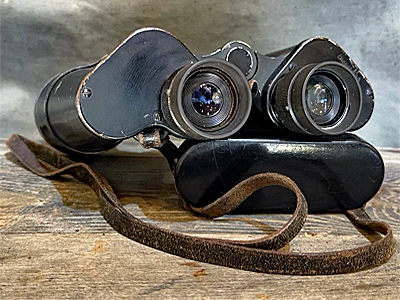


CZ 10×50 1943-02 2188094 blc Albairate, Italy / ZEISS BLC KRIEGSMARINE 7X50 BINOCULARS. GOOD VIEWING AND COLLIJAZION. NEEDS A LITTLE CLEANING IF DESIRED, BUT CAN BE USED AS-IS.
Lenses show some signs of use; the rubbers were probably subjected to maintenance and are therefore not original.
DUE TO THEIR AGE, NO WARRANTY IS INCLUDED. NO RETURNS. SOLD AS NON-WORKING OR SPARE PARTS.
Doppelfernrohr 7×50 manufactured by BLC (Carl Zeiss) in 1943 and intended for the Beobachter (observers) of the Kriegsmarine.
It features special removable rubber eyepieces called “Gas Mask Eyepieces” (very rare to find intact and original), which allow the eyes to rest completely on the eyepieces and ensure the constant distance needed to view the entire image. In fact, if we don’t remove the Gas Mask eyepieces and try to rest our eyes on the rubber eyepieces, the same thing happens as looking through a sniper scope: if we don’t maintain the exact distance and centering on the lenses, we won’t be able to observe the framed image in a “perfect circle.”
The term “Gas Mask” was given to this version of “eyepieces” precisely because of the total isolation to which the eye is subjected. Indeed, just like a gas mask, once worn, one is completely isolated from external factors. In the specific case of these eyepieces, the observer was guaranteed a longer view over time, as they were free from the bothersome effects of dust, and especially wind and water, factors that forced the observer to lose continuity of observation due to frequent blinking. In the case of a Marine Artilleriezeugamt (Marine Artillery Control Center) station, this was essential in one way or another.
The 7×50 Gas Mask Binoculars have slightly convex lenses and a larger diameter than standard 7×50 binoculars, allowing for a wider field of view. The larger lenses allow more light to reach the observer’s eyes, resulting in a brighter and more defined view.
The lenses are coated with a blue anti-reflective coating (fully coated) called “Transparenzbelag” (this system was developed and patented on November 1, 1935, by Aleksander Smakula, a member of the Zeiss team in Jena since 1934).
The view is extremely bright thanks to the crystal-clear lenses, and every mechanism functions flawlessly.
———————-
WWII WW2 German Navy Kriegsmarine U-boat Commander Binoculars Zeiss blc 8×60 2161722 / CZ 8×60\CZ 8×60 1942-08 2161722 blc
Up for sale is a pair of WWII era German Navy Kriegsmarine U-boat Commander’s 8×60 ‘Slim’ (or sometimes called ‘Tall’) binoculars made by Carl Zeiss Jena (war time manufacturer code ‘blc’ (1941-1944)).
Towards the end of WWI, a type of wide-angle (9.1 degrees) binoculars with a Porro II prism system and a specification of 8×60 was developed for the first time at the Zeiss factory. These high-performance binoculars feature wide-angle eyepieces with an impressive field of view and unsurpassed optical performance. They were manufactured in several variants until the end of World War II for the navy and air defense.
According to Dr. Stephen Rohan’s book ‘A Guide to Handheld Military Binoculars 1894-1945’ (published by Optical Press in 2001), ‘This model was put into production succeeding the 8×60 HT model (H: field lens cemented to prism; T: transparent anti-reflective coating) because the anti-reflective coating was so successful the extra cost and labor time of the H system was not needed. The image quality of this glass is still to this day unsurpassed by other handheld binoculars.’ The eyepieces have aspheric lenses to achieve the wide field of view. This model is the latest war time 8×60 slim model made by Zeiss and features two screw-in desiccator cartridges in the prism chambers.
Regarding this specific pair of binoculars for sale, according to the Zeiss production serial numbers list in Dr. Hans Seeger’s ‘gray’ book 4th edition, this pair was one of a small batch of 300 pairs Kriegsmarine ordered in June 1941.
Although the prior service/maintenance history is unknown, optically this pair is in excellent condition. There’re minor grease spots and specks on the prisms and lenses, and inside the binoculars body, but no chips or major scratches on prisms or lenses. Images are in general clear, crispy, and bright. Collimation is very good. The left side does appear a bit dirtier than the right side and the left side objective lens does show minor separation of cementing elements (snowflakes, as shown in the attached pictures), which in my opinion does not affect imaging and can be fixed rather easily and cheaply by a professional (lens re-cementing). Mechanically, this pair is also in very good condition. The center hinge is tight but not stiff. The two individual focusers are quite stiff. However, (1) they actually work properly; (2) the design of the eyepiece in this model makes the ‘stiff’ feeling normal, because the metal ocular tube directly and tightly contacts and pushes against the rubber O-ring inside the eyepiece when the focuser rotates to achieve waterproofing. I consider this stiffness as a design-caused feature. Cosmetically, this pair does show signs of normal use, but nothing abnormal considering this pair is over 80 years old. Cosmetic defects include: (1) some loss of exterior special texture paint finish; (2) some loss of black smooth paint on metal parts; (3) minor paint touch-up (? Not sure) on left side prism chamber cover plate; (4) the center hinge rear end cap is missing. I do not know if this pair originally had a regular end cap disc or a Benutzer cord retainer system (according to historic photos, not all 8×60 slim have the Benutzer cord retainer system), but the repro can be easily found online. Overall, a very rare and highly collectible example to any serious military handheld binoculars collectors.