
Bolshevik State Plant No. 232
• Государственный завод № 232 «Большевик»
• Gosudarstvennyy zavod № 232 «Bol’shevik»
Saint Petersburg, Russia (Санкт-Петербург, Россия) 1922-1992
In the Russian armed forces, military service binoculars are marked to identify them as government property.
Military service binoculars are issued to soldiers with specialized functions. For example, a group leader or an artillery observer was issued a set of binoculars to perform his duties.
The most common type of Russian military service binoculars used during the period of the State Optics Factory (GOZ) in Russia (1921-1930), began with the 6×30 Model AK military service binoculars. Starting in 1928, production switched to a new 6×30 Model Type G, that in 1930, was slightly updated and renamed the 6×30 Model B-1.
In 1930, the factory received a new name, which later became world-famous, State Optical-Mechanical Factory No. 349 (GOMZ), Государственный оптико-механический завод №349 (ГОМЗ), Gosudarstvennyi Optiko-Mekhanicheskii Zavod №349 (ГОМЗ).
The number “6” identifies the magnification power of the binoculars. In this case, “6” indicates that objects appear six times closer than their actual distance.
The number “30” identifies the diameter in millimeters of the front (objective) lenses — the light gathering lenses — in this case 30 millimeters in diameter.
Bolshevik State Plant No. 232
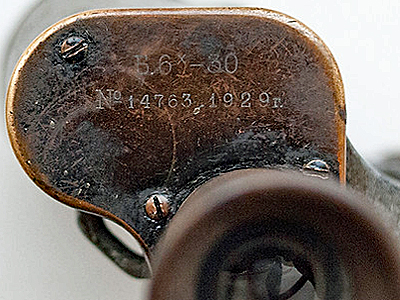
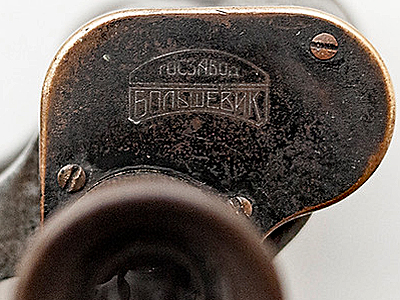
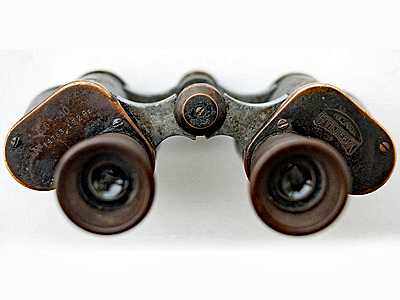
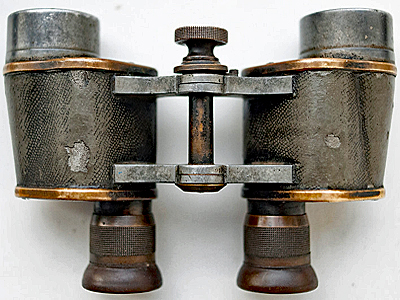
6×30 early pattern, 1929, №14763, Saint Petersburg, Russia
|
|
Soviet Russian 6×30 military service binoculars, production serial number, №14763, heavy, made of brass, early pattern body covering, manufactured in 1929 by the Bolshevik State Plant No. 232 (Государственный завод № 232 «Большевик», Gosudarstvennyy zavod № 232 «Bol’shevik»), Saint Petersburg, Russia. These Soviet Russian military service binoculars are marked with white characters stamped on the left prism cover with Б.6x-30 (Б. is the abbreviation of Бинокль, Binoculars), over № 14763 1929г. (г. is the abbreviation of год, the year, of manufacture). The right prism cover is marked with white characters stamped ГОСЗАВОД, GOSZAVOD (STATE PLANT), over БОЛЬШЕВИК, BOL’SHEVIK (BOLSHEVIK), all within a trademark logo similar to the Carl Zeiss trademark logo. |
“Bolshevik” optical factory, Leningrad (prior to 1930)
Optical-mechanical factory, Leningrad (1930-1935)
The “Bolshevik” factory in St. Petersburg was the first factory in the Russian Empire, that was not a branch of a foreign optical manufacturer, that started the production of binoculars. The first binoculars were manufactured in 1905.
The Obukhov factory was renamed the “Bolshevik” factory in 1922. The first binoculars were manufactured there in 1925.
The “Bolshevik” factory tracks its history to the Obukhov factory (in St. Petersburg), which was the first factory in the Russian Empire (that was not a branch of a foreign manufacturer) which started the production of binoculars. The first binoculars were manufactured in 1905. In 1922 the Obukhov factory was renamed the “Bolshevik” factory, first post revolution binoculars were manufactured there in 1925.
In 1930 the optics manufacturing facilities from the Bolshevik factory were moved to the Leningrad Optical-mechanical factory (LOMZ), which continued binoculars production until 1935. LOMZ mainly produced the 6×30 model (different from later B-6 model), and 8×40, 7×50, 4×50 models in much lower quantities.
LOMZ also produced the so called “civil” binoculars that did not have a range-finding graticue, they were marked without the use of a hammer and sickle.
Both of “Bolshevik” and LOMZ 6×30 binoculars had specific construction of the objectives with easily detachable caps, which allowed for the collimating of binoculars in the field. This design was used in the earlier Obukhov factory imperial period binoculars.
The Bolshevik State Plant No. 232, located in St. Petersburg, Russia, was originally known as the Obukhov State Plant and played a significant role in the production of binoculars during the Soviet era. The factory’s history in binocular manufacturing dates back to 1905, when it became the first factory in the Russian Empire to produce binoculars independently of foreign manufacturers. In 1925, the factory began producing post-revolution binoculars after being renamed Bolshevik in 1922.
In 1930, the optics manufacturing facilities were moved to the Leningrad Optical-mechanical Factory (LOMZ), which continued binocular production until 1935. LOMZ produced various models, including the 6×30, 8×40, 7×50, and 4×50 models.
The Bolshevik factory, which was the main manufacturer during the prewar period, produced all binocular models except for the 4×45 and also produced PE sniper scopes. The B-6 6×30 modification was created based on the model produced by this factory since 1931.
During World War II, the factory was evacuated to Novosibirsk and stopped production of 6×30 and 8×30 binoculars until 1945, when it resumed production of the 7×50 model.
Today, Soviet binoculars are known for their durability and robust construction, making them popular among collectors and enthusiasts.
The Obukhov State Plant
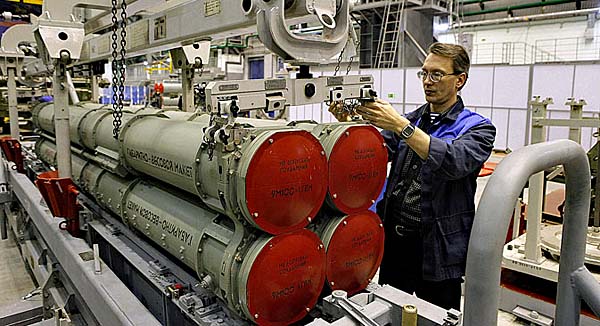
Located in present-day St. Petersburg, the Obukhov State Plant was one of the first and most successful major Russian enterprises founded with private capital. From top-of-the range 19th century naval guns to modern surface-to-air missile systems, the factory has produced world-class defense equipment since 1863, not even halting production for a day during the Siege of Leningrad in the Second World War.
In the second half of the 19th century, Russia entered the era of modernization with only a handful of factories, all of them state-owned. However, the government could not ensure the rate of growth of industrial production required to drive on the economy and ensure the fighting capacity of Russia’s army.
So when in 1863 metallurgists Nikolai Putilov and Pavel Obukhov came to the Navy Department with a proposal to create a plant near St. Petersburg that would supply the fleet with rifled artillery guns, the initiative was enthusiastically received.
Putilov invested his own capital in the project and Obukhov contributed the patent for the unique cast steel he had invented while working at the Zlatoust arms factory in the Urals.
The two men set themselves the ambitious goals of establishing a full production cycle from scratch and delivering one million rubles’ worth of weapons to the government in five years. Work began almost immediately in the marshland by the city to create one of the largest factories in the country. The planners thought well ahead in terms of the skilled workers that would be needed for the plant, and gave steel industry training to peasants from the outlying villages.
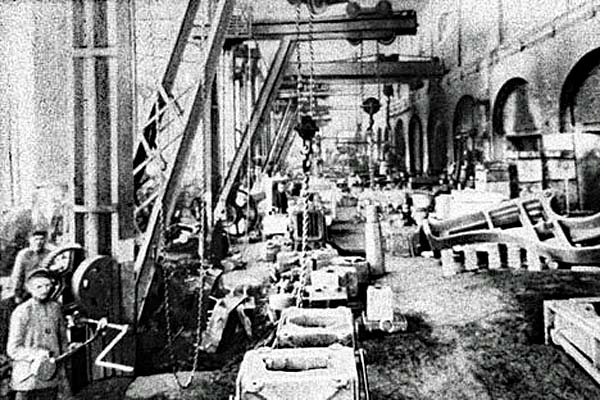
Soon named the Obukhov plant after one of its two founders, the company turned out its first products a year later. But since the costs proved to be higher than expected, the private owners had to turn to the Russian state for assistance. After receiving a powerful financial boost, the Obukhov plant had by the start of the 1870s attained parity with the world’s largest manufacturers of artillery weapons.
Bringing science to steel production
It was in St. Petersburg that a serious scientific approach was first taken to Russian steel production. To this end, the Obukhov management brought on board one of the greatest steelmakers of his time, Dmitry Chernov. Under his leadership the steel production process was tied to a clear formula, which in turn enabled breakthrough innovations such as the installation of open-hearth furnaces.
By 1872, the plant was already manufacturing the first Russian 305-mm heavy naval guns, production of which had previously been monopolized by the German company Krupp. In the 1880s, the plant also mastered the manufacture of a new kind of weapon, the torpedo.
Other innovations included engines for the first aircraft prototypes in the world, built by Alexander Mozhaisky, armored plates for warships, artillery shells, rifle scopes, binoculars and a wide range of civilian products.
The government gave constant recognition to the Obukhov plant for its outstanding work and granted it, together with a few other select companies, the right to place the imperial double-headed eagle on its products. In 1886, it was accorded “strategic” status and in 1886 was nationalized by the state.
In 1908, Tsar Nicholas II gave instructions for the plant to receive its own flag, and its products went on to win consistent acclaim at exhibitions in Paris, Philadelphia and Vienna, despite stiff competition from global armament giants like Krupp, France’s Creusot, and Britain’s Armstrong. The Obukhov plant was unrivaled on the Russian market, however, and in 1913 more than half of the imperial army’s land guns and more than 90 percent of Russia’s naval guns bore the Obukhov stamp.
New beginnings
In 1922, the enterprise was given a new name and a new mission in the Soviet era. The “Bolshevik” plant in Petrograd (later renamed Leningrad) built tractors, aircraft engines, railway carriages and drive shafts for hydroelectric power stations.
In the 1920s, the plant produced a new weapon for the Russian armed forces – the tank, the first Soviet tank being the T-18. The plant’s weapons engineers were combined into a separate design bureau.
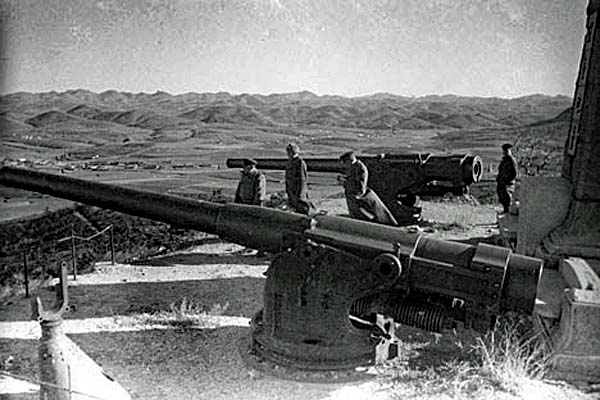
Obukhov guns massively increased the power of the Soviet army on the eve of the Second World War. Between 1941 and 1945, the plant in Leningrad did not stop production for a single day, even during the 872-day siege of Leningrad by Nazi forces. Its production lines also turned out thousands of shells and mines, while the plant workers built an additional 30 artillery batteries on railway platforms.
After the war, the industrial complex grew ever bigger and by mid-1987 employed more than 17,000 people in the development and production of a wide range of products for the navy, nuclear missile forces, and military space forces that depended on the missile industry.
The 1991 collapse of the Soviet Union and the crisis of that decade dealt a major blow to production at the plant, causing output to plummet almost 30 times over.
The turnaround came at the start of the 21st century with a decree signed in 2002 by Russian President Vladimir Putin, which added the plant to the Almaz-Antey air-defense concern.
Today the main products of the Obukhov plant are surface-to-air (SAM) missile systems, including the S-300, S-400, and S-500 systems.
Obukhov State Plant
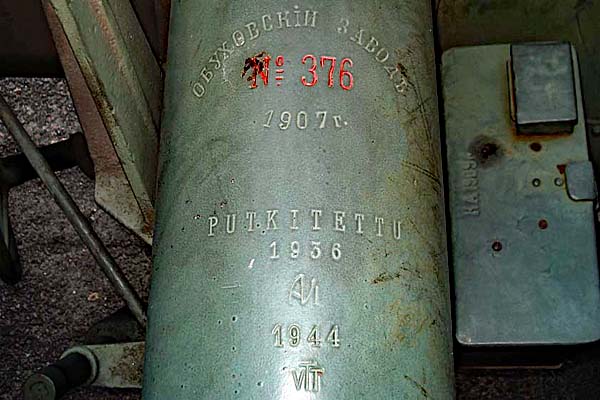
The Obukhov State Plant (also known as the Obukhovski Plant, (Государственный Обуховский Завод, Gosudarstvennyy Obukhovskiy Zavod) is a major Russian metallurgy and heavy machine-building plant in Saint Petersburg, Russia.
The Obukhov State Plant was founded in 1863 to produce naval artillery for the Russian Navy. The naval guns built by Obukhov were modeled on German designs of the Krupp Steel Works (Friedrich Krupp AG Hoesch-Krupp, formerly Friedrich Krupp AG and Friedrich Krupp GmbH).
Krupp was Germany’s premier weapons manufacturer during both world wars, and the largest company in Europe at the beginning of the 20th century.
Krupp produced battleships, submarines, tanks, howitzers, guns, utilities, and hundreds of other weapons and heavy equipment, including steel used to build railroads in the United States.
From 1922 to 1992, the Obukhov State Plant was named Bolshevik Plant No. 232.
In the late 1920s, the Obukhov State Plant became one of the two main Soviet tank factories, along with the Kharkov Locomotive Factory.
The Obukhov State Plant produced the first indigenous tank, the T-18. The company later became home to the AVO-5 tank design bureau, soon renamed OKMO, which was responsible for the T-26 infantry tank.
OKMO (Opytniy Konstruktorsko-Mekhanicheskiy Otdel, ‘Experimental Design Mechanical Department’) was the tank design team in the Soviet Union during the early 1930s. Located in Leningrad, it produced the design of the T-26 infantry tank, of which about 12,000 would be produced.
Most other designs from the bureau never saw the light of day, but it was here that Mikhail Koshkin, designer of the famous T-34 medium tank, gained his early experience. The bureau was gutted in the Great Purge and broken up by the beginning of the Second World War.
In 1930, the Bolshevik Factory No. 232 became home to the AVO-5 tank design bureau, soon renamed OKMO. In 1932, the tank department of the Bolshevik factory, became the new Factory No. 174 (K.E. Voroshilov). This new, independent enterprise was dedicated to the mass production of the T-26 tank.
In 1932, one of the former departments of the Bolshevik factory became a base for the new independent entity, named in 1935 as Factory No. 185 (S.M. Kirov), under the direction of N. Barykov and Semyon Alexandrovich Ginzburg.
The OKMO, for a few months a part of Factory No. 174, moved at the same time to Factory No. 185. The new enterprise was also dedicated to the production of tanks, while the main part of Bolshevik Factory remained focused on production of heavy artillery. Because of the same name and the same city of location, the Factory No. 185 is often mistaken in Western sources with Kirov Plant (or Factory No. 100), notably in Sewell’s “Why Three Tanks?” and works of Steven Zaloga.
They were independent factories. The Factory No. 185 was a home of OKMO bureau (Ginzburg), while the larger Factory No. 100 was a home of SKB-2 (Kotin, known for KV line of heavy tanks). In 1941, because of German threat, parts of both factories were moved to Chelyabinsk, where the large complex was given the name Chelyabinsk Kirov Plant No. 100 (unofficially Tankograd), and continued the production of Kotin’s designs.
In 1930, bureau oversaw design changes to the British Vickers E tank for construction as the T-26 light infantry tank, and later improvements to the T-26.
In 1930 OKMO also began design studies for heavy tanks. A team led by German engineer Eduard Grote worked on a 100-ton design with 107 mm gun, four sub-turrets, and pneumatic suspension and servo-controls, called the T-41 or TG-5. A slightly more practical “land battleship” was the T-35 heavy tank, designed by N. Tseits’s team and inspired by the British Vickers Independent.
In 1934, OKMO designed the T-43-2, a design for an amphibious tank with convertible drive—being able to run on tracks or wheels—as a possible replacement for the T-37 amphibious scout tank. It, and Moscow Factory no. 37’s competing T-43-1 were both rejected in favour of continuing T-37 production.
Also in 1934, N. Barykov and N. Tseits worked with graduate students from the Leningrad Technical Institute to modernize the multi-turreted T-28 medium tank by adding a Christie suspension. The resulting T-29-5 adopted the wheel-and-track running gear from the BT fast tank. Further T-29-4 and T-29-1 prototypes were built in 1935, but in testing at the NIIBT in Kubinka none of these were found satisfactory.
Following Soviet armored experience in Spain, another version was built with thicker armour and a better gun—it was considered for the A-20/T-32 competition which led to the famous T-34 medium tank, but by this time was obviously outdated. One of the Leningrad engineering students had been Mikhail Koshkin, the T-34’s chief designer.
In the 1930s, OKMO also designed a number of self-propelled artillery and antiaircraft guns, and tracked infantry, ammunition and fuel transporters, but only prototypes or trial batches of any were ever built, except for the T-26-T artillery tractor.
In 1936–37, OKMO designed the T-111 (or T-46-5), the first attempt at a Soviet tank with “shell-proof” armor, effective against more than just small arms. The engine and gun were inadequate, and only a prototype was built.
The T-100 ‘Sotka’ was a two-turreted heavy tank prototype. It became rejected in favour of the KV-1 heavy tank. A second prototype was made as a single self-propelled gun T-100Y, later designated SU-100Y, presently displayed in Kubinka Tank Museum. The bureau started work on the T-50 infantry tank in 1939, but was gutted during the Great Purge. The T-50 was handed over to the Factory No. 174.
In 1932, the tank department of Bolshevik Plant No. 232 became a new Factory, No. 174 (K. E. Voroshilov). This new, independent enterprise was dedicated to the production of the T-26 tank.
One of the former departments of the Bolshevik Factory became a base for the new independent “Factory No. 185 (S.M. Kirov).” The OKMO, for a few months a part of Factory No. 174, moved at the same time to Factory No. 185. The new enterprise was also dedicated to the production of tanks, and because of it’s name is often confused with Kirov Factory.
The main part of the Bolshevik Factory remained focused on production of heavy artillery. On the other hand, Zaloga says that in 1935, after the assassination of Sergey Kirov, the whole Bolshevik Factory No. 232 was renamed “Factory No. 185 (S.M. Kirov)”, yet Leningrad inhabitants continued to refer to it as the Bolshevik Factory.
The Leningrad factory’s historical name was restored in 1992 by the formation of a unitary enterprise, FSUE Obukhov State Plant. In 2002 it became part of the Almaz-Antey military industrial concern, and in 2003, it became a joint-stock company, OJSC GOZ Obukhov Plant.