

German Empire contract, 1903-1918
OIGEE (Optische Anstalt Optikal Industrie-G.M.B.H.), Berlin-Schöneberg
In the armed forces of the German Empire, military service binoculars were marked to identify them as government military property.
Military service binoculars were issued to soldiers with specialized functions. For example, group leaders and artillery observers were issued military service binoculars to perform their duties.
The most common type of service glass used by the armed forces of the German Empire prior to and during the First World War was the 6×24 D.F. 03 and D.F. 6x military service binocular.
The number “6” identifies the magnification power (in this case, “6” indicates that objects appear six times closer than their actual distance).
The number “24” identifies the diameter in millimeters of the front (objective) lenses — the light gathering lenses — in this case 24 millimeters in diameter.
This is a selection of 6×24 D.F. 03, D.F. 6x, and D.F. 6×24 military service binoculars, listed in serial number sequence, as manufactured by the Carl Zeiss optical company of Jena, Thuringia for the armed forces of Germany from 1903 to 1918, observed in collections and recorded from sources online.
6x D.F. 03, OIGEE, Berlin-Schöenberg
OIGEE, Berlin-Schöenberg, German Empire contract
6× D.F. 03, 1914-1915, 57386, Nr. 9312, Berlin-Schöenberg, Germany
|
|
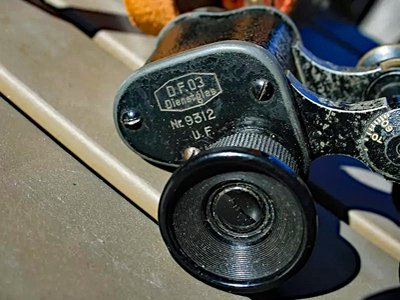
German 6×24 D.F. 03 Dienstglas military service binoculars, production serial number, 57386, heavy construction, made of brass, black “Vulkanite” schwarzes Kunstleder (black synthetic leather) Körperbedeckung (body covering), brass fittings, manufactured in 1914-1915 by Oigee (Optische Anstalt Optikal Industrie-G.M.B.H., Berlin-Schöneberg). Left prism cover marked in white with “D.F. 03” (“Dopplefernrohr 03″ – Binoculars 03), over “Dienstglas” (Service glass), over “Nr. 9312” (German armed forces property number), over “U.F” (“Unteroffizier Fernglas” – Non-commissioned officer, Sergeant, Service glass). Right prism cover marked in white with “OIGEE” (Optische Anstalt Optikal Industrie-G.M.B.H.) / “BERLIN” (Berlin-Schöneberg), over / “Vergr. 6x” (Magnification power 6x), over “D.R.P.” (Deutsches Reich Patent – German Empire Patent). Front face of left front bridge cross member marked in white with “57386″ (production serial number). |
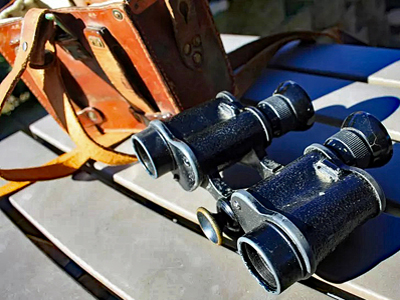
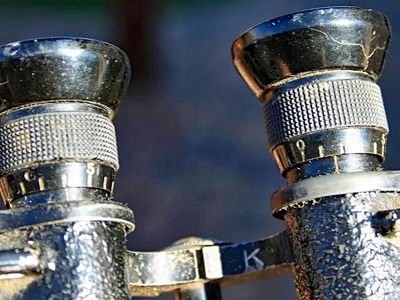
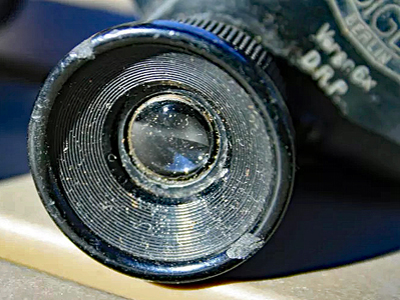
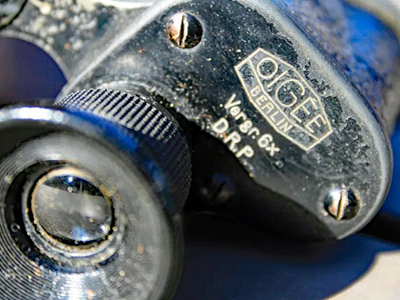
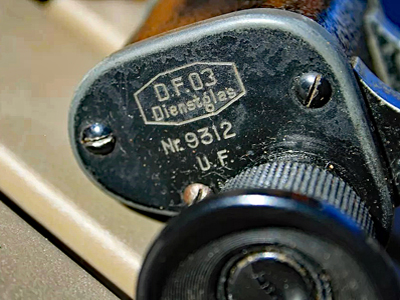
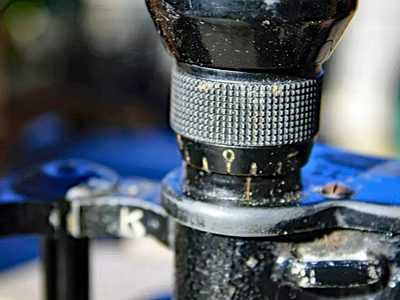
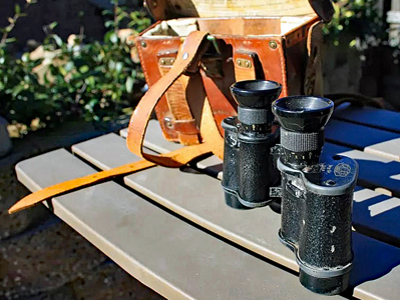
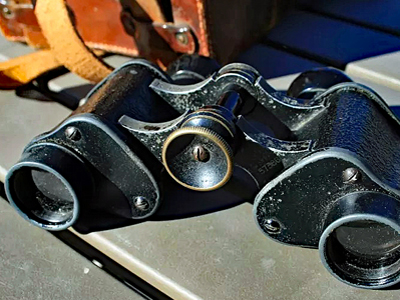
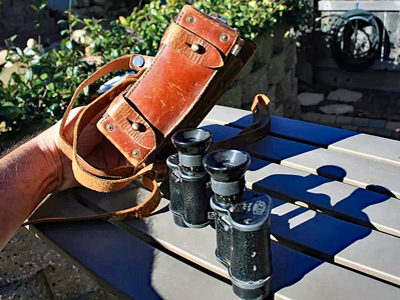
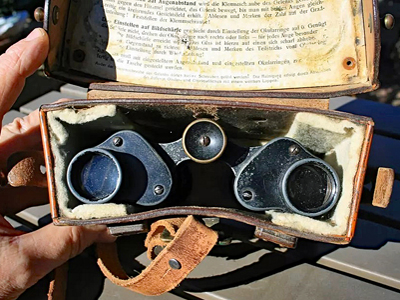
This D.F. 03 (“Doppelfernrohr 03″ – Binoculars 03) “Dienstglas” (Service glass) was manufactured by “OIGEE” (Optische Anstalt Optikal Industrie-G.M.B.H.) of “BERLIN” (Berlin-Schöneberg), in the early years, 1914-1915, of the First World War.
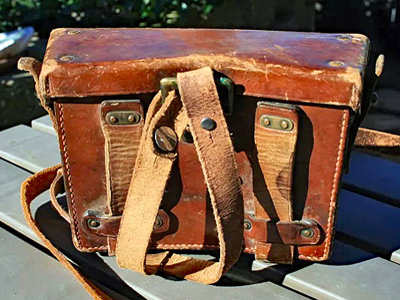
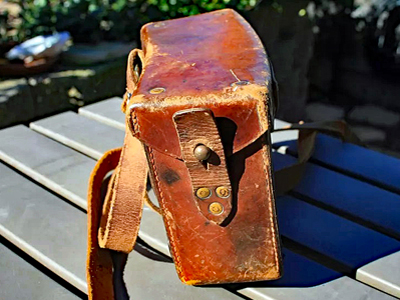
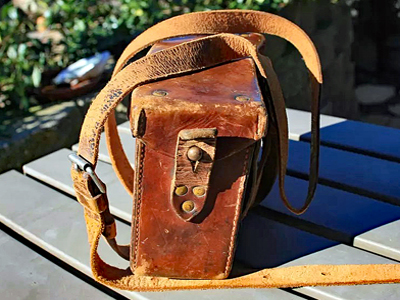
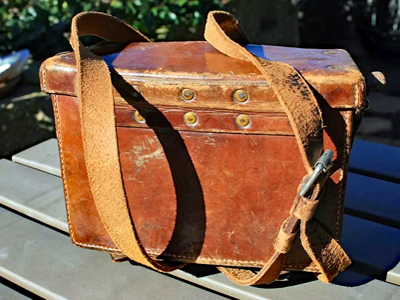
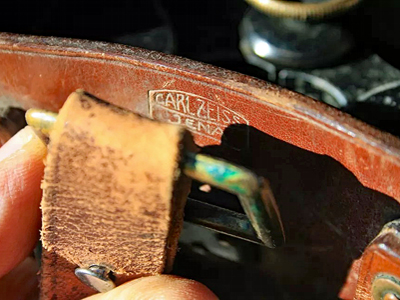
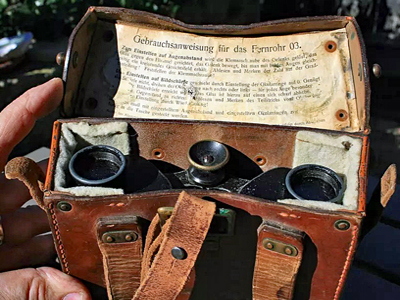
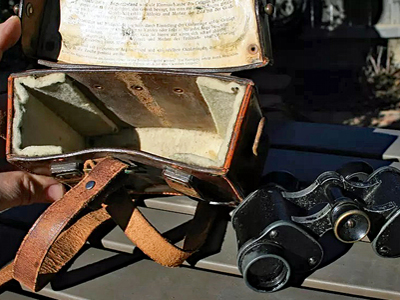
This D.F. 03 6x (6×24) Dienstglas is accompanied by its original Pattern 03 curved brown leather case bearing the “CARL ZEISS” / “JENA” logo stamped into the leather case behind the brass connection clip for the brown leather carrying strap.
Another type of military binoculars used by Imperial Germany during the First World War was the Galilean Model 08 Dienstglas, also known as the Fernglas 08.
The Galilean optical design of the Model 08 Dienstglas used inline lenses instead of angled prism lenses, making the Model 08 lighter and more compact. The angled prism optical design of the Model 03 Dienstglas provided a much wider field of view.
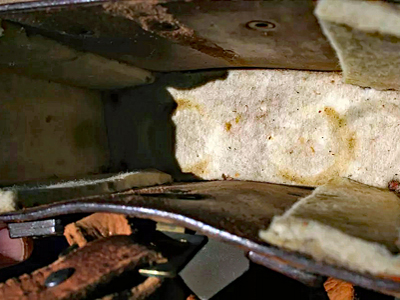
Model 03 brown leather cases were curved. Model 08 brown leather cases were square. Model 03 and 08 cases had printed paper instructions riveted inside the lid explaining the use and maintenance of the field glasses.
Toward the end of the war, shortages of leather forced manufacturers to use substitute materials such as fabric and compressed cardboard.
The left prism cover of this D.F. 03 6x Dienstglas is marked with the designation “D.F. 03” (“Doppelfernrohr 03″ – Binoculars 03) over “Dienstglas” (Service glass) over “Nr. 9312” over “U.F.” (“Unteroffizier Fernglas” – Non-commissioned officer, Sergeant, Service glass).
The number “Nr. 9312″ is the German armed forces property number of this particular Dienstglas when it was manufactured at the Oigee factory in Berlin sometime in 1914-1915.
The production serial number “57386″ is marked on the forward face of the left front bridge cross member.
The right prism cover is marked with the name of the manufacturer “OIGEE” (Optische Anstalt Optikal Industrie-G.M.B.H.) over “BERLIN” (Berlin-Schöneberg) over “Vergr. 6x” (Magnification power 6x) over “D.R.P.” (Deutsches Reich Patent – German Empire Patent). The term “G.M.B.H.” means Gesellschaft mit beschränkter Haftung (Company with limited Liability).
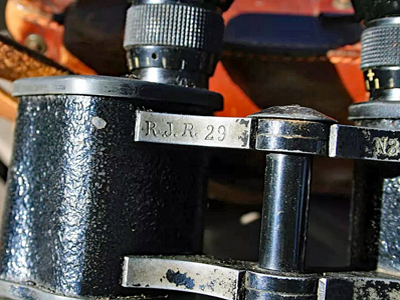
The designation “R.J.R. 29” is stamped on top of the right rear bridge cross member, indicating that the binoculars were the property of “Rheinisches Jager Regiment 29” (Infanterie-Regiment von Horn (3. Rheinisches) Nr. 29).
The German 29th Infantry Regiment was part of the 31st Infantry Brigade (31. Infanterie-Brigade) of the 16th Division (16. Division).
The men of the 16th Division were mainly recruited in the densely populated Prussian Rhein Province, mainly from the cities and towns along the Rhine and Moselle Rivers.
After the First World War, the 16th Division was disbanded during the demobilization of the German Army in 1919.
In the opening months of the First World War, the division marched through Luxembourg, Belgium and France in 1914, in what became known to the Allies as the Great Retreat, culminating in the First Battle of the Marne.
In 1916, the 16th Division fought in the Battle of the Somme. The division was briefly sent to the Eastern Front in late 1916, where it saw action in 1917 in the Battle of Passchendaele, also known as the Third Battle of Ypres.
The division participated in the 1918 German spring offensive, including the Battle of the Lys, and defended against the Allied counteroffensives, including the Second Battle of the Somme.
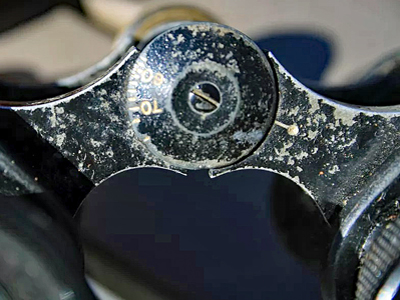
The designation “9.K N.3” is stamped on top of the left rear bridge cross member, indicating that the binoculars were the property of “9. Kompanie Nachrichtengruppe 3” (9th Company, Signals / Communications / Intelligence Group 3).
• During the First World War, Nachrichtengruppe 3 of the 9. Kompanie was responsible for military communications using heavy wooden box radiotelephones to transmit voice signals over hard wire landlines.
• Soldiers Nachrichtengruppe 3 of the 9. Kompanie were also employed as signal dispatch runners to carry plain text or encoded written messages on the battlefield.
• Nachrichtengruppe 3 of the 9. Kompanie was also responsible for conducting combat patrols to gather and provide intelligence information about enemy forces to command and control staff for strategic purposes.
Gefreiter (Corporal) Adolph Hitler served as a signal dispatch runner on the Western Front in Belgium and France during the First World War.
At the outbreak of the war in August 1914, Hitler was living in Munich and voluntarily enlisted in the Bavarian Army, serving in the Königliche Bayerisches Reserve-Infanterie-Regiment List Nr. 16 (Royal Bavarian Reserve Infantry Regiment List Nr. 16 (1. Kompanie, List Nr. 16).
The Bavarian 16th Reserve Infantry Regiment was part of the 12th Bavarian Reserve Infantry Brigade (12. Bayerische Reserve-Infanterie-Brigade) of the 6th Bavarian Reserve Division (6. Bayerische Reserve-Division).
Since the 6th was a reserve division, it consisted mainly of reservists recalled to active duty and volunteers from cities such as Munich, Ingolstadt, Passau, Straubing, Landshut, Rosenheim, Freising, and Dachau.
The 16th Bavarian Reserve Infantry Regiment entered the war on October 30, 1914 when it fought in the First Battle of Ypres.
The fighting at Ypres initiated the “race to the sea” in which 440 miles of labyrinthine trenches and fortifications were dug deep into the ground along the Western Front from Switzerland to the North Sea.
The Western Front then became a meat grinding, killing ground, bloody stalemate for the next four years.
Corporal Adolph Hitler was assigned to the 1st Company of the 16th as a signal dispatch runner, responsible for carrying plain text or encoded written messages on the battlefield.
From 1914 to 1916, the 16th fought in numerous actions in Flanders, including the Battle of Fromelles in July 1916. Hitler was decorated for bravery, receiving the Iron Cross, Second Class.
During the Battle of the Somme in October 1916, Adolph Hitler was wounded in the left thigh when a shell exploded in the dispatch signal runners’ dugout. Hitler left the hospital and returned to his regiment on March 5, 1917.
In April and May 1917, the 16th fought in the Battle of Arras. In July and August 1917, the 16th fought in the Battle of Passchendaele. The regiment was then transferred to Upper Alsace for rest. From there, it was sent to the Chemin des Dames region.
In 1918, the 16th participated in the German spring and summer offensives and counteroffensives. The 16th fought against French and American troops on the Arras and Champagne-Marne rivers.
Hitler was awarded the Black Wound Badge on May 18, 1918.
In August 1918, the 16th returned to Flanders. That month, on the recommendation of Lieutenant Hugo Gutmant, his Jewish superior officer, Adolph Hitler received the Iron Cross, First Class, a decoration rarely awarded to a soldier of Corporal Hitler’s rank.
On October 15, 1918, Adolph Hitler was temporarily blinded in a mustard gas attack and was hospitalized.
A month later, the armistice was declared, ending the war on November 11, 1918.