
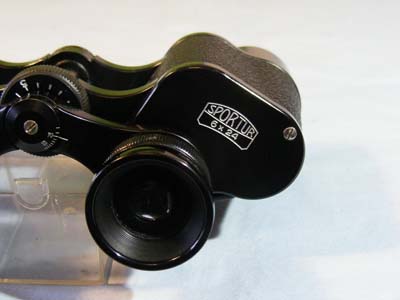
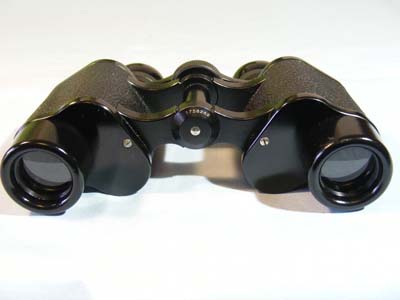
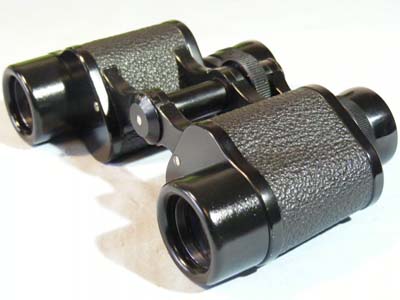
6×24 “Sportur” (1936-1943) |
|||||
| S/N | Identifying Features | Year of Mfg |
|||
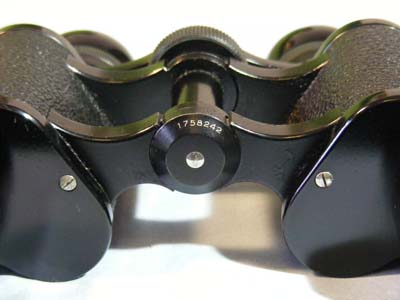
| 1758242 |
|
CZ : 1758242 mfg. about Oct 1936
|
|||
|
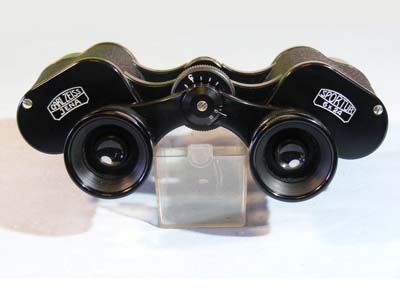
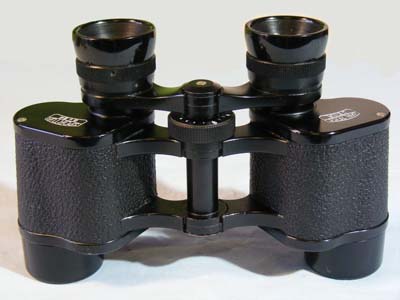
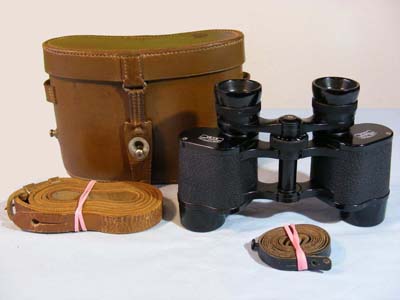
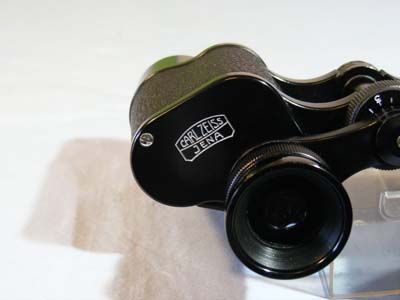
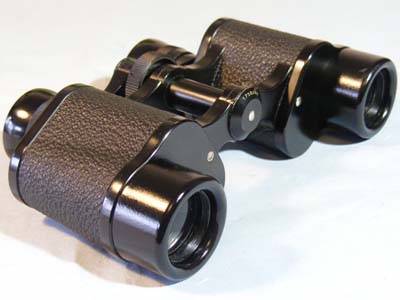
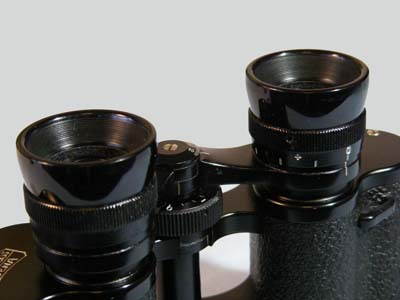
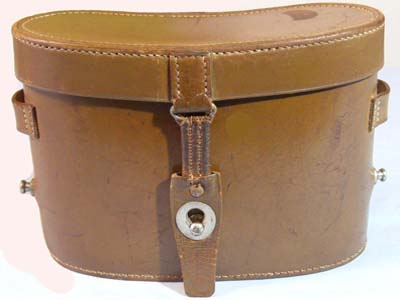
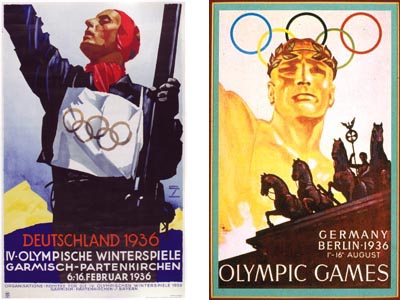
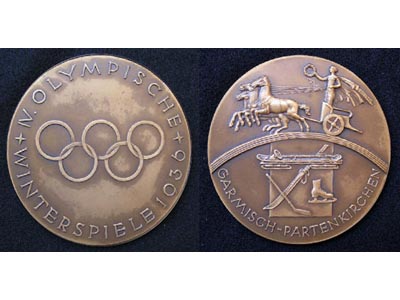
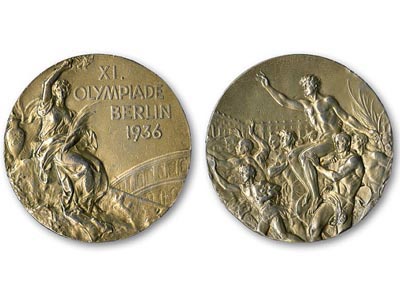
The 6×24 “Sportur” was launched by Carl Zeiss / Jena in 1936, the year of the IV Winter Olympic Games (IV Olympische Winterspiele 1936) in Garmisch-Partenkirchen, Bavaria, Germany (February 6-16, 1936), and the XI Summer Olympic Games (XI Olympische Sommerspiele 1936) in Berlin, Germany (August 1-16, 1936), officially known as the Winter Games of the IV Olympiad and the Summer Games of the XI Olympiad. The 6×24 “Sportur” continued in production until 1943. Its outstanding feature was its very light weight, only 330 grams – 11.64 ounces (avoirdupois),10.61 ounces (troy) – making it the ideal companion for watchers of sporting events, and walkers and hikers to whom it was actively marketed. Key to its light weight was the use of a newly developed alloy of magnesium and aluminum – “Elektron” – which is unusually light, about 36% lighter than aluminum alloy. Magnesium’s relatively low density makes its alloy variants suitable for use in auto racing and aerospace engineering. In 1935, the Carl Zeiss company of Jena, Germany began using metal housings made of Elekton to manufacture binoculars. The 6×24 “Sportur” is not very common these days. This one, serial number 1758242 (October 1936), is still virtually in new condition, with optics, center focus, and right diopter working perfectly. In spite of being more than 80 years old, the paint is in excellent condition, with the lettering still crisp and white. This 6×24 “Sportur” may be one of the better remaining examples outside the Zeiss museum in Jena. It was sold in Britain, and has an English brown leather case. 6 x 24| TELEXEM |120 |1912-1935| 550| SUCCESSOR TO 6×21 TELEXEM, 1936 SPORTUR IS LIGHT WEIGHT METAL VERSION 6 x 24| SPORTUR |150 |1936-1943| 330| LIGHT WEIGHT METAL SUCCESSOR TO TELEXEM |
|||||
Elektron (alloy)
Elektron is the registered trademark of a wide range of magnesium alloys manufactured by the British company, Magnesium Elektron Ltd (MEL, or the Mag).
There are about 100 different alloys in the Elektron range, containing from 0% to 9.5% of some of the following elements in varying proportions: aluminum (Al) (< 9.5%), yttrium (Y) (5.25%), neodymium (Nd) (2.7%), silver (Ag) (2.5%), gadolinium (Gd) (1.3%), zinc (Zn) (0.9%), zirconium (Zr) (0.6%), manganese (Mn) (0.5%) and other rare-earth metals.
Varying amounts of alloying elements (up to 9.5%) added to the magnesium result in changes to mechanical properties such as increased tensile strength, creep resistance, thermal stability, and corrosion resistance. Elektron is unusually light and has a specific gravity of about 1.8 compared with the 2.8 of aluminium alloy. Magnesium’s relatively low density makes its alloy variants suitable for use in auto racing and aerospace engineering applications.
History
Elektron or Elektronmetall was first developed in 1908 by Gustav Pistor and Wilhelm Moschel at the Bitterfeld works of Chemische Fabrik Griesheim-Elektron (CFGE or CFG), whose HQ was in Griesheim am Main, Germany.
The composition of the initial Elektron alloy was approximately Mg 90%, Al 9%, other 1%. At its pavilion at the International Aviation Fair (Internationale Luftschiffahrt-Ausstellung, ILA) in Frankfurt am Main in 1909, CFG exhibited an Adler 75HP engine with a cast magnesium alloy crankcase. Also exhibiting at the 1909 Frankfurt Air Exhibition was August Euler (1868–1957) – owner of German pilot’s licence No. 1 – who manufactured Voisin biplanes under licence in Griesheim am Main. His Voisins with Adler 50 hp engines flew in October 1909.
Chemische Fabrik Griesheim-Elektron (CFGE or CFG) joined the newly created IG Farben as an associate company in 1916. During the allied occupation after World War I, Major Charles J. P. Ball, DSO, MC, of the Royal Horse Artillery was stationed in Germany. He later joined F. A. Hughes and Co. Ltd., which began manufacturing elektron in the UK under licence from IG Farben from around 1923.
CFG merged fully with the IG Farben conglomerate in 1925 along with Versuchsbau Hellmuth Hirth (a copper alloy manufacturer), and another company, Elektronmetall Bad Cannstatt Stuttgart, was formed. In 1935 IG Farben, ICI and F. A. Hughes and Co. (22% shares) founded Magnesium Elektron Ltd. of Clifton, Greater Manchester. The company is still manufacturing alloys today.
Uses
Elektron has been used in aircraft, Zeppelins, and motor racing applications. In 1924, magnesium alloys (AZ; 2,5–3,0% Al; 3,0–4,0% Zn) were used in automobile pistons diecast by Elektronmetall Bad Cannstatt, another IG Farben company formed out of Versuchsbau Hellmuth Hirth.
Siemens-Halske used elektron casings for their Hellschreiber military teleprinter.
Incendiary bombs using elektron were developed towards the end of the World War I by both Germany (the B-1E Elektronbrandbombe or Stabbrandbombe) and the UK. Although neither side used this type of bomb operationally during the conflict, Erich Ludendorff mentions in his memoirs a plan to bomb Paris with a new type of incendiary bomb with the intention of overwhelming the city’s fire services. This planned raid was also reported in the Paris newspaper, Le Figaro, on December 12, 1918. The lightness of elektron meant that a large aircraft like the Zeppelin-Staaken R-type bomber could carry hundreds of bomblets.
The British and German incendiary bombs, used extensively during World War II, weighed about 1 kg, and consisted of an outer casing made of elektron alloy, filled with thermite pellets, and fitted with a fuse. The fuse ignited the thermite, which in turn ignited the magnesium casing that burned with intense heat for about 15 minutes. Trying to extinguish the fire with water actually intensified the fire. The burning magnesium bomb casing could not be extinguished, and burned at such a high temperature that it could penetrate armor plate.
The metal called “Elektron” was first developed in 1908 by Gustav Pistor and Wilhelm Moschel at the Bitterfeld works of Chemische Fabrik Griesheim-Elektron (CFGE or CFG), whose HQ was in Griesheim am Main, Germany.
Elektron, also known as Elektronmetall, was first mass produced under license in 1935 by the British company, Magnesium Elektron Ltd (MEL, or the Mag), a joint venture formed between Imperial Chemical Industries (ICI), one of the largest chemical companies in Britain (48%), the German conglomerate I.G. Farbenindustrie AG, at one time, the largest chemical and pharmaceutical company in the world (30%), and F.A. Hughes & Co (22%).
In 1936, the company opened a factory northwest of Manchester in Britain to produce magnesium metal. During World War II, the company produced thousands of tons of magnesium metal alloys for the British aircraft industry. During World War II, ICI was involved with the United Kingdom’s nuclear weapons program code named Tube Alloys.
I.G. Farbenindustrie AG become a donor to the Nazi Party in the 1930s, and was a huge government contractor in Nazi Germany. IG Farben produced synthetic dyes, nitrile rubber, polyurethane, Prontosil, and Resochin, among many other products. IG Farbin made the poison gas Zyklon B that was used to murder prisoners at Auschwitz concentration camp.The nerve agent Sarin was first discovered by IG Farben. One product crucial to the operations of the Wehrmacht was synthetic fuel, made from lignite using the coal liquefaction process.
After World War II, I.G. Farbenindustrie AG resumed operations, but in 1951 was split into its four largest original constituent companies, Agfa, BASF, Bayer, and Sanofi, which today remain among largest chemical and pharmaceutical companies in the world.