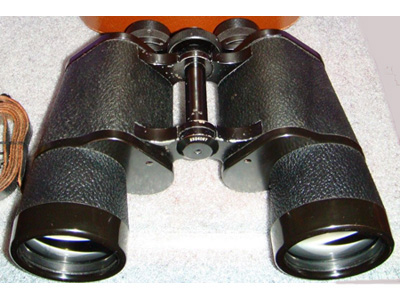
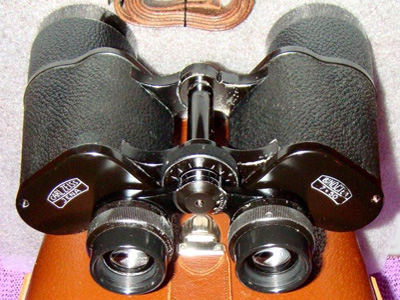
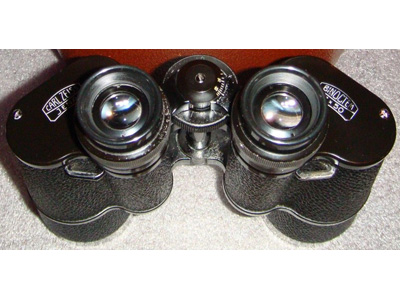
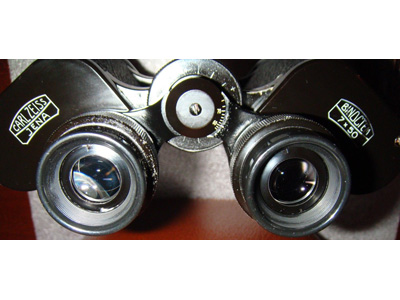
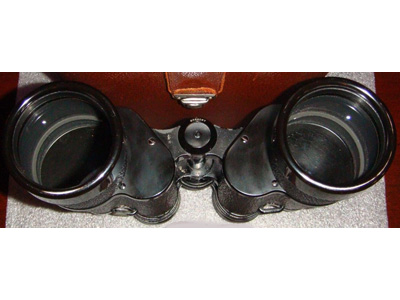
7×50 “Binoctem” (1936-1943) |
|||||
| S/N | Identifying Features | Year of Mfg |
|||
| 2324087 |
|
CZ : 2324087 mfg. about Apr 1945
|
|||
| The 7x 50 Is Born:
By the beginning of the 20th century, glass and prism technologies had improved so much that Zeiss could begin to develop binoculars with larger light gathering lenses for use in low light conditions. A perfect application was making binoculars for use on ships at sea where instruments with higher magnifications were especially desired. Studies by Zeiss demonstrated that the Iris of a typical healthy adult eye, when adapted to darkness, would dilate (open) to about 7mm in diameter. Since a 7 mm Exit Pupil with 7x magnification pointed to 50 mm objectives, Zeiss developed the first 7x50mm binocular and named it “Noctar”. Right: the long and slender profile of the Carl Zeiss Jena Noctar, their first production 7x 50mm binocular. Note the cylindrical Porro I prisms housings. The retractable lens shades (shown extended) help to cut glare and ghosting from off-axis stray light and reduce likelihood of dew or spray build-up on the objectives (front) lenses (image 130,088 bytes). The Noctar was announced simultaneously with a higher-magnification variant, the 10×50 “Dekar”, about 1910 or 1911, with this first model being discontinued about 1919. It is not known whether the Carl Zeiss company in Jena or the Ernst Leitz company in Wetzlar produced the first 7×50. The slender arrangement of these first 50 mm models relied on the patented Abbe (or Abbe-Koenig) prism design, sometimes referred to as Porro I, that was described as early as 1895 by Prof. Dr. Siegfried Czapski. The basic prism design is so sound that it remains in production, being employed in the Zeiss Victory series and other premium binoculars of today. The 50mm aperture became the standard for observing in low light or adverse circumstances. While 7x was about the limit of what most people could hold the binocular with good stability over extended periods of time. For naval applications, the 7×50 is a good balance of magnification, reasonable field of view, and stability on moving platforms like ships and submarines, and today remains the most popular marine binocular. Left: several generations of Carl Zeiss 7×50 Marine binoculars exhibited at Company Seven. Counterclockwise and starting at top right: the tall and slender Carl Zeiss Jena NOCTAR – their first 7×50 introduced in 1911, Carl Zeiss Jena 7×50 BINOCTAR introduced in 1919 and produced through 1990, a Kriegsmarine issue 7x50H introduced in 1938 (this example with AR Coatings captured at sea early in 1941), a Carl Zeiss Jena BLC-marked model designed specifically for U-Boat service produced from 1942 to 1945, a civilian Zeiss West Germany Marine binocular made 1964 to 1972, the latest and greatest Carl Zeiss 7×50 B/GA T* made from 1979 to 2016 with this one having been made in 2016, a sophisticated Carl Zeiss Jena RLN-marked 1944 military issue model (image 148,191 bytes). By 1914, Zeiss had introduced the relatively compact and manageable 7×50 “Binoctar”, which became the standard of marine and low light binoculars. The 7×50 remains the standard for mariners and astronomers. The individual focus Binoctar introduced in 1919, and it’s central focus version the Binoctem, along with some variants (D.F., etc.) would remain in production at Carl Zeiss in Jena and later at the Eisfeld factory of Carl Zeiss Jena of East Germany, with some improvements in materials and design until 1990. Carl Zeiss of West Germany too would introduce their own more compact and robustly constructed 7×50, later culminating in what may be the finest 7x 50 ever made: the individual focus Carl Zeiss 7×50 T∗ B/GA Nautik marine binocular Model 525505. One of our last arriving new example 525505 has been retired to our museum collection exhibit (shown among the group of 7×50 binoculars above at left), and so we exhibit a comprehensive span of Carl Zeiss 7×50 history to date. Pressstoff or Preßstoff is the German term for a type of ersatz or artificial, synthetic leather used during the first half of the 20th century. Made of specially layered and treated paper pulp, Presstoff was durable and easily adapted for use in place of leather, which under wartime conditions was rationed. First invented in the 19th century, it was used in Germany, Switzerland, Norway, Finland, and Russia from about 1900 to 1945, and gained its widest production and use in Germany during World War II. Military uses during World War II included binocular cases, handgun holsters, straps, horse tack, bayonet frogs, equipment belts, cap visors, and many other small items of equipment. Presstoff was a replacement item for almost everything made of leather, except items like footwear that wase constantly subjected to flexing and exposure to moisture, causing Presstoff to disintegrate and fall apart. In 1945, towards the end of World War II, Jena was heavily bombed by American and British bombers, killing 709 people, injuring 2,000, and destroying most of the medieval town center. Jena was the Thuringian city whose level of destruction was exceeded only by Nordhausen, whose destruction was total. Jena was occupied by the American Army on April 13, 1945, and was left to Red Army on July 1, 1945. Jena fell within the Soviet zone of occupation in post-World War II Germany. In 1949, it became part of the new German Democratic Republic (GDR). The Soviets dismantled great parts of the Zeiss and Schott factories in Jena, and took them to the Soviet Union. Carl Zeiss AG, one of the oldest manufacturers of optical systems, industrial measurements and medical devices, was founded in Jena, Germany in 1846. Carl Zeiss, together with Ernst Abbe (joined 1866) and Otto Schott (joined 1884), built one of the most highly regarded optical manufacturing firms in the world. Schott AG developed and manufactured optical glasses for microscopes, telescopes, and binoculars. 7 x 50| BINOCTAR |128 |1919-1971|1160| 1937, 830gm LIGHT WEIGHT METAL VERSION 7 x 50| BINOCTEM |128 |1931-1990|1300| CENTER FOCUS VERSION OF BINOCTAR; 1937, 860gm VERSION |
|||||
 Military and Naval Binoculars