

Optical-Mechanical Factory 297 • Oптико-механический завод 297
Yoshkar-Ola, Siberia (Йошкар-Ола, Сибирь) 1940-1945
In the Russian armed forces, military service binoculars were marked to identify them as government property.
Military service binoculars were issued to soldiers with specialized functions. For example, a group leader or an artillery observer was issued a set of binoculars to perform his duties.
The most common type of military service binoculars was the 6×30 Standardized Model B-6 military service binoculars.
The number “6” identifies the magnification power of the binoculars (in this case, “6” indicates that objects appear six times closer than their actual distance).
The number “30” identifies the diameter in millimeters of the front (objective) lenses — the light gathering lenses — in this case 30 millimeters in diameter.
|
|
Soviet Russian 6×30 Standardized Model B-6 military service binoculars, production serial number, N41048860, heavy, made of brass, manufactured in 1941 by the State Optical-Mechanical Factory (Gosudarstvennyi Optiko-Mekhanicheskii Zavod (ГОМЗ), of Tomsk, Siberia. These Russian military binoculars are marked with white characters stamped on the left prizm cover with 6×30 at the top, followed by the Soviet hammer, sickle, and star insignia, then by the manufacturer’s trademark logo, and finally by the production serial number, N41048860. The first two numbers, 41, indicate year of manufacture. These 6×30 Standardized Model B-6 military binoculars are accompanied by the original brown leather carrying strap. The Kazan Optical-Mechanical Factory (Казанский оптико-механический завод, KOMZ), established in 1940, was a company based in Kazan, Russia. |

This D.F. (“Doppelfernrohr” – “binoculars”) Model 03 (1903) “Dienstglas” (“Service glass”) was manufactured by “OIGEE” (Optische Anstalt Optikal Industrie-G.M.B.H.) of “BERLIN” (Berlin-Schöneberg), in the early years, 1914-1915, of the First World War.
This 6×30 Standardized Model B-6 military binoculars is accompanied by its original brown leather and fabric case bearing the “CARL ZEISS JENA” logo stamped into the leather case behind the brass connection clip for the brown leather carrying strap.
Optical-Mechanical Factory 297 located in Yoshkar-Ola (Йошкар-Ола)
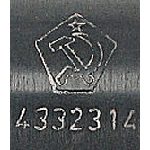
The logo of Optical-Mechanical Factory 297 is the Soviet hammer, sickle, and star coat of arms enclosed within a pentagon.
Examples of the factory’s production serial numbers show the first two digits of the year of manufacture followed by the production serial number.
Other examples show the full four digit year of manufacture and separately the capital letter N followed by the production serial number.


Yoshkar-Ola
Yoshkar-Ola (Mari and Russian: Йошкар-Ола) is the capital city of Mari El, Russia. Yoshkar-Ola means “red city” in Mari and was formerly known as Tsarevokokshaysk (Царевококшайск) before 1919, as Krasnokokshaysk (Краснококшайск) between 1919 and 1927 both after the Malaya Kokshaga River and Charla (Чарла), by the Mari people.
Yoshkar-Ola was established as a military fortress in 1584, following the Russian conquest of the Mari-inhabited regions of the Volga and its tributaries. It is one of the centers of the Mari people (especially of the Meadow Mari subgroup) and the administrative center of the Yoshkar-Ola city district.
Yoshkar-Ola was established as a military fortress in 1584, following the Russian conquest of the Mari region. Yoshkar-Ola means “red city” in Mari and before 1919 was known as Tsaryovokokshaysk (Царевококшайск), between 1919 and 1927 also as Krasnokokshaysk (Краснококшайск) both after the Malaya Kokshaga River and is known as Charla (Чарла) amongst the Mari people.
During the Soviet era, especially after World War II, the city was a regional industrial and transport center and grew to its current size.
The collapse of the Soviet Union removed support for state enterprises, and led to the shutdown of most manufacturing activity in the area. Much of the city’s economic activity was supported by shuttle traders who would transport (often counterfeit) goods from the bustling markets of Moscow to Yoshkar-Ola’s bazaars. The sharp decline in living standards led to the emigration of specialized professionals to larger cities in Russia.
The Malaya Kokshaga River runs through the city.
During World War II, many industrial plants and factories to the west were relocated in Kazan, making the city a center of the military industry, producing tanks and planes. After the war Kazan consolidated as an industrial and scientific center. In 1979, the city’s population reached one million.
The Kazan Optical-Mechanical Plant (Казанский оптико-механический завод), established in 1940, is a company based in Kazan, Russian Federation.
The Kazan Optical-Mechanical Plant Production Association is one of the largest Russian optical companies. It develops and produces a wide range of optical-electronic and optical-mechanical instruments, including submarine periscopes, aerial cameras, satellite cameras, laser rangefinders, binoculars and night-vision instruments.
The Soviet hammer, sickle and star was adopted in 1923 and finalized in the 1924 Soviet Constitution.
1. State optical-mechanical factory (GOMZ), Leningrad (1940-1941);
Optical-mechanical factory No. 237 NKV (KOMZ), Kazan (since late 1941) .
The GOMZ factory produced binoculars in the 1920’s-1930’s, it stopped production of their own design B-1 6×30 model in 1936. In 1940 it restored binocular production, but this time it produced the standardized B-6 6×30 model. Production continued until the Autumn of 1941, when due to the German and Finn offensive on Leningrad, part of the GOMZ factory was evacuated to Kazan, and included into the structure of Kazan optical-mechanical factory. Technically, production of GOMZ binoculars ended in Autumn 1941, but during the initial production period in Kazan, the factory still used the GOMZ logo (stylized ray of light).
The post-evacuation marking is missing the hammer and sickle, which were used during 1940-1941 production in Leningrad. In early 1942, the factory marking was moved to the bridge instead of the left plate. Also, in early 1942, the factory finally started to use the GOMZ logo on binoculars (also a stylized ray of light). During 1940-1944, the production year was coded into the two first letters of the serial number (40, 41, and so on), starting in mid 1944 and later, a full year marking under the serial number was used.
After evacuation factory introduced many simplifications to construction. Late 1941 – early 1942 binoculars had plates made from silicium – aluminum alloy (sometime alloy plates are mixed with old design brass plates at one binoculars), later in 1942 alloy plates were replaced with steel plates, and steel plates in 1944 were replaced with copper plated steel plates. Also in early 1942 was eliminated rubber finish on the tubes (tubes were painted only with black paint), brass eyepiece diopter adjustment sleeves were replaced with cast sleeves also made from the silicium – aluminum alloy, also alloy was used in production of the other parts instead of brass, brass caps of the objective lens assemblies were replaced with steel caps. Because of these reason original condition early-mid war KOMZ binoculars are very difficult to find, alloy became very brittle after some use, and many of these binoculars had replaced parts.
In 1943 (possibly late 1942) rubber finish of the tubes was returned to production (prewar pattern was changed to unique to KOMZ dot pattern), cast alloy eyepiece sleeves remained in production up to 1945. In 1946 was returned into production prewar pattern with brass parts, also was changed style of the markings – they were moved to the left pate, and hammer and sickle marking was used again.
6×30 model (B-6 modification)
1.1. GOMZ factory marking, 1940-1941 (pre evacuation period).
Novosibirsk Instrument-making Plant (NPZ)
A brief history of the company is that they were founded in 1905 as factory #19 in Krasnogorsk (aka factory #69 as of 1933, aka NKOP (НКОП), aka Krasnogorsk factory) but was moved to it’s final location in Novosibirsk.
Examples of their serial numbers are prefixed with N, NA ,NB and then the production number. I believe they started over the prefixes for each year of producing the PE model 1931 (PE) scope. Meaning you can have a 1933 scope with a serial prefixed by N, NA and NB as well as a 1934, 1935, 1936 dated scopes with serials prefixed by N, NA and NB
Their original logo was the basic pentagon shape.

However when used on optics it appears elongated and pointing in towards the Soviet coat of arms at an angle.

Progress
In 1936 the Soviets contracted with Karl Zeiss in Jena, Germany, to set up a microscope production plant in Leningrad. That firm was called Progress, and they were quite successful.
Examples of their serial numbers are prefixed with either Nº, №A- or №Б- and then the production number.
Their logo was a flat-convex lens.

Прогресс – Progress
Завод «Прогресс», №357 — Ленинград.
Progress Plant, No. 357 – Leningrad.
 | Незамкнутый контур плоско-выпуклой линзы, намёк на букву «П» (перевёрнутую). Вариант знака, использовавшийся до 1938 года. Завод основан в 1926 году на базе неработавшего завода «Промет». An open contour of a plano-convex lens, a hint of the letter “P” (inverted). A variant of the sign used until 1938. The plant was founded in 1926 on the basis of the non-operating “Promet” plant. |
 | Плоско-выпуклая линза. В эвакуации завод находился в Омске, после вернулся в Ленинград. Plano-convex lens. During the evacuation the plant was in Omsk, then returned to Leningrad. |
Kharkov Machine-Building Plant (FED)
This is their military logo which appears as a “broken” lens

All examples I have seen are dated 1940


Kazan Optical-Mechanical Factory (KOMZ)
History of KOMZ can be read at About Company • English version • KOMZ
Their logo is a polygon which represents a lens/mirror and an arrow which represents light being reflected.

Examples of their serial numbers exist with the two digit year of manufacture as the prefix followed by the production number.


Unlike the rifle scopes, KOMZ binoculars did have the coat of arms as well as the full year of production marked.
1946 and 1947 6×30’s


Another KOMZ 6×30 shows no date and it’s serial is prefixed with the letter B. Did KOMZ use prefixes prior to marking the date of manufacture? Or did they start using prefixes after marking the year of manufacture? If someone knows please let me know.

Krasnogorsk Mechanical Plant (KMZ)
Good history of KMZ can be found here ACP – Introduction to KMZ
Their logo is a stylized Dove prism

They are the makers of the rare aluminum PU scope.
Their serial numbers are prefixed with N and then the production number. I have seen one example have the year 1941 under the serial number but the photo is poor quality to verify if it is genuine.


KMZ binoculars show the year of mfg and the serial number. Two examples of 6×30 binoculars, only 1 year apart. Both are marked on the right hand side where as most Russian binoculars are marked on the left hand side. First shows the Russian coat of arms and date, 19[Coat of Arms]45r with a serial number prefixed with №. The 1946 mfg binoculars is free of the coat of arms and no prefix to the serial. Would this be a non military produced 6×30?


Factory 297 located in Yoshkar-Ola.
Their logo, like NPZ’s, utilized a pentagon except the coat of arms is inside the pentagon.
Examples of their serial numbers are prefixed with either the first two digits of the year of mfg and then the production number. Other example shows the full year of manufacture with a serial number prefixed by N and then the production number.
State Optical-mechanical Plant (GOMZ)
Founded in 1932 near Leningrad, the GOMZ factory is one of the oldest of Soviet optical companies.
Their logo also uses the popular pentagon and arrow representing a ray of light being reflected.


Traceability on their binoculars is prefixed with N and what I believe is the two digits representing the year of mfg followed by the production number.
In the case of these 6×30 it would be 1941


Zagorsk Optical Mechanical Plant (ZOMZ)
They were located in present day Sergiev Posad, formerly known as Zagorsk.
History can be found at “ñàéò îàî çîìç”
Their logo is a joining of the three lenses

Maker’s of the widely used TR 4 periscope that the snipers used.
A pristine example of the maker’s mark on eckmann’s 1942 TR 4

Note: The opinions expressed herein or statements made in the article below are solely those of the author, and do not necessarily reflect the views of the Military Surplus Collectors Forums, or the ownership and moderation group of this site. MILSURPS.COM accepts no legal liability or responsibility for any claims made or opinions expressed herein. Also, please note that MILSURPS.COM recommends that any member of these forums, or a reader of this article, try this type of experimentation without the proper knowledge, equipment and training.
This article was originally published in forum thread: Guide to Russian Optics Manufacturers started by Badger View original post
Categories:
Yoshkar-Ola (Mari and Russian: Йошкар-Ола) is the capital city of Mari El, Russia. Yoshkar-Ola means “red city” in Mari and was formerly known as Tsarevokokshaysk (Царевококшайск) before 1919, as Krasnokokshaysk (Краснококшайск) between 1919 and 1927 both after the Malaya Kokshaga River and Charla (Чарла), by the Mari people.
Yoshkar-Ola was established as a military fortress in 1584, following the Russian conquest of the Mari-inhabited regions of the Volga and its tributaries. It is one of the centers of the Mari people (especially of the Meadow Mari subgroup) and the administrative center of the Yoshkar-Ola city district.
Demographics
[edit]
Population: 248,782 (2010 Census);[8] 256,719 (2002 Census);[15] 241,601 (1989 Soviet census).[16]
History
[edit]
This section does not cite any sources. Please help improve this section by adding citations to reliable sources. Unsourced material may be challenged and removed. (September 2022) (Learn how and when to remove this message)

Historical affiliations
Tsardom of Russia 1584–1721
Russian Empire 1721–1917
Russian Soviet Federative Socialist Republic 1918-1922
Union of Soviet Socialist Republics 1922–1991
Russian Federation 1991–present
Yoshkar-Ola was established as a military fortress in 1584, following the Russian conquest of the Mari region. Yoshkar-Ola means “red city” in Mari and before 1919 was known as Tsaryovokokshaysk (Царевококшайск), between 1919 and 1927 also as Krasnokokshaysk (Краснококшайск) both after the Malaya Kokshaga River and is known as Charla (Чарла) amongst the Mari people.
During the Soviet era, especially after World War II, the city was a regional industrial and transport center and grew to its current size.
The collapse of the Soviet Union removed support for state enterprises, and led to the shutdown of most manufacturing activity in the area. Much of the city’s economic activity was supported by shuttle traders who would transport (often counterfeit) goods from the bustling markets of Moscow to Yoshkar-Ola’s bazaars. The sharp decline in living standards led to the emigration of specialized professionals to larger cities in Russia.[when?]
The 4th Kiev-Zhitomir Rocket Division of the 27th Guards Missile Army of the Strategic Rocket Forces is located nearby.[17]
Yoshkar-Ola has a prison colony, which came to international attention in September 2022 as the location of a Wagner Group video in which Yevgeny Prigozhin promised convicts they would be released from prison if they served a six-month combat tour in the war against Ukraine.[18]
Yoshkar-Ola is linked to other cities and regions in Russia by a series of train and bus routes. The local train station is currently served by a daily train to and from the capital Moscow with other short-service trains running to and from Kazan. Moscow and various other nearby towns and regions can also be reached by buses departing from the local bus station. The Yoshkar-Ola Airport is also located 9 km north of the city and handles small aircraft Moscow-bound flights (Vnukovo International Airport) since April 2012.
Destinations within the city limits can be reached through a network of buses, trolleys, and route taxis, or marshrutkas.
Завод № 297 НКВ, после перепрофилирования в 1949 году: Марийский машиностроительный завод — Йошкар-Ола.
 | Пентапризма. Т.к. завод с августа 1941 по 1946 год выпускал исключительно военную продукцию, вариант знака без её признака — изображения серпа и молота со звездой — не применялся. Pentaprism. Since the plant produced exclusively military products from August 1941 to 1946, the version of the sign without its feature – the image of a sickle and hammer with a star – was not used. |
ММЗ
Завод № 297 НКВ, после перепрофилирования в 1949 году: Марийский машиностроительный завод — Йошкар-Ола.
| Пентапризма. Т.к. завод с августа 1941 по 1946 год выпускал исключительно военную продукцию, вариант знака без её признака — изображения серпа и молота со звездой — не применялся. Pentaprism. Since the plant produced exclusively military products from August 1941 to 1946, the version of the sign without its feature – the image of a hammer and sickle with a star – was not used. |
 | Прямоугольная призма с крышкой с ходом луча в ней. Знак использовался после 1946 года в течение трёх лет для маркировки гражданской продукции (крупноформатные ящичные фотоаппараты типа ФК, кинопроекторы). A rectangular prism with a cover with a beam path in it. The sign was used after 1946 for three years to mark civilian products (large-format box cameras of the FK type, film projectors). |