
Optical Factory of the Main Artillery Directorate
• Оптический завод Главного артиллерийского управления
• Opticheskiy zavod Glavnogo artilleriyskogo upravleniya
Prior to 1926, Подольск (Podolsk), Московская область (Moscow Region)
БОЛЬШЕВИК
BOL’SHEVIK
Podolsk Optical Factory
• Подольский оптический завод
• Podol’skiy opticheskiy zavod
1926-1928, Подольск (Podolsk), Московская область (Moscow Region)
Factory of Precise Mechanics No. 19
• Завод Точной Механики № 19
• Zavod Tochnoy Mekhaniki № 19
1928-1936, Павшино (Pavshino), Красногорск (Krasnogorsk), Московская область (Moscow Region)
Factory of Precise Mechanics No. 69
• Завод Точной Механики № 69
• Zavod Tochnoy Mekhaniki № 69
1936-1941, Красногорск (Krasnogorsk), Московская область (Moscow Region)
Novosibiersk Instrument-Making Factory (NPZ)
• Новосибирский приборостроительный завод (НПЗ)
• Novosibirskiy priborostroitel’nyy zavod (НПЗ)
Starting in late 1941, Новосибирск (Novosibirsk), Новосиби́рская о́бласть (Novosibirsk Region)
Optical Factory of the Main Artillery Directorate
In 1917, the Optical Factory of the Main Artillery Directorate was moved from Petrograd to Podolsk, Moscow region, and was temporarily placed in the area of the Podolsk Mechanical Factory (the former Singer Sewing Machine factory). In 1928 it was included into the newly created optical factory in Pavshino, Moscow region, and later in Krasnogorsk, Moscow region, starting in the early 1930s.
The Optical Factory of the Main Artillery Directorate (Оптический завод Главного артиллерийского управления, Opticheskiy zavod Glavnogo artilleriyskogo upravleniya), also known as Factory No. 357 NKV (“Progress” factory) in Leningrad, was a significant producer of military optics during the early to mid-1930s.
The factory was renamed several times between the 1920s and 1940s, and was the main optical equipment manufacturer during the prewar period. It produced all military service binocular models, except for the 4×45, and also produced PE rifle scopes.
Precision Mechanics Plant No. 19 VSNKh, NKTP,
Petrograd Optical Plant GAU,
Podolsk Optical Plant (POZ) VSNKh,
State Optical Plant “Red Panorama” VSNKh
City of Petrograd, Tikhvinskaya Street, 15 (-1918), city of Podolsk, Moscow Region (1918-), city of Moscow-Pavshino (1927), settlement of Zorkiy, Moscow District, P.O. Box 2 (1929-30) “Zorkiy” (1929-32), settlement of Ban’ki near Pavshino, Moscow Region
The 6×30 B-6 modification was created on the base of the 6×30 B-1 model, produced by this factory since 1931. In the 1930s, this factory also produced “civil” binoculars (for the civilian market), which were marked without the hammer and sickle military service marking, and did not have a graduated range-finding scale.
The factory, evacuated to Novosibirsk in 1941, discontinued the production of 6×30 and 8×30 military service binoculars until 1945, but still continued to produce 7×50 military service binoculars.
During the 1930s, the factory manufactured the PE rifle scope, a complex and expensive device, that eventually led to the development of the PEM rifle scope, a simplified version of the PE rifle scope, without diopter adjustment, in the fall of 1936.
The Main Artillery Directorate (Главное артиллерийское управление, Glavnoye artilleriyskoye upravleniye) or Directorate of Military Devices of the Main Artillery Directorate (Управление военных приборов Главного артиллерийского управления, Upravleniye voyennykh priborov Glavnogo artilleriyskogo upravleniya), was the military agency that placed orders for rifle scopes at manufacturing factories. These rifle scopes were marked with the factory’s emblem, production year, and serial number, and sometimes included the model name and abbreviations indicating the order of production.
After successful trials, the Main Artillery Directorate recommended replacing the PE rifle scope with the new PEM model. Production of the modernized PEM rifle scope began in Leningrad in early 1937, and continued until mid-1940, after which the factory switched to producing the PU rifle scope.
In addition, Factory No. 349 NKV, the State Optical-Mechanical Factory (GOMZ), in Leningrad, also produced military optics, including the PEM rifle scope. Production of the PEM rifle scope was discontinued in 1940, but a small number continued to be assembled at GOMZ during 1942 and 1943.
In the Russian armed forces, military service binoculars are marked to identify them as government property.
Military service binoculars are issued to soldiers with specialized functions. For example, a group leader or an artillery observer was issued a set of binoculars to perform his duties.
The most common type of Russian military service binoculars used during the period of the State Optics Factory (GOZ) in Russia (1921-1930), began with the 6×30 Model AK military service binoculars. Starting in 1928, production switched to a new 6×30 Model Type G, that in 1930, was slightly updated and renamed the 6×30 Model B-1.
In 1930, the factory received a new name, which later became world-famous, State Optical-Mechanical Factory No. 349 (GOMZ), Государственный оптико-механический завод №349 (ГОМЗ), Gosudarstvennyi Optiko-Mekhanicheskii Zavod №349 (ГОМЗ).
The number “6” identifies the magnification power of the binoculars. In this case, “6” indicates that objects appear six times closer than their actual distance.
The number “30” identifies the diameter in millimeters of the front (objective) lenses — the light gathering lenses — in this case 30 millimeters in diameter.
Optical Factory of the Main Artillery Directorate
Optical Factory of the Main Artillery Directorate
6×30 Model B-1, 1923, №6629, Podolsk, Moscow region, Russia
|
|
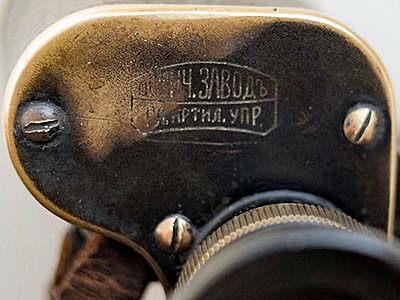
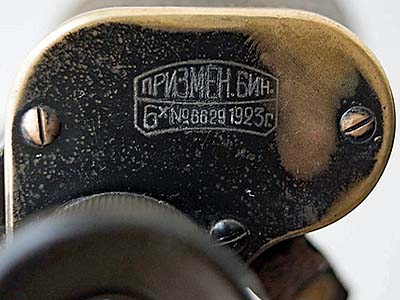
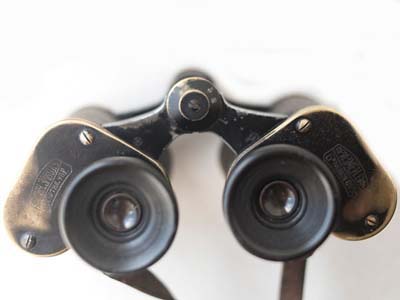
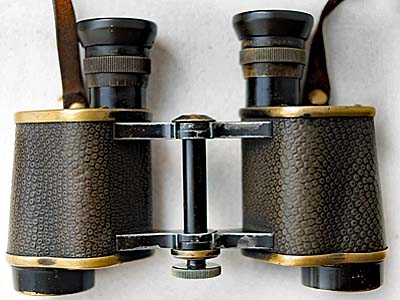
Soviet Russian 6×30 Model B-1 military service binoculars, production serial number, №6629, heavy construction, made of brass, early pattern body covering, manufactured in 1923 by the Main Artillery Directorate (Главное артиллерийское управление, Glavnogo artilleriyskogo upravleniya), Podolsk, Moscow region. Left prism cover marked with “ОПТИЧ.ЗАВОДЪ” (abbreviation of Оптический Завод, Optical Factory) over “ГЛ.АРТИЛ.УПР.” (abreviation of Главное артиллерийское управление, Main Artillery Directorate) in white characters, all within a trademark logo similar to the Carl Zeiss trademark logo. Right prism cover marked with “ПРИЗМЕН.БИН” (abbreviation of ПризменнЫй Бинокль, Prism Binoculars), over “6x№6629 1923г.” (г. is abbreviation of год, year, of manufacture) in white characters, all within a trademark logo similar to the Carl Zeiss trademark logo. These 6×30 binoculars are accompanied by the original brown leather carrying strap, |
Podolsk Optical Factory
Podolsk Optical Factory
• Подольский оптический завод
• Podol’skiy opticheskiy zavod
Г.У.В.П.
• Управление военных приборов Артиллерийского управления
• Upravleniye voyennykh priborov Artilleriyskogo upravleniya
• Directorate of Military Devices of the Artillery Directorate
Г.В.
• Управление военных
• Upravleniye voyennykh
• Military Administration
А.У.
• Артиллерийское управление
• Artilleriyskoye upravleniye
• Artillery Directorate
6×30 Model B-1, 1928, №18721, Podolsk, Moscow region, Russia
|
|
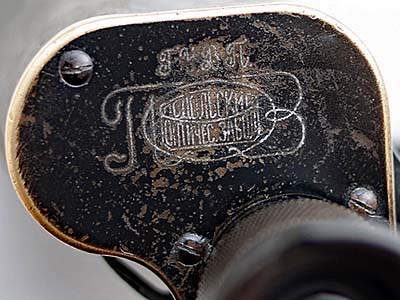
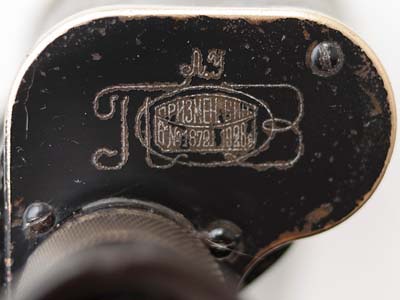
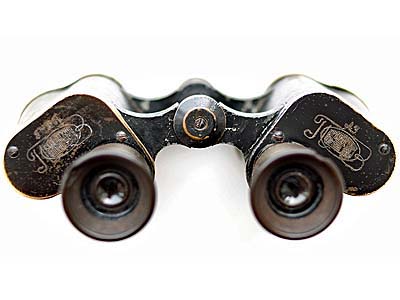
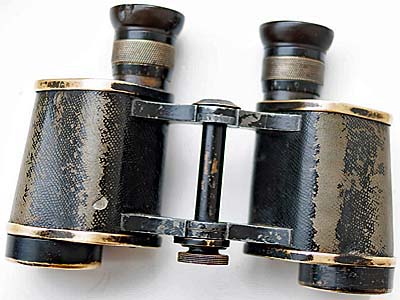
Soviet Russian 6×30 Model B-1 military service binoculars, production serial number, №18721, heavy construction, made of brass, early pattern body covering, manufactured in 1928 by the Podolsk Optical Factory (Подольский оптический завод), Podolsk, Moscow region. Left prism cover marked with “Г.У.В.П.” (abbreviation of Управление военных приборов Артиллерийского управления, Directorate of Military Devices of the Artillery Directorate) over “Подольский оптичес. завод,” (abbreviation of Podolsk Optical Factory) in white characters, all within a horizontal oval, superimposed upon the horizontally expanded initials “ГВ” (abbreviation of Управление военных, Military Administration). Right prism cover marked with “А.У.” (abbreviation of Артиллерийское управление, Artillery Directorate) over “Призмен. Бин.” (abbreviation of ПризменнЫй Бинокль, Prism Binoculars), over “6x№18721 1928г.” (abbreviation of год, year, of manufacture) in white characters, all within a trademark logo similar to the Carl Zeiss trademark logo, superimposed upon the horizontally expanded initials “ГВ” (abbreviation of Управление военных, Military Administration). |
Factory of Precise Mechanics No. 19
Factory of Precise Mechanics No. 19
• Завод Точной Механики № 19
• Zavod Tochnoy Mekhaniki № 19
1928-1936, Павшино (Pavshino), Красногорск (Krasnogorsk), Московская область (Moscow Region)
У.В.П.
• Управление военных приборов
• Upravleniye voyennykh priborov
• Directorate of Military Devices
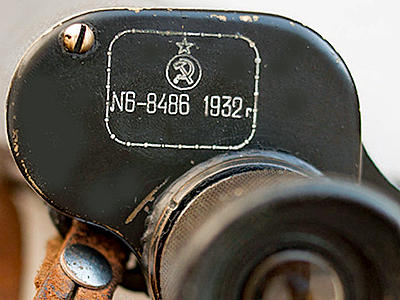
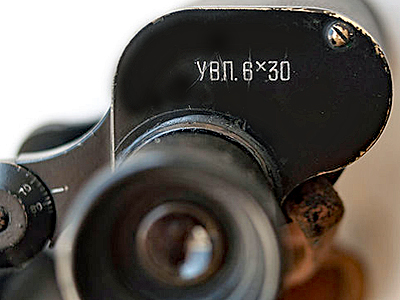
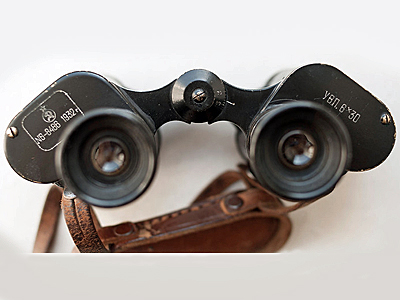
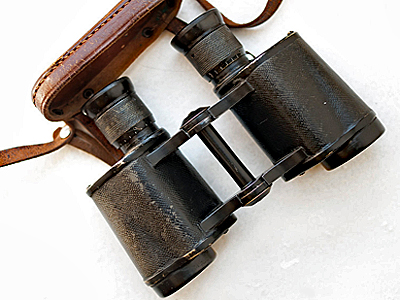
6×30 Model B-1, 1932, N6-8486, Factory of Precise Mechnics No. 19, Moscow region, Russia
|
|
Soviet Russian 6×30 Model B-1 military service binoculars, production serial number, N6-8486, heavy construction, made of brass, early pattern body covering, manufactured in 1932 by the Factory of Precise Mechanics №19 (Завод Точной Механики №19), Podolsk, Moscow region. Left prism cover marked with the early pattern Soviet hammer, sickle, and star insignia, over the production serial number, “N6-8486”, followed by “1932 г” (abbreviation of год, year, of manufacture) in white characters, all within a —.—.— rectangle with rounded corners. Right prism cover marked with “УВП.” (abbreviation of Управление военных приборов, Directorate of Military Devices) followed by “6×30”. These 6×30 military service binoculars are accompanied by the original brown leather carrying strap, and brown leather eye piece protector. |
Factory of Precise Mechanics No. 69
Factory of Precise Mechanics No. 69
• Завод Точной Механики № 69
• Zavod Tochnoy Mekhaniki № 69
1928-1936, Павшино (Pavshino), Красногорск (Krasnogorsk), Московская область (Moscow Region)
У.В.П.
• Управление военных приборов
• Upravleniye voyennykh priborov
• Directorate of Military Devices
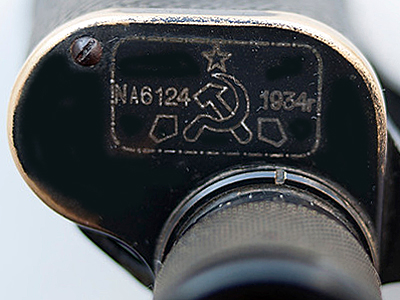
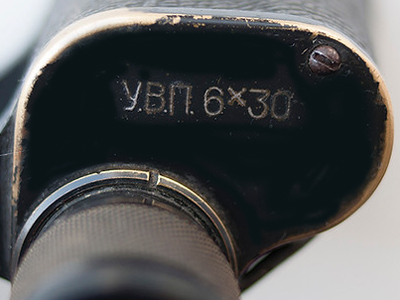
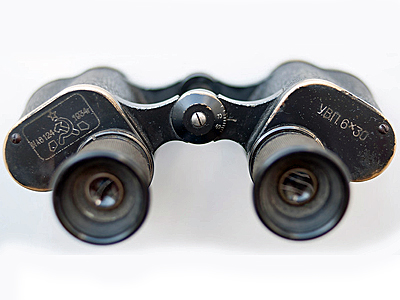
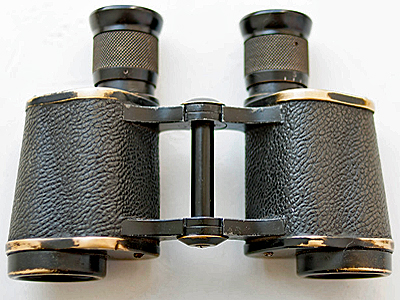
6×30 Model B-1, 1934, NA6124, Factory of Precise Mechnics No. 69, Moscow region, Russia
|
|
Soviet Russian 6×30 Model B-1 military service binoculars, production serial number, NA6124, heavy construction, made of brass, early pattern body covering, manufactured in 1934 by the Factory of Precise Mechanics №69 (Завод Точной Механики №69), Podolsk, Moscow region. Left prism cover marked with the production serial number, “NA6124”, followed by the Soviet hammer, sickle, and star insignia, incorporating the manufacturer’s trademark logo, followed by “1934 г” (abbreviation of год, year, of manufacture) in white characters, all within a —.—.— rectangle with rounded corners. Right prism cover marked with “У.В.П.” (abbreviation of Управление военных приборов, Directorate of Military Devices) followed by “6×30”. |
Factory of Precise Mechanics No. 19
Factory of Precise Mechanics No. 19
• Завод Точной Механики № 19
• Zavod Tochnoy Mekhaniki № 19
1928-1936, Павшино (Pavshino), Красногорск (Krasnogorsk), Московская область (Moscow Region)
У.В.П.
• Управление военных приборов
• Upravleniye voyennykh priborov
• Directorate of Military Devices
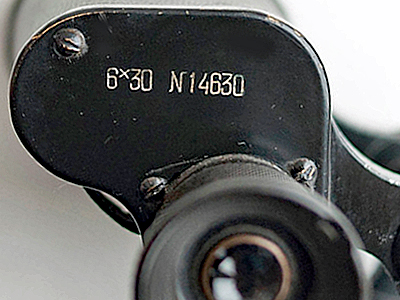
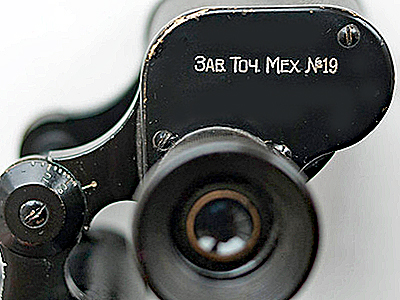
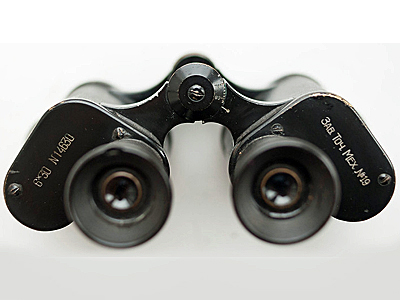
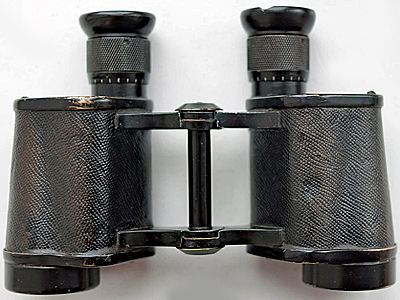
6×30 Model B-1, unknown year of manufacture, NA14630, Factory of Precise Mechnics No. 19, Moscow region, Russia
|
|
Soviet Russian 6×30 Model B-1 military pattern binoculars sold on the civilian market, production serial number, N14630, heavy, made of brass, early pattern body covering, unknown year of manufacture (likely about 1932) by the Factory of Precise Mechanics №19 (Завод Точной Механики №19), Podolsk, Moscow region. These Soviet Russian military pattern binoculars are marked with white characters stamped on the left prism cover with 6×30 followed by the production serial number, N14630. The right prism cover is marked with white characters stamped Зав. Точ. Мех. № 19 (abbreviation of Завод Точной Механики № 19, Factory of Precise Mechanics No. 19). |
Factory of Precise Mechanics No. 19
Factory of Precise Mechanics No. 19
• Завод Точной Механики № 19
• Zavod Tochnoy Mekhaniki № 19
1928-1936, Павшино (Pavshino), Красногорск (Krasnogorsk), Московская область (Moscow Region)
У.В.П.
• Управление военных приборов
• Upravleniye voyennykh priborov
• Directorate of Military Devices
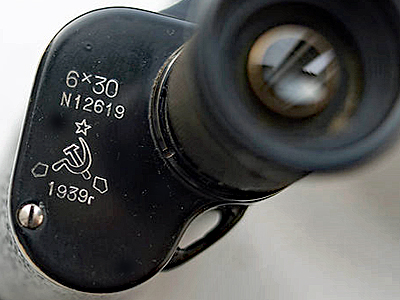
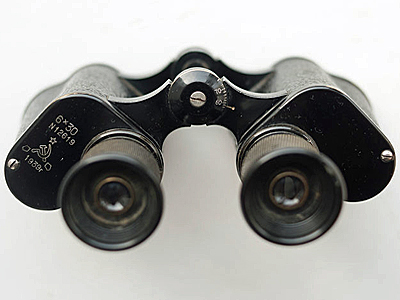
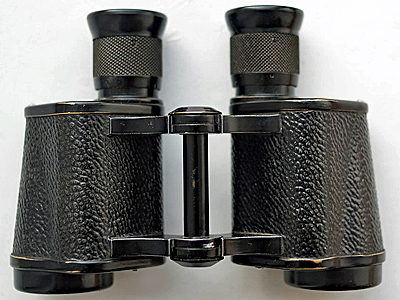
6×30 Model B-1, 1939, N12619, Factory of Precise Mechnics No. 19, Moscow region, Russia
|
|
Soviet Russian 6×30 Model B-1 military service binoculars, production serial number, N12619, heavy, made of brass, early pattern body covering, manufactured in 1939 by the Factory of Precise Mechanics №19 (Завод Точной Механики №19), Podolsk, Moscow region. These Russian military binoculars are marked with white characters stamped on the left prism cover with 6×30 at the top, followed by the production serial number, N12619, then by the manufacturer’s trademark logo, incorporating the Soviet hammer, sickle, and star insignia, and finally by 1939г (год, year) of manufacture. The right prism cover is blank. |
E. Krauss et Compagnie
8×20 STÉRÉO-JUMELLE, 1913, № 35392, Paris, France
E. Krauss et Cie. was founded by Emile Krauss in Germany in 1882. The company produced photographic equipment and Galilean binoculars. In 1892 the company moved from Berlin to Paris at which time a license was obtained from Zeiss to manufacture “Zeiss-Anastigmate” photographic objective lenses.
In 1896, this business relationship grew when Zeiss licensed E. Krauss et Cie to manufacture prismatic binoculars with the objective lenses spaced horizontally farther apart to enhance stereo three dimensional depth perception, which was a design patented by Zeiss until 1908.
During the same time period, Zeiss also licensed Bausch & Lomb in the United States to manufacture stereoscopic binoculars. Another maker, Hensoldt in Germany, violated the Zeiss patent by manufacturing stereoscopic binoculars prior to 1908 without having a license.
Krauss Stéréo-Jumelle Zeiss binoculars were made from 1896/97 until 1908/09. After 1902, the Zeiss name was no longer marked on the binoculars. The binoculars were available in various powers of magnification. Although they were not exact copies of the Zeiss Feldstecher models, they very much resembled them.
The Krauss binoculars were built with a military type clamping knob at the end of the center bar which when tightened immovably fixed the halves of the binocular at a selected setting. The Zeiss Feldstechers were built with a spring tensioned click stop knob which when tightened applied a click stop tension at a selected setting but still allowed the halves of the binocular to be moved out of the click stop setting to another position.
Other than the crossed rifles with bayonets insignia, there are no actual French or Russian military markings on these binoculars.
During this same time period, some Zeiss binoculars were offered for sale as “Armee Modell” Feldstechers, presumably meant for private purchase by German and foreign military personnel.
It could be that these 8×20 Krauss Stéréo-Jumelle Zeiss binoculars were also intended for private purchase by French and foreign army officers.
The 8×20 Krauss Stéréo-Jumelle Zeiss binoculars are just as well constructed as the 8×20 Zeiss Feldstechers, and the optical performance of the binoculars is exactly the same.
Imperial Russian Officer Schools
In 1913, the officer schools of the Imperial Russian Army included eleven infantry schools, two Cossack schools, three cavalry schools, three artillery schools, and one engineer school.
Imperial Russian Army Officer Training: Officers were trained in various military skills, including marksmanship, which was crucial for infantry, cavalry, and artillery units. These schools were designed to train officers for various roles within the military, ensuring a structured and specialized education for future leaders.
There is no specific mention of a shooting school in the Imperial Russian Army school system. However, officer training in the Imperial Russian Army included various military skills, and marksmanship would have been an essential part of the curriculum for most branches, such as infantry, cavalry, and artillery.
Military Schools: These schools provided comprehensive military education, including tactical and strategic training. The schools were part of the military education system for commissioned officers from the page corps, cadet corps, junker and military schools. The junker schools were re-designated as military schools in 1910. There is no specific information regarding marksmanship shooting schools.
Russia in the First World War
The German optical companies, C. P. Goerz, and Carl Zeiss, opened factories in Riga, Latvia, which was then part of the Russian Empire. The Goerz factory opened in 1911, and the Zeiss factory in 1912.
Russia entered the First World War in August 1914, fulfilling its promise to support its Balkan ally, Serbia, against Austria-Hungary. Despite having the largest army in the world at the time, with over five million soldiers when fully mobilized, Russia was not prepared for a major war due to inadequate equipment and incompetent leadership.
The Russian army suffered significant defeats, particularly in the Battle of Tannenberg in August 1914, where the Russians lost 30,000 casualties with another 100,000 soldiers taken prisoner.
In May 1915, the Russian Empire confiscated the Goerz and Zeiss factories, and the Russian State Agrarian University assumed management. In July 1915, the Goerz and Zeiss factories, with all their equipment and personnel, were evacuated from Riga, Latvia to Petrograd, Russia.
In September 1915, Russian Tsar Nicholas II, despite having no military experience, took direct control of the Russian army, which associated him with its future defeats and losses. This decision further weakened the already fragile situation within Russia. The war exacerbated Russia’s internal problems, economic strain, inflation, food shortages, and widespread discontent among the Russian people.
In May 1916, the combined Goerz and Zeiss factories were renamed the Petrograd Optical Factory (Петроградский оптический завод, Petrogradskiy opticheskiy zavod).
By 1917, Russia’s involvement in the war was deeply unpopular. The war’s impact on Russia was profound, leading to the February 1917 Revolution in which soldiers joined striking workers in Petrograd to protest against the Tsar’s rule. On March 15, 1917, Tsar Nicholas II was forced to abdicate, ending the Romanov dynasty’s 304 year rule. The collapse of the Romanov Dynasty, and Russia’s losses in the First World War were catastrophic, with between 900,000 and 2,500,000 soldiers killed and at least 1,500,000 wounded.
The March 15, 1917 abdication of Tsar Nicholas II and the subsequent overthrow of the Russian Provisional Government in the October 1917 Revolution, sparked the beginning of the Russian Civil War. This vicious internal struggle within the former Russian Empire, in which many factions fought each other to determine Russia’s political future, was one of the most turbulent events of the 20th century.
The Treaty of Brest-Litovsk
During the October 1917 Revolution, the Bolsheviks (большевики, bol’sheviki, from большинство, bol’shinstvo, ‘majority’), led by Vladimir Lenin and Leon Trotsky, seized power in Russia, and on November 7, 1917, proclaimed the Russian Soviet Republic.
Negotiations for peace were convened by the Central Powers, Germany, Austria-Hungary, the Ottoman Empire, and Bulgaria at Brest-Litovsk, a city in south-western Belarus on the border with Poland, to force the newly proclaimed Russian Soviet Republic to end Russia’s involvement in the First World War.
Germany and Austria-Hungary pressed the new Soviet government to sign the proposed treaty to avoid further advances by German and Austro-Hungarian forces into Russia. The negotiations were characterized by a stark imbalance of power, with the more capable German delegation facing a less capable Russian delegation.
Within the government of the Russian Soviet Republic, the Central Committee was the supreme authority of the governing party. Throughout its history, the party and the Central Committee were torn apart by factional infighting.
Concerning the Treaty of Brest-Litovsk, there were many heated debates in the Central Committee about how to conclude peace with the Germans to remove Russia from the war.
On the night of February 18, 1918, the Central Committee, by a margin of seven to five, approved Lenin’s decision that Russia accept the Treaty of Brest-Litovsk. The Treaty of Brest-Litovsk was signed on March 3, 1918, ending Russia’s involvement in the First World War.
The treaty was controversial in Russia, providing unifying motivation to the White movement and opening a split between the Bolsheviks and the Left Socialist-Revolutionaries, whose representatives withdrew from the Council of People’s Commissars after the signing, and later rebelled in the Left Socialist-Revolutionaries Uprising.
The Treaty of Brest-Litovsk between the Russian Soviet Republic and the Central Powers, Germany, Austria-Hungary, the Ottoman Empire, and Bulgaria, was a humiliating peace agreement for Russia.
Under the terms of the treaty, the Russian Soviet Republic was forced to relinquish much of the western lands of the former Russian Empire to the German Empire, in exchange for peace on the Eastern Front of the First World War.
Russian Soviet Republic lost control of Ukraine, Poland, Belarus, Lithuania, Latvia, and Estonia, and its Caucasus provinces of Kars and Batum. These lands comprised 34% of the former Russian Empire’s population, 54% of its industrial land, 89% of its coalfields, and 26% of its railways.
The Bolshevik government of the Russian Soviet Republic also confirmed the independence of Finland, which it had recognized in January 1918, and pledged to end its war with the Ukrainian People’s Republic, which the Central Powers had recognized under a prior February 9, 1918 Treaty of Brest-Litovsk.
A supplementary protocol signed in August 1918 required Russia to pay Germany war reparations of six billion marks.
The treaty marked a significant shift in Eastern Front dynamics, allowing Germany and its allies to concentrate their forces on the Western Front, while providing a critical moment for the Bolshevik regime to consolidate its power in Soviet Russia.
The Treaty of Brest-Litovsk awakened the specter of German domination of Eastern Europe, and the Allies began to seriously consider military intervention in Russia.
Meanwhile, on the night of July 16-17, 1918, the abdicated Russian Imperial Romanov family (Tsar Nicholas II of Russia, his wife Alexandra Feodorovna, and their five children, Olga, Tatiana, Maria, Anastasia, and Alexei, were shot and bayoneted to death by Bolshevik revolutionaries under Yakov Yurovsky on the orders of the Ural Regional Soviet in Yekaterinburg.
Also murdered that night were members of the imperial entourage who had accompanied them, court physician Eugene Botkin, lady-in-waiting Anna Demidova, footman Alexei Trupp, and head cook Ivan Kharitonov. The bodies were taken to the Koptyaki forest, where they were stripped, mutilated with grenades and acid to prevent identification, and buried.
The Russian Soviet Republic
The Treaty of Brest-Litovsk did provide some relief to the Bolsheviks, who were heavily engaged in fighting their rivals within Russia in the Russian Civil War. The treaty removed Russia’s claims to Poland, Finland, Estonia, Latvia, Belarus, Ukraine, and Lithuania, and set conditions for the eventual formation of the Soviet Union on December 30, 1922.
The Treaty of Brest-Litovsk was effectively nullified when the November 1918 Armistice was declared, and the subsequent 1919 Treaty of Versailles was signed, ending the First World War. Germany had been humbled and forced into unconditional surrender by the Allied powers. The Austro-Hungarian Empire and the Turkish Empire were carved up into other sovereign states.
From January 23 to January 31, 1918, the Third All-Russian Congress of Soviets of Workers’, Soldiers’, and Peasants’ Deputies, meeting in Petrograd, formally established the Russian Soviet Republic (Российская Советская Республика, Rossiyskaya Sovetskaya Respublika), as a sovereign state, the world’s first socialist government guided by communist ideology. The Third All-Russian Congress of Soviets solidified the power of the Bolsheviks and set the stage for the development of the Soviet system in Russia.
At the Fourth Extraordinary All-Russian Congress of Soviets (March 14–16, 1918), the Treaty of Brest-Litovsk was ratified.[23][24] This marked a rift between the Bolsheviks and the Left Socialist Revolutionaries, who voted against the treaty and whose ministers quit the Sovnarkom in protest.[25]
From July 4 to July 10, 1918, the Fifth All–Russian Congress of Soviets met in Moscow and changed the name of the Russian government from the Russian Soviet Republic to the Russian Socialist Federative Soviet Republic (Российская Социалистическая Федеративная Советская Республика, Rossiyskaya Sotsialisticheskaya Federativnaya Sovetskaya Respublika).
to the Russian Soviet Federative Socialist Republic (Российская Советская Федеративная Социалистическая Республика, Rossiyskaya Sovetskaya Federativnaya Sotsialisticheskaya Respublika), and adopted the Constitution of the Russian SFSR.
Eighth Congress of Soviets of the USSR
Main article: Eighth All-Union Congress of Soviets
The Extraordinary Eighth Congress of Soviets of the USSR was held from November 1936 to December 1936 to ratify the 1936 Constitution of the Soviet Union, thereby dissolving itself permanently and transferring its powers to the newly established Supreme Soviet of the Soviet Union. The All-Union Congress approved the Constitution, and also approved plans for the publication of copies of the Constitution and invited citizens to discuss the new changes to the Constitution.[6]
Effective December 5, 1936, the Constitution changed the names of all Union Republics, the constituent states of the Soviet Union, transposing the second word “socialist” and third word “soviet” (or equivalent e.g. “radianska” in Ukrainian). Republics were named after the primary nationality and followed by “Soviet Socialist Republic” (SSR), except for the Russian Soviet Federative Socialist Republic (RSFSR).
This congress was significant as it adopted the Constitution of the Russian Soviet Federative Socialist Republic of 1918.
The Russian Socialist Federative Soviet Republic, known unofficially as Soviet Russia, was a socialist state from 1917 to 1922.
On December 30, 1922, the Russian Socialist Federative Soviet Republic and delegations from Ukraine, Belarus, and the Transcaucasian Federation ratified the Treaty of the Creation of the USSR, officially establishing the Union of Soviet Socialist Republics (USSR).
The final Soviet name for the constituent republic, the Russian Soviet Federative Socialist Republic, was adopted in the later Soviet Constitution of 1936. The Russian Soviet Federative Socialist Republic (RSFSR) was not founded in 1936.
It was established on November 7, 1917, following the October Revolution. However, in 1936, the RSFSR underwent significant changes with the adoption of the new Soviet constitution on December 5, 1936, which reorganized the government and elevated some autonomous republics to full Union Republic status.
Afterwards the largest and most populous constituent republic of the Soviet Union (USSR) from 1922 to 1991, until becoming a sovereign part of the Soviet Union with priority of Russian laws over Union-level legislation in 1990 and 1991, the last two years of the existence of the USSR.[5] The Russian SFSR was composed of sixteen smaller constituent units of autonomous republics, five autonomous oblasts, ten autonomous okrugs, six krais and forty oblasts.[5] Russians formed the largest ethnic group. The capital of the Russian SFSR and the USSR as a whole was Moscow and the other major urban centers included Leningrad (Petrograd until 1924), Stalingrad (Volgograd after 1961), Novosibirsk, Sverdlovsk, Gorky and Kuybyshev.
In the spring of 1918, the Petrograd Optical Factory was told to evacuate. By June 10, 1918, all the equipment had been removed, and the factory was completely evacuated, first to Voronezh, about 300 miles southeast of Moscow, then to Perm, about 900 miles northeast of Moscow, then finally, in the fall of 1918, to Podolsk, about 22 miles south of Moscow.
The Petrograd Optical Factory finally found a home in the buildings of the former Singer Sewing Machine Factory (Фабрика швейных машин «Зингер», Fabrika shveynykh mashin «Zinger»). Soon the Petrograd Cartridge Factory (Петроградский патронный завод, Petrogradskiy patronnyy zavod) was also evacuated to the same location.
In December 1918, after the evacuation was completed, the Petrograd Optical Factory was renamed the Podolsk Optical Factory (POZ), under the jurisdiction of the 1st department (1-й отдел, 1-y otdel) of the Central Optical Plant of the State Agrarian University (Центральный оптический завод Государственного аграрного университета, Tsentral’nyy opticheskiy zavod Gosudarstvennogo agrarnogo universiteta).
From 1919 to November 1921, the Podolsk Optical Factory (POZ) was under the jurisdiction of the Central Optical Plant of the Industrial Military Council of the Supreme Council of the National Economy (Центральный оптический завод Военно-промышленного совета ВСНХ, Tsentral’nyy opticheskiy zavod Voyenno-promyshlennogo soveta VSNKH).
Supreme Soviet of the National Economy, Superior Soviet of the People’s Economy, (Высший совет народного хозяйства, ВСНХ, Vysshiy sovet narodnogo khozyaystva, VSNKh) was the superior state institution for management of the economy of the RSFSR and later of the Soviet Union. There were two institutions with this name, at different times, 1917–1932 and 1963–1965.
During the Russian Civil War, the Podolsk Optical Factory was the only operating optical factory of the Soviet military industry, working with imported glass of pre-revolutionary supply.
In 1920, the optical department of the Obukhov plant and the construction of IZOS were transferred here. During the relocations, the plant lost a significant amount of equipment and qualified personnel (at the beginning of 1920, a large number of workers returned to Latvia) and was on the verge of closing. However, from mid-1919, it resumed operations.
In March 1922, the Podolsk Optical Factory (POZ) was under the jurisdiction of the 1st department of the TPU GUVP (Главное военно-политическое управление, Glavnoye voyenno-politicheskoye upravleniye).
In 1924 to January 1925 – GUVP (GUVP (Main Directorate of Military Industry, Главное управление военной промышленности, Glavnoye upravleniye voyennoy promyshlennosti)
VSNKh (VSNKh, Supreme Soviet of the National Economy, Верховный Совет Народного Хозяйства, Verkhovnyy Sovet Narodnogo Khozyaystva)
In accordance with the order of the GUVP (GUVP Main Directorate of Military Industry, Главное управление военной промышленности, Glavnoye upravleniye voyennoy promyshlennosti), dated June 26, 1922, in October 1922, the plant management renamed the Podolsk Optical Factory (POZ) the State Optical Plant “Red Panorama”.
In accordance with the order of the GUVP (Main Directorate of Military Industry, Главное управление военной промышленности, Glavnoye upravleniye voyennoy promyshlennosti) No. 3, dated May 10, 1926, the plant was transferred from Voenprom to the jurisdiction of the created Orudars of the Supreme Council of the National Economy (and as of February 1930), in June 1926, in terms of mobilization, it was subordinated to the armament subdepartment of the VPU VSNKh.
In accordance with the decree of the Council of People’s Commissars, dated April 27, 1926, according to the order of the Supreme Council of the National Economy/NKVM/OGPU No. 73ss of 07.09.1927.
From October 1, 1927, the Podolsk Optical Factory (POZ) was renamed the Precision Mechanics Plant No. 19 (the name Pavshinsky Optical-Mechanical Plant No. 19 was also mentioned) under the jurisdiction of the Orudars of the Supreme Council of the National Economy (order of the Supreme Council of the National Economy No. 86s of September 22, 1927, the execution of the previous order was suspended for a month).
In 1929, the plant became part of TOMP, in December 1930 – VOOMP VSNKh (until January 1932), from .January 1932 – under the jurisdiction of VOOMP Glavmashprom NKTP (and in October 1932). In May 1934, the plant was under the jurisdiction of GUSP NKTP.
According to Voenprom Ave. No. 138 of March 25/27, 1926, the plant’s representative office in Moscow was liquidated. In 1926, in order to expand production, it was decided to relocate the plant to the settlement of Ban’ki near Pavshino (the future city of Krasnogorsk).
Before the revolution, Polyakov’s textile factory and Lipinsky’s dye factory were built on the bank of the Ban’ki River, on the site of the future city of Krasnogorsk. In 1918, the factories were nationalized, and in 1924-25 they were merged and transferred to the jurisdiction of the State Agrarian University. After the decision was made to relocate, the factories were reconstructed.
In 1927, the plant was relocated to the site of the factories. In 1931, reconstruction of the plant and construction of new buildings began. The plant was to become the country’s main military optical plant.
The first stage was supposed to be put into operation in July 1932, but the deadlines were missed. Construction continued until the beginning of the war. At a meeting of the Politburo of the Central Committee of the All-Union Communist Party (Bolsheviks) on 04.05.1934 (minutes No. 6), a special procedure for hiring and firing workers was introduced at the plant, and a hiring and firing department was organized.
In 1924, for the first time in Russia, the production of spectacle optics was established. In 1927-28, the plant produced binoculars, field panoramas, stereoscopic tubes, spectacle lenses and frames, and magnifying glasses.
According to the Glavtochmash NKTP No. 99 dated September 17, 1934, Plant No. 19 was renamed Plant No. 69.
The term “Glavtochmash” refers to a specific department within the People’s Commissariat of Heavy Industry (NKTP Народный комиссариат тяжелой промышленности, Narodnyy komissariat tyazheloy promyshlennosti) in the Soviet Union. The NKTP was a powerful economic department responsible for key branches of the economy, including the fuel-energy complex, metallurgy, machine building, and the chemical industry.
Singer Factories – Podolsk, Russia
Up until 1900 the Singer company had sold its machines into Russia through a series of local agents managed from an office in Hamburg in Germany. In 1900, after 4 years of preparation, the company purchased a block of land in the small town of Podolsk, Russia and quickly erected a factory for the manufacture of its sewing machines. This new plant was intended to supply the entire Russian market as well as those in Turkey, the Balkan states, Persia (Iran), Japan, and China.
The plant was constructed and managed by Walter Frank Dixon, who remained in this position until 1917.
The plant was built rapidly and was equipped with the latest technology of the time. Singer’s Elizabethport Factory (Elizabethport, New Jersey, USA) supplied the plans for the buildings and all of the machinery except for the steam engines and boilers which were purchased in Russia.
In 1902 when the foundry and a two storey manufacturing building for lacquering the stands were completed, the Podolsk factory started production in the same way that other foreign Singer factories had started. That was, by manufacturing the heavy stands and fitting them with imported machine heads made in the Elizabethport Singer Factory (Elizabethport, New Jersey, USA) or the Kilbowie Singer Factory (Kilbowie, Clydebank, Scotland). Once the stands were in production, work started on 3 new buildings to house the machinery for the manufacture of the machine heads.
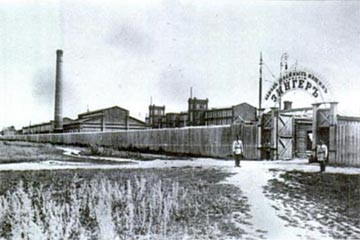
Singer Sewing Machine Factory – Podolsk
The first locally made machine head was completed in 1905. During that year a total of 5,430 machine heads were produced. In 1906 the plant was still only making one model, but 42,322 heads were made plus 155,745 stands in thirteen styles. In 1907 a second model of head was added and total production was almost 100,000 heads and 190,000 stands.
In 1908 sales reached 440,000 machines, but despite all of the rapid expansion, the factory could still only produce 1/3 of the heads and 3/4 of the stands required. New plans were initiated to double the production of heads at the plant. By 1911 the plant employed more than 2500 workers making 300,000 heads and 200,000 stands. The Podolsk plant was now making the complete range of parts except for needles, flying shuttles, and a few special parts. By 1914 they were making over 675,000 machines per year. Had it not been for the outbreak of WW1 it was expected that total production for 1914 would have exceeded 900,000, making it equal to that in the USA.
In 1904 a wood working department was added. The wooden cabinet parts were cut in the USA, and then for tax reasons shipped to the Kilbowie Singer Factory (Kilbowie, Clydebank, Scotland) for rough finishing before finally being sent to Podolsk for final finishing and assembly. This practice continued throughout the life of the plant, as suitable supplies of Russian veneer could not be found.
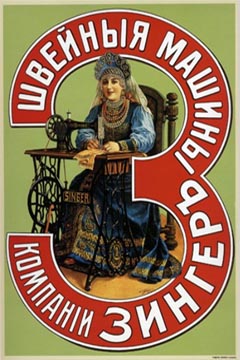
Singer Logo – Russia – The Singer logo reads ШВЕЙНЫЯ МАШИНЫ КОМПАНꙆИ ЗИНГЕРЪ, SHVEYNYYA MASHINY KOMPANꙆI ZINGER, meaning SEWING MACHINES OF THE SINGER COMPANY.
With the outbreak of the First World War, production of sewing machines dropped and the Podolsk factory was converted to making munitions. During the 1917 Russian Revolution the Singer company passed over control of the factory to the government for a nominal lease in order to prevent the plant from being closed. In November 1918 the plant was officially nationalised into state control and began the production of domestic “Singer” machines branded “Gosshveymashina” (State sewing machine) and then “Podolsk”.
After WW1 and the 1917 revolution, production was slow to restart and by 1924 production was only just over 60,000 machines. In subsequent years production increased steadily, until in 1928 it was again back to over 400,000 machines per year, although now with 6500 workers. In 1931 for the first time the factory began producing industrial models and also sewing machine needles. Production in 1931 was around 520,000 machines with 11,000 workers.
After WW11 the Podolsk factory was re-equipped with machinery taken as reparations from the former Singer Factory in Wittenberge (Wittenberge, Prussia). The older designs that Podolsk had been producing were updated at that time using details of the later Singer features taken from Wittenberge.
The factory was renamed Podolsk Engineering Plant (PMZ), and then later as Kalinin Sewing Machines (ZIK)
During the 1960’s and 70’s there was massive over-production of poor quality and outdated machines and the factory went into decline.
In 1994 with the changing political situation in Russia, the plant was purchased by Semi-Tech, which also owned the Singer brand, so the Podolsk factory was once again renamed as Singer. The factory was finally closed around 2000.
In 2011 the city of Podolsk celebrated the 230th anniversary of the town by erecting a full size bronze sculpture of a Singer sewing machine and treadle table mounted on a red granite pedestal in front of the local museum.