


Казанский оптико-механический завод №237 (KOMЗ) • Kazan Optical-Mechanical Factory No. 237 (KOMZ)
Kazan, Tartarstan, Russia (Казань, Татарстан, Россия) 1940-1945
In the Russian armed forces, military service binoculars are marked to identify them as government property.
Military service binoculars are issued to soldiers with specialized functions. For example, a group leader or an artillery observer was issued a set of binoculars to perform his duties.
The most common type of Soviet Russian military service binoculars used during the Great Patriotic War, the Second World War, was the 6×30 Standardized Model B-6 military service binoculars.
The number “6” identifies the magnification power of the binoculars. In this case, “6” indicates that objects appear six times closer than their actual distance.
The number “30” identifies the diameter in millimeters of the front (objective) lenses — the light gathering lenses — in this case 30 millimeters in diameter.
Каzan Optical-Mechanical Factory No. 237 (KOMZ)
6×30 Standardized Model B-6, 1941, N41048860, Kazan, Tartarstan
|
|
Soviet Russian 6×30 Standardized Model B-6 military service binoculars, production serial number, N41048860, heavy, made of brass, manufactured in 1941 by the State Optical-Mechanical Factory (GOMZ), Gosudarstvennyi Optiko-Mekhanicheskii Zavod №237 (ГОМЗ), of Tomsk, Siberia. These Russian military binoculars are marked in white characters stamped on the left prism cover with 6×30 at the top, followed by the Soviet hammer, sickle, and star insignia, then by the manufacturer’s trademark logo, and finally by the production serial number, N41048860. The first two numbers, 41, indicate year of manufacture. These 6×30 Standardized Model B-6 military binoculars are accompanied by the original brown leather carrying strap. The State Optical-Mechanical Factory No. 237 (GOMZ), Gosudarstvennyi Optiko-Mekhanicheskii Zavod №237 (ГОМЗ), established in 1940 in Leningrad, was evacuated in Autumn 1941, to Tomsk, Siberia. |

Каzan Optical-Mechanical Factory No. 237 (KOMZ)
6×30 Standardized Model B-6, 1945, 109335, Kazan, Tartarstan
|
|
Soviet Russian 6×30 Standardized Model B-6 military binoculars, production serial number, 109335, heavy, made of brass, manufactured in 1945 by the Kazan Optical-Mechanical Factory No. 237 (KOMZ), Казанский оптико-механический завод №237 (KOMЗ), of Kazan, Russia. Usually, Russian military binoculars are marked with the manufacturer’s trademark logo, production serial number, and year of manufacture on the left prism cover. On some binoculars, the first two numbers of the production serial number (40, 41, 42, 43, 44) indicated the year of production. In early 1942, the markings of some factories were moved from the left prism cover to the back of the bridge. The markings on these binoculars are stamped in white characters on the back of the binoculars bridge. Left bridge arm: 6×30, manufacturer’s trademark logo. Right bridge arm: production serial number, 109335, year of manufacture, 1945. These 6×30 Standardized Model B-6 military binoculars are accompanied by the original dark brown leather carrying strap, dark brown leather eye piece protector, and light brown leather case with light brown fabric carrying strap. These binoculars came from Kyiv (Київ), the capital city of Ukraine. |


Каzan Optical-Mechanical Factory No. 237 (KOMZ)
6×30 Standardized Model B-6, 1945, 129526, Kazan, Tartarstan
|
|
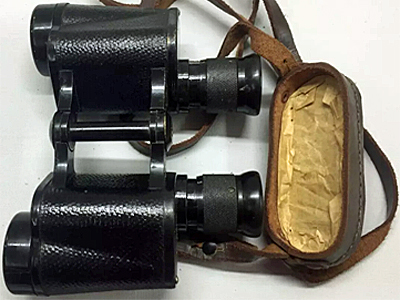
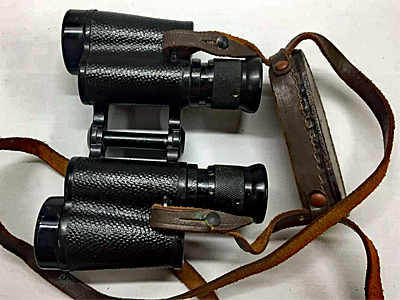
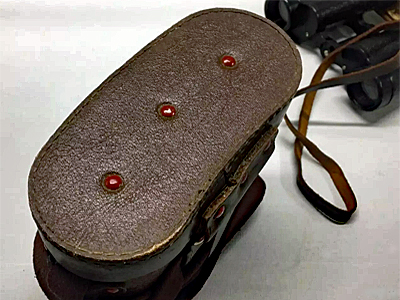
Soviet Russian 6×30 Standardized Model B-6 military binoculars, production serial number, 129526, heavy, made of brass, manufactured in 1945 by the Kazan Optical-Mechanical Factory No. 237 (Казанский оптико-механический завод №237, KOMZ), of Kazan, Russia. Usually, Russian military binoculars are marked with manufacturer’s trademark logo, production serial number, and year of manufacture on the left prizm cover. In this case, these markings are stamped with white characters on the back of the binoculars bridge. Left bridge arm: 6×30, manufacturer’s trademark logo. Right bridge arm: production serial number, 129556, year of manufacture, 1945. These 6×30 Standardized Model B-6 military binoculars are accompanied by the original dark brown leather carrying strap, dark brown leather eye piece protector, and dark brown leather case with dark brown fabric carrying strap. These binoculars came from Cherkasy (Черкаси], the administrative center of Cherkasy Oblast, in central Ukraine on the east bank of the Dnieper (Дніпро) River at the Kremenchuk (Кременчук) Reservoir, about 200 km (124 miles) south of Kyiv (Київ), Ukraine’s capital city. The Kazan Optical-Mechanical Factory (KOMZ), Казанский оптико-механический завод (KOMЗ), established in 1940, was a company based in Kazan, Russia. |







Каzan Optical-Mechanical Factory No. 237 (KOMZ)
6×30 Standardized Model B-6, 1946, 7581, Kazan, Tartarstan
|
|
Soviet Russian 6×30 Standardized Model B-6 military binoculars, production serial number, 7581, heavy, made of brass, manufactured in 1946 by the Kazan Optical-Mechanical Factory No. 237 (KOMZ), Казанский оптико-механический завод №237 (KOMЗ), of Kazan, Russia. These Russian military binoculars are marked in white characters stamped on the left prism cover with 6×30 at the top, followed by the Soviet hammer, sickle, and star insignia, then by the manufacturer’s trademark logo, then by the production serial number, 7581, and finally by the year of manufacture, 1946. These 6×30 Standardized Model B-6 military binoculars are accompanied by the original brown leather carrying strap. The Kazan Optical-Mechanical Factory No. 237 (KOMZ), Казанский оптико-механический завод №237 (KOMЗ), established in 1940, was a company based in Kazan, Russia. |

Каzan Optical-Mechanical Factory No. 237 (KOMZ)
6×30 Standardized Model B-6, 1946, B 10274, Kazan, Tartarstan
|
|
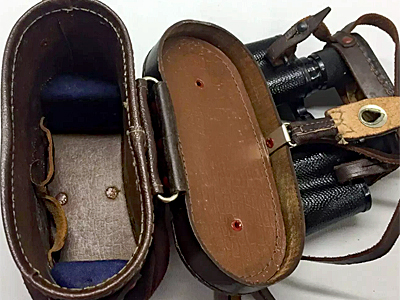
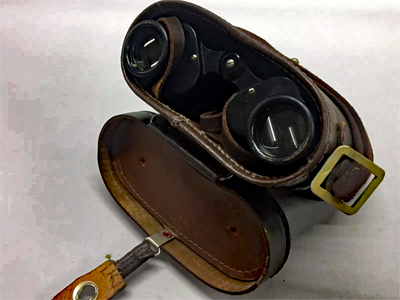
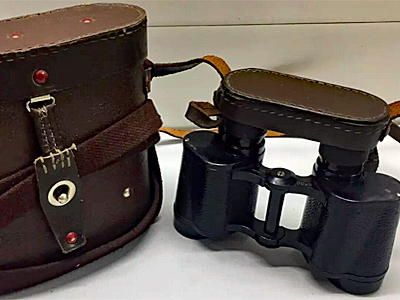
Soviet Russian 6×30 Standardized Model B-6 military binoculars, production serial number, B 10274, heavy, made of brass, manufactured in 1946 by the Kazan Optical-Mechanical Factory No. 237 (KOMZ), Казанский оптико-механический завод №237 (KOMЗ), of Kazan, Russia. These Russian military binoculars are marked in white characters stamped on the left prism cover with 6×30 at the top, followed by the Soviet hammer, sickle, and star insignia, then by the manufacturer’s trademark logo, and finally by the production serial number, B 10274. These 6×30 Standardized Model B-6 military binoculars are accompanied by the original brown leather carrying strap, brown leather eye piece protector, and original light brown fabric-covered leather case with brown leather carrying strap. The Kazan Optical-Mechanical Factory No. 237 (KOMZ), Казанский оптико-механический завод №237 (KOMЗ), established in 1940, was a company based in Kazan, Russia. |


Attached inside the lid of the leather carrying case of the 6×30 Standardized Model B-6 military binoculars, production serial number B 10274, manufactured by KOMZ in 1946, is a paper label, translated below from Russian to English, that provides a description of the contents of the binoculars case as it was packed, inspected, and shipped from the factory.
|
|
ОписЬ вложения на бинокль 6×30 1. Бинокль 6×30 с дождевнком н шеӥиЫм ремнем . . . 1 ШТ. 2. Светофетнльтры . . . 2 ШТ. 3. Глазная раковина . . . 1 ШТ. 4. Салфетка 200х200 мм . . . 1 ШТ. У nакобку nроберuл: (подписано инспектором) List of contents for binoculars 6×30 1. Binoculars 6×30 with rain cover and neck strap . . . 1 PC. 2. Light filters . . . 2 PCS. 3. Eye cup . . . 1 PC. 4. Napkin 200×200 mm . . . 1 PC. The package was checked by: (signed by the inspector) |

Каzan Optical-Mechanical Factory No. 237 (KOMZ)
6×30 Standardized Model B-6, 1946, B 17000, Kazan, Tartarstan
|
|
Soviet Russian 6×30 Standardized Model B-6 military binoculars, production serial number, B 17000, heavy, made of brass, manufactured in 1946 by the Kazan Optical-Mechanical Factory No. 237 (KOMZ), Казанский оптико-механический завод №237 (KOMЗ), of Kazan, Russia. These Russian military binoculars are marked in white characters stamped on the left prism cover with 6×30 at the top, followed by the Soviet hammer, sickle, and star insignia, then by the manufacturer’s trademark logo, and finally by the production serial number, B 17000. These 6×30 Standardized Model B-6 military binoculars are accompanied by the original dark brown leather carrying strap. |

Каzan Optical-Mechanical Factory No. 237 (KOMZ)
6×30 Standardized Model B-6, 1947, 25765, Kazan, Tartarstan
|
|
Soviet Russian 6×30 Standardized Model B-6 military binoculars, production serial number, 25765, heavy, made of brass, manufactured in 1947 by the Kazan Optical-Mechanical Factory No. 237 (KOMZ), Казанский оптико-механический завод №237 (KOMЗ), of Kazan, Russia. These Russian military binoculars are marked in white characters stamped on the left prism cover with 6×30 at the top, followed by the Soviet hammer, sickle, and star insignia, then by the manufacturer’s trademark logo, then by the production serial number, 25765, and finally by the year of manufacture, 1947. These 6×30 Standardized Model B-6 military binoculars are accompanied by the original brown leather carrying strap. The Kazan Optical-Mechanical Factory No. 237 (KOMZ), Казанский оптико-механический завод №237 (KOMЗ), established in 1940, was a company based in Kazan, Russia. |

mmmmmmmmmmmmmmmmmmmmmmmmmmmmmmmmmmmmmmmmmm
Каzan Optical-Mechanical Factory No. 237 (KOMZ)
6×30 Standardized Model B-6, 1947, 25765, Kazan, Tartarstan
|
|
Soviet Russian 6×30 Standardized Model B-6 military binoculars, production serial number, 25765, heavy, made of brass, manufactured in 1947 by the Kazan Optical-Mechanical Factory No. 237 (KOMZ), Казанский оптико-механический завод №237 (KOMЗ), of Kazan, Russia. These Russian military binoculars are marked in white characters stamped on the left prism cover with 6×30 at the top, followed by the Soviet hammer, sickle, and star insignia, then by the manufacturer’s trademark logo, then by the production serial number, 25765, and finally by the year of manufacture, 1947. These 6×30 Standardized Model B-6 military binoculars are accompanied by the original brown leather carrying strap. The Kazan Optical-Mechanical Factory No. 237 (KOMZ), Казанский оптико-механический завод №237 (KOMЗ), established in 1940, was a company based in Kazan, Russia. |
bbbbbbbbbbbbbbbbbbbbbbbbbbbbbbbbbbbbbbbbbbbbbbbbbbbbbbbbbbb
The Beginning
In 1917, Kazan became one of the centers of revolution in Russia. In 1918, Kazan was the capital of the Idel-Ural State, which was suppressed by the Bolshevik government. In the Kazan Operation of August 1918, Kazan was briefly occupied by Czechoslovak Legions.
In 1920, Kazan became the center of the Tatar Autonomous Soviet Socialist Republic. After the Treaty of Rapallo (1922) until 1933, the German army and the Russian army together operated the Kama tank school in Kazan.
In 1935, the Central Committee of the Communist Party of the Soviet Union (Коммунистическая партия Советского Союза) and the Council of People’s Commissars (Совет народных комиссаров), the highest executive authorities of the Soviet Union and the Soviet republics from 1917 to 1946, decided to build a new large optical-mechanical plant in the Volga region as a backup to the State Optical-Mechanical Plant No. 349 (GOMZ) in Leningrad. A commission was created to select a site for the construction of the new plant.
On October 11, 1936, the Council of Labor and Defense (Совет труда и обороны), the agency responsible for the central management of the economy and the production of military materiel in the Soviet Union, adopted a resolution for the construction of the new optical-mechanical plant. The site chosen was a former wagon-building plant, Vagonstroy, 18 km (11.2 miles) from Kazan, in the Tatar Autonomous Soviet Socialist Republic (Татарская Автономная Советская Социалистическая Республика).
The Kazan area was chosen because it had a large, well-trained labor force, and several technical universities that were training a well qualified specialized workforce. The city of Kazan was connected with established railway and water communications, and had an already prepared construction site (Vagonstroy) to build the new factory.
Kazan, the largest city and capital of Tatarstan, is located at the confluence of the Volga and the Kazanka Rivers. The city of Kazan is about 435 miles east of Moscow in the Autonomous Republic of Tatars, a semiautonomous republic within Russia located in Eastern Europe. The republic has a strong economy, primarily driven by oil production and petrochemical industries. It is also home to significant natural resources, including oil and natural gas.
The city of Kazan covers an area of 425.3 square kilometres (164.2 square miles), with a population of over 1.3 million residents, and up to nearly two million residents in the greater metropolitan area. Kazan is the fifth-largest city in Russia, being the most populous city on the Volga, as well as within the Volga Federal District.
With the design of the plant established, the State Optical-Mechanical Factory No. 349 (GOMS), Государственный оптико-механический завод №349 (ГOMЗ) in Leningrad was tasked with providing the administrative management and workforce training for the new factory.
On February 3, 1937, plans were in place for the construction of Kazan Optical-Mechanical Factory No. 237 (KOMZ), Казанский оптико-механический завод №237 (KOMЗ) to begin in June 1937. The construction of adobe barracks, two-story wooden houses, and School No. 101 also began.
In December 1939, Building 7 (Mechanical Shop No. 7) was commissioned, in which 25 units of equipment for the production of periscope tubes were installed.
On February 8, 1940, the USSR People’s Commissariat for Finance (Народный комиссариат финансов) declared the Kazan Optical-Mechanical Factory No. 237 operational. February 8, 1940 is considered the founding day of the factory.
The Second World War
On June 22, 1941, Nazi Germany invaded Soviet Russia, beginning the Great Patriotic War. On July 11, 1941, USSR State Defense Decree No. GKO-99ss was issued to begin the emergency evacuation of industrial factories from western Russia to Siberia in the east, beyond the Ural Mountains, to protect them from capture by German armed forces.
During the Second World War, many industrial plants and factories in western Russia were relocated east of the Ural Mountains to Kazan, making Kazan a center of the military industry, producing tanks and planes. After the Second World War, Kazan became a major industrial and scientific center. In 1979, the city’s population reached one million residents.
The State Optical-Mechanical Factory No. 349 (GOMZ) in Leningrad was evacuated to the site of the Kazan Optical-Mechanical Factory No. 237 (KOMZ), then under construction in Kazan, as determined by the People’s Commissariat of Armaments in the Tatar Autonomous Soviet Socialist Republic.
From July to August 1941, seven waves of people and equipment from the State Optical-Mechanical Factory No. 349 (GOMZ) in Leningrad arrived at the Kazan Optical-Mechanical Factory No. 237 (KOMZ) in Kazan, including 1,284 workers and 327 engineering and technical workers with their families.
On August 31, 1941, the last wave of the State Optical-Mechanical Factory No. 349 (GOMZ) workers and equipment arrived in Kazan. The combined staff of factory workers at the Kazan Optical-Mechanical Factory No. 237, including existing workers and evacuees, was about 3,500 people.
Two months after the arrival of the first wave of Factory No. 349 (GOMZ) workers, Factory No. 237 (KOMZ) was the first among all the evacuated factories in the optical industry to produce its first products for the Soviet armed forces at the front. Factory No. 237 (KOMZ) produced 5,000 military service binoculars assembled from unfinished production parts brought from Leningrad.
On September 16, 1941, in accordance with NKVD (People’s Commissariat for Internal Affairs, Народный комиссариат внутренних дел) order No. 451, GOMZ and KOMZ were officially merged, and the new combined factory in Kazan was designated as Optical-Mechanical Factory No. 349.
The People’s Commissariat for Internal Affairs (NKVD), Народный комиссариат внутренних дел (НКВД) was the interior ministry and secret police of the Soviet Union from 1934 to 1946.
On October 4, 1941, the chief designer of the factory developed the first trademark logo of the Kazan Optical-Mechanical Factory, a semi-pentaprism with a ray of light passing through the prism, essentially half of the GOMZ pentaprism trademark.
This KOMZ trademark design is registered in Certificate No. 2999, dated October 17, 1946, in the Bureau of Registration of Trademarks of the USSR Ministry of Trade. It is the oldest trademark of the Kazan Optical-Mechanical Factory.
In December 1941, the factory supplied the front with mortar and tank sights, and from the beginning of 1942, the Hertz PG artillery panoramic sight, which became the plant’s signature product throughout the years of the Great Patriotic War.
As of January 1, 1942, the Optical-Mechanical Factory No. 349 in Kazan employed 3,960 people, and accounted 1,574 units of equipment, including 1,292 machines from Leningrad
On July 21, 1942, by order of the NKVD, the KOMZ factory was redesignated as the Optical-Mechanical Factory No. 237, under which it was built. The GOMZ factory in Leningrad retained its designation as Optical-Mechanical Factory No. 349.
By the end of 1942, the production of binoculars at the factory was increased to 15,000 pieces per month.
In 1943, the factory was already producing 43 types of products, 10 of which were in large quantities, including binoculars, marine rangefinders, photographic lenses, photo control devices, mortar and tank sights, including the Goertz artillery panorama “PG”, and sights for dive bombers PBL-2, and simulators.
On February 10, 1943, the factory staff collected a donation from workers’ personal savings, and transferred 1,004,000 rubles for the purchase of “Stalin artillery” Katyusha (Катю́ша) multiple rocket launchers.
The Katyusha (Катю́ша) is a type of rocket artillery first built and fielded by the Soviet Union in the Second World War. Multiple rocket launchers deliver explosives on a target area more intensively than conventional artillery, but with lower accuracy and requiring a longer time to reload. They are fragile compared to artillery guns, but are cheap, easy to produce, and usable on almost any truck chassis.
German troops coined the nickname “Stalin’s organ” (Stalinorgel), after Soviet leader Joseph Stalin, comparing the visual resemblance of the launch array to a pipe organ, and the distinctive howling sound of the weapon’s rocket motors that terrified German troops, adding a psychological warfare aspect to their use.
On October 12, 1943, the NKVD order of the day noted the exemplary work of Factory No. 237, working on schedule, exceeding production from month to month. In 1944, the factory fulfilled two and a half times the production of 1942.
By the end of the war, thanks to the introduction of the first overhead conveyor in the USSR for assembling binoculars with a given production rhythm, the output of binoculars was increased to 25,000 pieces per month.
At the beginning of 1945, 5,663 people worked at the factory, 50.6% of whom were under 18 years of age.
During the war, the factory was awarded the Red Challenge Banner of the Central Committee of the All-Union Communist Party (Bolsheviks) and the State Defense Committee 17 times. In 1946 the factory was awarded forever, and 198 factory workers were awarded orders and a large group were awarded medals.
In total, during the war, the factory sent 700,000 binoculars, 30,000 gun, mortar, and tank sights, and about 1,000 bomb sights to the front.
On September 16, 1945, by Decree of the Presidium of the Supreme Soviet (Президиум Верховного Совета) of the USSR, the highest state authority in the Soviet Union, the factory was awarded the Order of Lenin for outstanding services in the uninterrupted supply of optical equipment to field artillery, navy, and aviation.
On August 5, 1945, by Decree of the Presidium of the Supreme Soviet of the USSR, 45 plant workers received awards for the development of new types of artillery, tank and aviation optical devices, and the successful fulfillment of the State Defense Committee task to increase their output for the front.
On September 16, 1945, by Decree, workers of the arms industry received awards for the successful fulfillment of State Defense Committee tasks to create new types of weapons and provide the Red Army with artillery, small arms, and military optical devices. Thirty-eight plant workers received awards.
After the War
The Kazan Optical-Mechanical Factory Production Association is one of the largest optical manufacturing companies in Russia. It develops and produces a wide range of optical-electronic and optical-mechanical instruments, including submarine periscopes, aerial cameras, satellite cameras, laser rangefinders, binoculars and night-vision instruments.
For the consumer market, the company manufactures a wide variety of 35mm RF and SLR accessory lenses, slide projectors, underwater camera housings, laboratory equipment, and civilian binoculars.
Today, “Baigish” is the signature brand name marked on optical equipment manufactured by KOMZ.
Shvabe Holding (Швабе) is a holding company within the Russian state-owned Rostec group responsible for development and production of high-tech optical-electronic systems both for military and civil purposes, manufacturing of optical, medical and energy-saving equipment.
Established in 2008, the company was known as JSC NPK Optical Systems and Technologies until October 26, 2012.
Its companies manufacture electro-optical equipment, devices and defense systems and hi-tech civil products, such as systems for surveillance, aerospace monitoring and remote sensing, laser systems and facilities, distance gauges, target finders, photolithographic systems, precision elements and nanounits, medical equipment, surveying instruments, lighting equipment and much more.
Shvabe manufactures about 6,000 product units supplied to 83 countries.
Since 2011, the holding company is registered in Yekaterinburg. According to Rostec’s plans in 2013, Shvabe will launch an IPO within four or five years.
Structure
[edit]
Companies of the holding:[7]
- Krasnogorsky Zavod
- Lytkarino Optical Glass Factory
- NCLSK Astrophysika
- NPO Orion
- Novosibirsk Instrument-Building Plant
- Polyus Scientific Research Institute
- Research and technological institute of optical materials all-Russia scientific center “S.I.Vavilov State Optical Institute”
- Scientific and Production Association “Optica”
- Urals Optical & Mechanical Plant
- Vavilov State Optical Institute
- Vologda Optical-Mechanical Plant
- Zagorsk Optical-Mechanical Plant
- State Institute for Applied Optics, Kazan
- MZ Sapfir
- Precision Instrument Engineering Construction Bureau
- Shvabe Tech Lab, Kazan (before 2014 – TSKB “Photon” OJSC)
xxxxxxxxxxxxxxxxxxxxxxxxxxxxxxxxxxxxxxxxxxxxxx
In 1926, the Progress Experimental Pipe Factory (Опытный трубный завод «Прогресс») became Progress Factory No. 357, and the new company moved into buildings on the site of the non-operating Promet (Промет) factory in Leningrad, which had been mothballed for seven years since 1919. The new Progress Factory No. 357 produced military optical equipment for the Russian armed forces.
Kazan Optical-Mechanical Factory No. 237 (KOMZ) • Казанский оптико-механический завод №237 (KOMЗ)
Leningrad, Russia (Ленинград, Россия) 1940-Present
The company was established on February 8, 1940 in Kazan, as a backup in the Volga region of Russia to the State Optical-Mechanical Factory No, 237 (GOMZ) in Leningrad. The company continues today as the Kazan Optical-Mechanical Factory Production Association, with the name “Baigish” as the signature brand name.
The trademark logo of Kazan Optical-Mechanical Factory No. 237 is a semi-pentaprism – half of the GOMZ trademark – with a ray of light passing through it, perhaps with the letter “K” encrypted within the emblem, mirrored in the vertical axis.
September 16, 1941 – NKVD order No. 451 on merging with GOMZ and assigning the plant in Kazan No. 349. Andrey Fedorovich Soloviev is appointed director of the plant
October 4, 1941 – the chief designer of the plant developed the first trademark of the Kazan plant – a semi-pentaprism with a ray path – like half of the GOMZ trademark – a pentaprism. This trademark was registered in the Bureau of Registration of Trademarks of the USSR Ministry of Trade (Certificate No. 2999 dated October 17, 1946) and is the oldest trademark of the Kazan Optical and Mechanical Plant.
The company was established on February 8, 1940 in Kazan, Russia. The name “Baigish” is the signature brand name marked on binoculars manufactured by KOMZ. The company continues today as the Kazan Optical-Mechanical Factory Production Association
The Kazan Optical-Mechanical Factory Production Association is one of the largest optical manufacturing companies in Russia. It develops and produces a wide range of optical-electronic and optical-mechanical instruments, including submarine periscopes, aerial cameras, satellite cameras, laser rangefinders, binoculars and night-vision instruments.
The name of Progress Factory No. 357 changed several times over the years, but the name “Progress” was always its primary identity. From its beginning, Progress Factory No. 357 manufactured telescopic scopes for sniper rifles, artillery sights, and other military optical equipment for the armed forces of the Soviet Union.
In 1936, the Soviet government contracted with the Karl Zeiss company of Jena, Germany to set up a microscope production facility within Progress Factory No. 357 in Leningrad. Between 1936 and 1941, production of the M-9 microscope developed and expanded, and gained significant popularity. By the early 1940s, the factory was producing 10 types of microscopes.
xxxxxxxxxxxxxxxxxxxxxxxxxxxx
One of the major industrial companies in western Russia that was relocated east to Kazan was GOMZ in Leningrad. Production at GOMZ continued until the Autumn of 1941, when part of the GOMZ factory was evacuated to Kazan, and blended into the structure of the Kazan Optical-Mechanical Factory (KOMZ) in the face of the German and Finnish offensive on Leningrad.
Technically, the production of GOMZ military binoculars ended in the Autumn of 1941. However, during the initial production period in Kazan, the factory still used its GOMZ stylized ray of light logo on its binoculars. The hammer, sickle, and star marking, which was used by GOMZ during the 1940-1941 production years in Leningrad, was discontinued during the post-evacuation period in Kazan.
From 1940 to 1944, the first two numbers of the production serial number (40, 41, 42, 43, 44) indicated the year of production. In early 1942, the GOMZ factory markings were moved from the left prism cover to the back of the bridge. From mid-1944 and later, GOMZ once again marked its binoculars with the full year of manufacture under the production serial number.
After the 1941 evacuation, GOMZ and KOMZ began to introduce many simplifications to the construction of binoculars. Silicium aluminum alloy prism covers were used on some late 1941-1942 binoculars, and aluminum alloy prism covers were sometimes mixed with earlier design brass prism covers. Later in 1942, steel prism covers replaced aluminum alloy prism covers. In 1944, steel prism covers were replaced with copper plated steel prism covers.
In early 1942, the rubber body covering on lens tubes was eliminated, and lens tubes were painted instead with black paint. Steel objective lens caps replaced brass objective lens caps. Silicium cast aluminum alloy eyepiece diopter adjustment sleeves replaced brass eyepiece diopter adjustment sleeves. Silicium aluminum alloy, instead of brass, also replaced other parts.
Because of the use of these lesser quality substitute metals, original condition 1942-1944 KOMZ binoculars can be difficult to find, because the aluminum alloy parts became very brittle in use, and many of these cast aluminum parts had to be replaced.
In 1943 (possibly in late 1942), the rubber body covering on lens tubes was returned to production. The prewar pattern rubber body covering was changed to a unique KOMZ dot pattern. Cast aluminum alloy eyepiece sleeves remained in production up to 1945. In 1946, prewar brass parts were returned to production. The style of marking was also changed. Markings were removed from the bridge, and returned to the left prism cover. The hammer, sickle, and star marking was also used again on the left prism cover.
History
In 1935, the Central Committee of the All-Union Communist Party (Bolsheviks) and the Council of People’s Commissars of the USSR decided to build a new large optical-mechanical plant in the Volga region as a backup to the State Optical-Mechanical Plant No, 237 (GOMZ) in Leningrad. A commission was created to select a site for the construction of the new plant.
On October 11, 1936, the Council of Labor and Defense of the USSR adopted a resolution for the construction of the new optical-mechanical plant. The site chosen was a former wagon-building plant, Vagonstroy, in the Tatar ASSR, 18 km (11.2 miles) from Kazan.
Kazan was chosen because it had a large, well-trained labor force, and several technical universities that were training a well qualified specialized workforce. Kazan was connected with established railway and water communications, and an already prepared construction site (Vagonstroy) to build the new factory.
With the design of the plant established, GOMZ was tasked with providing administrative management and workforce training for the new factory.
On February 3, 1937, plans were in place for the construction of Kazan Optical-Mechanical Factory Number 237, for construction to begin in June 1937. The construction of adobe barracks, two-story wooden houses, and School No. 101 also began.
In December 1939, Building 7 (Mechanical Shop No. 7) was commissioned, in which 25 units of equipment for the production of periscope tubes were installed.
On February 8, 1940, the USSR People’s Commissariat of Finance declared the Kazan Optical-Mechanical Factory No. 237 operational. February 8, 1940 is considered the founding day of the factory.
On June 22, 1941, Nazi Germany invaded Soviet Russia, beginning the Great Patriotic War. On July 11, 1941, USSR State Defense Decree No. GKO-99ss was issued to begin the emergency evacuation of industrial factories from western Russia to Siberia in the east, beyond the Ural Mountains, to protect them from capture by German armed forces.
Plant No. 349 (GOMZ) in Leningrad was evacuated to the site of Plant No. 237 (KOMZ), then under construction in Kazan, as determined by the People’s Commissariat of Armaments in the Tatar ASSR.
From July to August 1941, seven waves of people and equipment from Plant No. 349 (GOMZ) in Leningrad arrived at Plant No. 237 (KOMZ) in Kazan, including 1,284 workers and 327 engineering and technical workers with their families.
On August 31, 1941, the last wave of GOMZ workers and equipment arrived in Kazan. The combined staff of factory workers at Plant No. 237, including existing workers and evacuees, was about 3,500 people.
Two months after the arrival of the first wave of GOMZ workers, Plant No. 237 (KOMZ) was the first among all the evacuated factories in the optical industry to produce its first products for the Soviet armed forces at the front. Plant No. 237 (KOMZ) produced 5,000 military service binoculars assembled from unfinished production parts brought from Leningrad.
On September 16, 1941, according to NKVD order No. 451, GOMZ and KOMZ were officially merged, and the new combined factory in Kazan was designated as Optical-Mechanical Factory No. 349.
On October 4, 1941, the chief designer of the factory developed the first trademark logo of the Kazan Optical-Mechanical Factory, a semi-pentaprism with a ray passing through the prism, essentially half of the GOMZ pentaprism trademark.
This KOMZ trademark design is registered in Certificate No. 2999, dated October 17, 1946, in the Bureau of Registration of Trademarks of the USSR Ministry of Trade. It is the oldest trademark of the Kazan Optical-Mechanical Plant.
In December 1941, the plant supplied the front with mortar and tank sights, and from the beginning of 1942, the Hertz PG artillery panoramic sight, which became the plant’s signature product throughout the years of the Great Patriotic War.
As of January 1, 1942, Optical-Mechanical Factory No. 349 in Kazan employed 3,960 people, and accounted 1,574 units of equipment, including 1,292 machines from Leningrad
On July 21, 1942, by order of the NKVD, the factory was redesignated as Optical-Mechanical Plant No. 237, under which it was built. The GOMZ factory in Leningrad retained its designation as Optical-Mechanical Plant No. 349.
By the end of 1942, the production of binoculars at the plant was increased to 15,000 pieces per month.
In 1943, the plant was already producing 43 types of products, 10 of which were in large quantities, including binoculars, marine rangefinders, photographic lenses, photo control devices, mortar and tank sights, including the Goertz artillery panorama “PG”, and sights for dive bombers PBL-2, and simulators.
On February 10, 1943, the plant’s staff collected a donation from their personal savings, and transferred 1,004,000 rubles for the purchase of artillery weapons “Stalin Artillery.”
On October 12, 1943, the NKV order of the day noted the exemplary work of Plant No. 237, working on schedule, exceeding production from month to month. In 1944, the plant fulfilled two and a half times the production of 1942.
By the end of the war, thanks to the introduction of the first overhead conveyor in the USSR for assembling binoculars with a given production rhythm, the output of binoculars was increased to 25,000 pieces per month.
At the beginning of 1945, 5,663 people worked at the plant, 50.6% of whom were under 18 years of age.
During the war, the plant was awarded the Red Challenge Banner of the Central Committee of the All-Union Communist Party (Bolsheviks) and the State Defense Committee 17 times. In 1946 the factory was awarded forever, and 198 plant workers were awarded orders and a large group were awarded medals.
In total, during the war, the plant sent 700,000 binoculars, 30,000 gun, mortar, and tank sights, and about 1,000 bomb sights to the front.
On September 16, 1945, by Decree of the Presidium of the Supreme Soviet of the USSR, the plant was awarded the Order of Lenin for outstanding services in the matter of uninterrupted supply of field artillery, the Navy and aviation with optical devices.
On August 5, 1945, by Decree of the Presidium of the Supreme Soviet of the USSR, 45 plant workers received awards for the development of new types of artillery, tank and aviation optical devices, and the successful fulfillment of the State Defense Committee task to increase their output for the front.
On September 16, 1945, by Decree, workers of the arms industry received awards for the successful fulfillment of State Defense Committee tasks to create new types of weapons and provide the Red Army with artillery, small arms, and military optical devices. Thirty-eight plant workers received awards.
In the post-war years, the range of products changed significantly, and the production of military equipment was significantly reduced.
In 1946-47, 6×30 binoculars, several types of magnifying glasses and lenses were produced. The plant excelled in the production of interferometers, astronomical and projection devices, photocontrol aerial photography equipment for the Air Force, filming equipment, refractometers, microfilming and electrophotographic equipment.
6×30 model (B-6 modification)
Kazan Optical-Mechanical Factory No. 237 (KOMZ)
Kazan Optical-Mechanical Factory No. 237 (Russian: Казанский оптико-механический завод №237) is a company based in Kazan, Russia and established in 1940.
The Kazan Optical-Mechanical Plant Production Association is one of the largest Russian optical companies. It develops and produces a wide range of optical-electronic and optical-mechanical instruments, including submarine periscopes, aerial cameras, satellite cameras, laser rangefinders, binoculars and night-vision instruments.
History of KOMZ can be read at About Company • English version • KOMZ
Their logo is a polygon which represents a lens/mirror and an arrow which represents light being reflected.
Examples of their serial numbers exist with the two digit year of manufacture as the prefix followed by the production number.


Unlike the rifle scopes, KOMZ binoculars did have the coat of arms as well as the full year of production marked.
1946 and 1947 6×30’s


Another KOMZ 6×30 shows no date and it’s serial is prefixed with the letter B. Did KOMZ use prefixes prior to marking the date of manufacture? Or did they start using prefixes after marking the year of manufacture? If someone knows please let me know.

State Optical-mechanical Plant (GOMZ)
Founded in 1932 near Leningrad, the GOMZ factory is one of the oldest of Soviet optical companies.
Their logo also uses the popular pentagon and arrow representing a ray of light being reflected.


Traceability on their binoculars is prefixed with N and what I believe is the two digits representing the year of mfg followed by the production number.
In the case of these 6×30 it would be 1941


KOMZ
KOMZ: Kazan Optical-Mechanical Factory. Kazan is located about 435 miles due East of Moscow, in what was, or is, the Autonomous Republic of Tatars. Kazan has manufactured a wide variety of 35mm RF and SLR accessory lenses, in addition to slide projectors, underwater camera housings, laboratory equipment, civil and military binoculars, and aerial cameras and lenses. Current status unknown.
KOMZ now sign their binoculars with the factory alias “Baigish”.
|
|
Soviet Russian 6×30 Standardized Model B-6 military binoculars, production serial number 109335, heavy, made of brass, manufactured in 1945 by the Kazan Optical-Mechanical Factory (Казанский оптико-механический завод, KOMZ), of Kazan, Russia. Usually, Russian military binoculars are marked with manufacturer’s trademark logo, production serial number, and date of manufacture on the left prizm cover. In this case, these markings are stamped with white characters on the back of the binoculars bridge. These 6×30 Standardized Model B-6 military binoculars are accompanied by the original dark brown leather carrying strap, dark brown leather eye piece protector, and light brown leather case with light brown fabric carrying strap. The Kazan Optical-Mechanical Factory (Казанский оптико-механический завод, KOMZ), established in 1940, was a company based in Kazan, Russia. |
|
|
Soviet Russian 6×30 Standardized Model B-6 military binoculars, production serial number 129526, heavy, made of brass, manufactured in 1945 by the Kazan Optical-Mechanical Factory (Казанский оптико-механический завод, KOMZ), of Kazan, Russia. Usually, Russian military binoculars are marked with manufacturer’s trademark logo, production serial number, and date of manufacture on the left prizm cover. In this case, these markings are stamped with white characters on the back of the binoculars bridge. These 6×30 Standardized Model B-6 military binoculars are accompanied by the original dark brown leather carrying strap, dark brown leather eye piece protector, and dark brown leather case with dark brown fabric carrying strap. These binoculars came from Cherkasy (Черкаси], the administrative center of Cherkasy Oblast, in central Ukraine on the east bank of the Dnieper (Дніпро) River at the Kremenchuk (Кременчук) Reservoir, about 200 km (124 miles) south of Kyiv (Київ), Ukraine’s capital city. The Kazan Optical-Mechanical Factory (Казанский оптико-механический завод, KOMZ), established in 1940, was a company based in Kazan, Russia. |
|
|
Soviet Russian 6×30 Standardized Model B-6 military binoculars, production serial number 7581, heavy, made of brass, manufactured in 1946 by the Kazan Optical-Mechanical Factory (Казанский оптико-механический завод, KOMZ), of Kazan, Russia. These Russian military binoculars are marked with white characters stamped on the left prizm cover with 6×30 at the top, followed by the Soviet hammer, sickle, and star insignia, then by the manufacturer’s trademark logo, and finally by the production serial number, 7581. These 6×30 Standardized Model B-6 military binoculars are accompanied by the original brown leather carrying strap. The Kazan Optical-Mechanical Factory (Казанский оптико-механический завод, KOMZ), established in 1940, was a company based in Kazan, Russia. |
|
|
Soviet Russian 6×30 Standardized Model B-6 military binoculars, production serial number 25765, heavy, made of brass, manufactured in 1946 by the Kazan Optical-Mechanical Factory (Казанский оптико-механический завод, KOMZ), of Kazan, Russia. These Russian military binoculars are marked with white characters stamped on the left prizm cover with 6×30 at the top, followed by the Soviet hammer, sickle, and star insignia, then by the manufacturer’s trademark logo, and finally by the production serial number, 25765. These 6×30 Standardized Model B-6 military binoculars are accompanied by the original brown leather carrying strap. The Kazan Optical-Mechanical Factory (Казанский оптико-механический завод, KOMZ), established in 1940, was a company based in Kazan, Russia. |
Kazan Optical and Mechanical Plant (КOMЗ) began operations in 1940. During the Second World War, KOMZ produced a wide range of optical instruments like binoculars, photographic lenses, photo controlling devices, marine range finders, and dive-bomber scopes. Their camera lenses include the Industar-22, Industar-27, Industar-50, Industar-51, Industar-37, Jupiter 11, Jupiter 37 and Fodis 1K.
KOMZ
KOMZ: Kazan Optical-Mechanical Factory. Kazan is located about 435 miles due East of Moscow, in what was, or is, the Autonomous Republic of Tatars. Kazan has manufactured a wide variety of 35mm RF and SLR accessory lenses, in addition to slide projectors, underwater camera housings, laboratory equipment, civil and military binoculars, and aerial cameras and lenses. Current status unknown.
KOMZ now sign their binoculars with the factory alias “Baigish”.
xxxxxxxxxxxxxxxxxxxxxxxxxxxxxxxxxxzzzzzzzzzzzzzzzzzzzzzzzzzzzzzzzzzzqqqqqqqqqqqqqqqqqqqqqqqqqq
mmmmmmmmmmmmmmmmmmmmmmmmmmmmmmmmmmmmmmmmmm
Каzan Optical-Mechanical Factory No. 237 (KOMZ)
6×30 Standardized Model B-6, 1947, 25765, Kazan, Tartarstan
|
|
ОписЬ вложения на бинокль 6×30 1. Бинокль 6×30 с дождевнком н шеӥиЫм ремнем . . . 1 ШТ. 2. Светофетнльтры . . . 2 ШТ. 3. Глазная раковина . . . 1 ШТ. 4. Салфетка 200х200 мм . . . 1 ШТ. У nакобку nроберuл: (подписано инспектором) —————————————————————————————-Description of the contents of the binoculars 6×30 1. Binoculars 6×30 with rain cover and a strap . . . 1 PC. 2. Light filters . . . 2 PCS. 3. Eye cup . . . 1 PC. 4. Napkin 200×200 mm . . . 1 PC. The package includes: (signed by the inspector) |
bbbbbbbbbbbbbbbbbbbbbbbbbbbbbbbbbbbbbbbbbbbbbbbbbbbbbbbbbbb
КОМЗ
Казанский оптико-механический завод, №237 — Казань.
 | Полупентапризма с ходом луча в ней. Возможно, в эмблеме зашифрована буква «К» (и знак зеркально отражён относительно вертикальной оси). A semi-pentaprism with a ray path in it. Perhaps the letter “K” is encrypted in the emblem (and the sign is mirrored relative to the vertical axis). |
ГОМЗ
Государственный оптико-механический завод, №349 — Ленинград.
 | Пентапризма с ходом луча в ней. В 1962 году завод вошёл в состав Ленинградского объединения оптико-механических предприятий (ЛООМП), которое в 1965 году было преобразовано в ЛОМО. Знак использовался в качестве символики Всесоюзного объединения оптико-механической промышленности (ВООМП, 1930–1936 годы), в том числе — и в перевёрнутом виде. Pentaprism with a beam path in it. In 1962, the plant became part of the Leningrad Association of Optical-Mechanical Enterprises (LOOMP), which was transformed into LOMO in 1965. The sign was used as a symbol of the All-Union Association of Optical-Mechanical Industry (VOOMP, 1930-1936), including in an inverted form. |
Kazan Optical and Mechanical Plant
Material from Wikipedia, the free encyclopedia
The current version of this page has not yet been reviewed by experienced contributors and may differ significantly from the version last reviewed on February 25, 2023; 15 edits require review.
Kazan Optical-Mechanical Plant
Logo image
Type joint-stock company
Year of foundation February 8, 1940
Location Flag of Russia Russia: Kazan
Key figures Maksimov Vadim Valerievich
Industry research and production
Products optical-mechanical equipment
Assets
₽6.38 billion (2016)[1]
Equity
₽2.23 billion (2016)[1]
Turnover
₽9.31 billion (2016)[1]
Operating profit
₽1.89 billion (2016)[1]
Net profit
₽1.51 billion (2016)[1]
Number of employees about 1,500 (2019)
Awards
Order of Lenin Book of Honor of Kazan
Website komzrt.ru
Wikimedia Commons logo Media files on Wikimedia Commons
Kazan Optical-Mechanical Plant (KOMZ) is a Russian multidisciplinary enterprise specializing in the development and production of optical devices. The full name of the enterprise is Joint-Stock Company “Kazan Optical-Mechanical Plant”.
It is located in the village of Derbyshki, Sovietsky District, Kazan, Tatarstan.
Since 2015, JSC “Stella-K” has been operating on the territory of the enterprise, engaged in the serial production of electronic warfare equipment.[2][3]
Contents
1 History
2 Products
3 Shareholders
4 Sanctions
5 See also
6 Literature
7 Notes
8 Links
History
In 1935, the Central Committee of the All-Union Communist Party (Bolsheviks) and the Council of People’s Commissars of the USSR decided to build a new large optical-mechanical plant – a backup (a reinforceing, supporting factory) of GOMZ in the Volga region. A commission was created to select a site for the construction of a new plant
On October 11, 1936, the Council of Labor and Defense of the USSR adopted a resolution on the construction of a new optical-mechanical plant – a backup of the Leningrad State Optical-Mechanical Plant (GOMZ) (currently, LOMO OJSC) – on the site of a former wagon-building plant in the Tatar ASSR, 18 km from Kazan. At that time, Kazan had labor reserves, several technical universities trained qualified specialists, there were established railway and water communications, and a prepared site for the construction of Vagonstroy. The design of the plant was entrusted to Lengiprommash, and GOMZ was entrusted with providing the future plant with documentation and training personnel.
On February 3, 1937, the plant under construction was assigned the number 237, in June the Construction Directorate was organized, with Vladimir Leonardovich Olshansky appointed as its head.
In the same year, simultaneously with the factory buildings, construction began on adobe barracks, two-story wooden houses, and School No. 101. In December 1939, Building 7 (Mechanical Shop No. 7) was commissioned, in which 25 units of equipment for the production of periscope tubes were installed.
On February 8, 1940, the USSR People’s Commissariat of Finance registered the plant as operating, assigning it No. 237. This date is considered the founding day of the plant.
With the beginning of the Great Patriotic War, on July 11, 1941, the USSR State Defense Decree No. GKO-99ss was issued on the evacuation of industrial enterprises, including Plant No. 349 (GOMZ) to the site of Plant No. 237 of the People’s Commissariat of Armaments under construction in the Tatar ASSR [4]
From July to August 1941, 7 echelons with people and equipment arrived at the plant. 1,284 workers and 327 engineering and technical workers with their families arrived. On August 31, 1941, the last 7th echelon with GOMZ equipment and workers arrived in Kazan. GOMZ Director A.F. Soloviev, Chief Designer P.S. Konev, Chief Technologist M.A. Minkov arrived with it. Together with the evacuees, the staff of Plant No. 237 consists of 3.5 thousand people.
Two months after the arrival of the first echelon with GOMZ workers, our plant was the first among all the evacuated plants in the industry to produce its first products for the front – 5,000 binoculars assembled from unfinished production parts brought from Leningrad.
September 16, 1941 – NKVD order No. 451 on merging with GOMZ and assigning the plant in Kazan No. 349. Andrey Fedorovich Soloviev is appointed director of the plant
October 4, 1941 – the chief designer of the plant developed the first trademark of the Kazan plant – a semi-pentaprism with a ray path – like half of the GOMZ trademark – a pentaprism. This trademark was registered in the Bureau of Registration of Trademarks of the USSR Ministry of Trade (Certificate No. 2999 dated October 17, 1946) and is the oldest trademark of the Kazan Optical and Mechanical Plant.
In December 1941, the plant supplied the front with mortar and tank sights, and from the beginning of 1942 – the “famous” Hertz PG artillery panoramic sight, which became the plant’s “signature” product throughout the war years.
As of January 1, 1942, the plant employed 3,960 people; 1,574 units of equipment, including 1,292 machines from Leningrad
July 21, 1942 – by order of the NKVD, the plant was returned to number 237, under which it was built, GOMZ (in Leningrad) remains under number 349
By the end of 1942, the production of binoculars at the plant was increased to 15,000 pieces per month.
In 1943, the plant was already producing 43 types of products, including 10 large
In 1943, the plant was already producing 43 types of products, 10 of which were in large series – binoculars, marine rangefinders, photo lenses, photo control devices, mortar and tank sights, including the Goertz artillery panorama “PG”, sights for dive bombers PBL-2, simulators
February 10, 1943 – the plant’s staff collected from their personal savings and transferred 1,004,000 rubles for the purchase of artillery weapons “Stalin Artillery”
October 12, 1943 – the NKV order notes the exemplary work of Plant 237, working on schedule, exceeding the program from month to month.
1944 – the plant fulfilled two and a half of the 1942 program.
By the end of the war, thanks to the introduction of the first overhead conveyor in the USSR for assembling binoculars[5] with a given production rhythm, the output of binoculars was increased to 25,000 pieces per month.
At the beginning of 1945, 5,663 people worked at the plant, 50.6% of whom were under 18 years of age.
During the war, the plant was awarded the Red Challenge Banner of the Central Committee of the All-Union Communist Party (Bolsheviks) and the State Defense Committee 17 times, and in 1946 it was awarded forever; 198 plant workers were awarded orders and a large group were awarded medals.
In total, during the war, the plant sent 700,000 binoculars, 30,000 gun, mortar, tank and about 1,000 bomb sights to the front.
On September 16, 1945, by Decree of the Presidium of the Supreme Soviet of the USSR, the plant was awarded the Order of Lenin for outstanding services in the matter of uninterrupted supply of field artillery, the Navy and aviation with optical devices.
August 5, 1945 – By Decree of the Presidium of the Supreme Soviet of the USSR, 45 plant workers are awarded for the development of new types of artillery, tank and aviation optical devices and the successful fulfillment of the State Defense Committee task to increase their output for the front.
September 16, 1945 – By Decree, workers of the arms industry are awarded for the successful fulfillment of State Defense Committee tasks to create new types of weapons and provide the Red Army with artillery, small arms, and military optical devices. 38 plant workers were awarded
In the post-war years, the range of products changed significantly, and the production of military equipment was significantly reduced.
In 1946-47, 6×30 binoculars, several types of magnifying glasses and lenses were produced. The plant mastered the production of interferometers, astronomical and projection devices, photocontrol aerial photography equipment for the Air Force, filming equipment, refractometers based on, microfilming and electrophotographic equipment
By 1950, the plant was already producing 80 types of products – photocontrol devices for the Air Force S-13 (1947), SSh-45 (1950) were launched into serial production, the first prototypes of shadow devices for aerodynamic studies of supersonic gas flows were manufactured (1948 – IAB-451)
March 1951 – by order of the Ministry, an experimental design bureau (OKB) was organized at the plant.
1951 – the plant is renamed to post office box No. 157
Since 1952 – export deliveries began, first to the PRC, MPR, people’s democracies, and then to capitalist countries
6x magnification binoculars are replaced by 8x magnification binoculars (1954), production of 4x theatrical binoculars began.
The plant takes part in an international exhibition abroad for the first time – at the World Exhibition in Brussels in 1958, where new products are demonstrated – a small-format film camera “Kama”, a film projector and a mirror-lens spotting scope with three interchangeable magnifications of 25x, 50x and 100x – ZRT-454
March 6, 1966 – an order was issued by the Minister of Defense Industry to change the name to “Kazan Optical and Mechanical Plant”
July 28, 1966 – the director of the plant Pavel Aleksandrovich Khalezov was awarded the title of Hero of Socialist Labor
1967 – the plant was awarded the Red Banner of the Tatar Regional Committee of the CPSU, the Presidium of the Supreme Soviet of the TASSR
Samples of the N-14 photo and movie camera were manufactured for filming during spacewalks, which was used by cosmonaut A.A. Leonov. (1972-73).
The wide-field telescope-spectrograph “Lira”, manufactured by “KOMZ”, on board the spacecraft “Soyuz-13”, provided unique ultraviolet spectrograms of stars in various parts of the starry sky (December 1973).
The space station “Salyut-3” uses the periscope of the circular view “Sokol” (manufactured by “KOMZ”) for panoramic observation of outer space and observation of cosmonauts outside the ship, external elements of the station’s structure (1975).
The onboard submillimeter telescope BST-1 with a primary mirror diameter of 1.5 m, developed and manufactured by KOMZ, is installed on the space station “Salyut-6” (1977). Work has begun on the creation of the multi-purpose electronic instrument complex “Pion-K” for long-term
xxxxxxxxxxxxxxxxxxxxxxxxxxxxxxxxxxxxxxxxxxxxxxxxxxxxxxxxxxxxxxxxxxx
In 1935, the Central Committee of the All-Union Communist Party (Bolsheviks) and the Council of People’s Commissars of the USSR decided to build a new large optical-mechanical plant in the Volga region as a backup for GOMZ in Leningrad. A commission was created to select a site for the construction of the new plant.
On October 11, 1936, the Council of Labor and Defense of the USSR adopted a resolution for the construction of the new optical-mechanical plant, as a backup for the Leningrad State Optical-Mechanical Plant (GOMZ). The site chosen was a former wagon-building plant, Vagonstroy, in the Tatar ASSR, 18 km from Kazan.
Kazan had labor reserves, and several technical universities trained qualified specialists. Kazan had established railway and water communications, and a prepared site (Vagonstroy) for the construction of the new factory. With the design of the plant established, GOMZ was tasked with providing the future plant with documentation and the training of personnel.
On February 3, 1937, plans were in place for the construction of Kazan Optical-Mechanical Factory Number 237, for construction to begin in June 1937. The construction of adobe barracks, two-story wooden houses, and School No. 101 also began.
In December 1939, Building 7 (Mechanical Shop No. 7) was commissioned, in which 25 units of equipment for the production of periscope tubes were installed.
On February 8, 1940, the USSR People’s Commissariat of Finance declared the Kazan Optical-Mechanical Factory Number No. 237 operational. February 8, 1940 is considered the founding day of the factory.
On June 22, 1941, Nazi Germany invaded Soviet Russia, beginning the Great Patriotic War. On July 11, 1941, USSR State Defense Decree No. GKO-99ss was issued to begin the emergency evacuation of industrial factories from western Russia to Siberia in the east, beyond the Ural Mountains, to protect them from capture by German armed forces.
Plant No. 349 (GOMZ) in Leningrad was evacuated to the site of Plant No. 237 (KOMZ), then under construction in Kazan, as determined by the People’s Commissariat of Armaments in the Tatar ASSR.
From July to August 1941, seven waves of people and equipment from Plant No. 349 (GOMZ) in Leningrad arrived at Plant No. 237 (KOMZ) in Kazan, including 1,284 workers and 327 engineering and technical workers with their families.
On August 31, 1941, the last wave of GOMZ workers and equipment arrived in Kazan. The combined staff of factory workers at Plant No. 237, including existing workers and evacuees, was about 3,500 people.
Two months after the arrival of the first wave of GOMZ workers, Plant No. 237 (KOMZ) was the first among all the evacuated factories in the optical industry to produce its first products for the Soviet armed forces at the front. Plant No. 237 (KOMZ) produced 5,000 military service binoculars assembled from unfinished production parts brought from Leningrad.
On September 16, 1941, according to NKVD order No. 451, GOMZ and KOMZ were officially merged, and the new combined factory in Kazan was designated as Optical-Mechanical Factory No. 349.
On October 4, 1941, the chief designer of the factory developed the first trademark logo of the Kazan Optical-Mechanical Factory, a semi-pentaprism with a ray passing through the prism, essentially half of the GOMZ pentaprism trademark.
This KOMZ trademark design is registered in Certificate No. 2999, dated October 17, 1946, in the Bureau of Registration of Trademarks of the USSR Ministry of Trade. It is the oldest trademark of the Kazan Optical-Mechanical Plant.
In December 1941, the plant supplied the front with mortar and tank sights, and from the beginning of 1942, the Hertz PG artillery panoramic sight, which became the plant’s signature product throughout the years of the Great Patriotic War.
As of January 1, 1942, Optical-Mechanical Factory No. 349 in Kazan employed 3,960 people, and accounted 1,574 units of equipment, including 1,292 machines from Leningrad
On July 21, 1942, by order of the NKVD, the factory was redesignated as Optical-Mechanical Plant No. 237, under which it was built. The GOMZ factory in Leningrad retained its designation as Optical-Mechanical Plant No. 349.
By the end of 1942, the production of binoculars at the plant was increased to 15,000 pieces per month.
In 1943, the plant was already producing 43 types of products, 10 of which were in large quantities, including binoculars, marine rangefinders, photographic lenses, photo control devices, mortar and tank sights, including the Goertz artillery panorama “PG”, and sights for dive bombers PBL-2, and simulators.
On February 10, 1943, the plant’s staff collected a donation from their personal savings, and transferred 1,004,000 rubles for the purchase of artillery weapons “Stalin Artillery.”
On October 12, 1943, the NKV order of the day noted the exemplary work of Plant No. 237, working on schedule, exceeding production from month to month. In 1944, the plant fulfilled two and a half times the production of 1942.
By the end of the war, thanks to the introduction of the first overhead conveyor in the USSR for assembling binoculars with a given production rhythm, the output of binoculars was increased to 25,000 pieces per month.
At the beginning of 1945, 5,663 people worked at the plant, 50.6% of whom were under 18 years of age.
During the war, the plant was awarded the Red Challenge Banner of the Central Committee of the All-Union Communist Party (Bolsheviks) and the State Defense Committee 17 times. In 1946 the factory was awarded forever, and 198 plant workers were awarded orders and a large group were awarded medals.
In total, during the war, the plant sent 700,000 binoculars, 30,000 gun, mortar, and tank sights, and about 1,000 bomb sights to the front.
On September 16, 1945, by Decree of the Presidium of the Supreme Soviet of the USSR, the plant was awarded the Order of Lenin for outstanding services in the matter of uninterrupted supply of field artillery, the Navy and aviation with optical devices.
On August 5, 1945, by Decree of the Presidium of the Supreme Soviet of the USSR, 45 plant workers received awards for the development of new types of artillery, tank and aviation optical devices, and the successful fulfillment of the State Defense Committee task to increase their output for the front.
On September 16, 1945, by Decree, workers of the arms industry received awards for the successful fulfillment of State Defense Committee tasks to create new types of weapons and provide the Red Army with artillery, small arms, and military optical devices. Thirty-eight plant workers received awards.
In the post-war years, the range of products changed significantly, and the production of military equipment was significantly reduced.
In 1946-47, 6×30 binoculars, several types of magnifying glasses and lenses were produced. The plant excelled in the production of interferometers, astronomical and projection devices, photocontrol aerial photography equipment for the Air Force, filming equipment, refractometers, microfilming and electrophotographic equipment.
GOMZ (Gosudarstvennyi Optiko-Mekhanicheskii Zavod, Russian for “State Optical-Mechanical Factory”) is one of Russia’s oldest optical manufacturing companies. It was founded in 1914 on the outskirts of the city of Петроград (Petrograd), and was originally established as a French-Russian joint venture to produce cameras and lenses. During the First World War, 1914-1918, the State Optical-Mechanical Factory in Petrograd manufactured gun sights for the Russian armed forces.
The Soviet hammer, sickle and star was adopted in 1923 and finalized in the 1924 Soviet Constitution.
The GOMZ factory produced binoculars in the 1920s-1930s. It stopped production of its own design 6×30 B-1 model in 1936. In 1940 it restored binocular production, but this time produced 6×30 Standardized Model B-6 military service binoculars.