


Новосибирский приборостроительный завод (НПЗ) • Novosibiersk Instrument-Making Factory (NPZ)
Novosibiersk, Siberia (Новосибирск, Сибирь) 1942-1945
In the Russian armed forces, military service binoculars were marked to identify them as government property.
Military service binoculars were issued to soldiers with specialized functions. For example, a group leader or an artillery observer was issued a set of binoculars to perform his duties.
The most common type of military service binoculars was the 6×30 Standardized Model B-6 military service binoculars.
The number “6” identifies the magnification power of the binoculars (in this case, “6” indicates that objects appear six times closer than their actual distance).
The number “30” identifies the diameter in millimeters of the front (objective) lenses — the light gathering lenses — in this case 30 millimeters in diameter.
This is a list of production serial numbers, observed in collections and recorded from sources online, of military service binoculars manufactured by the Novosibiersk Instrument-Making Factory (NPZ), Novosibiersk, Siberia, 1939-1945.
6×30 Production Serial Numbers
Novosibiersk Instrument-Making Factory (NPZ) • Новосибирский приборостроительный завод (НПЗ)
Novosibiersk Instrument-Making Factory (NPZ)
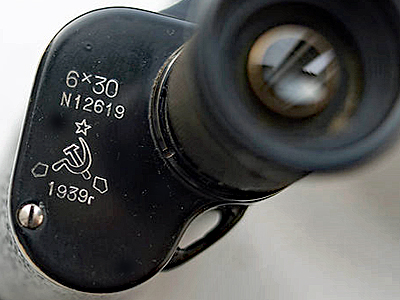
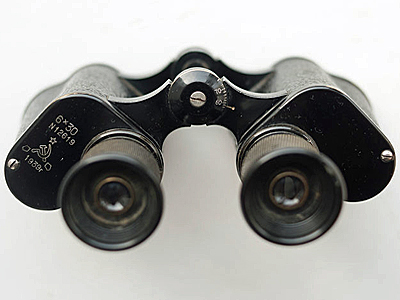
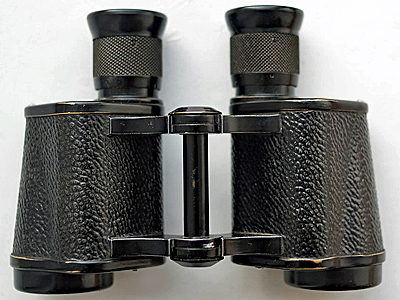
6×30 Standarized Model B-6, 1939, N12619, Novosibiersk, Siberia
|
|
Soviet Russian 6×30 Standardized Model B-6 military service binoculars, production serial number, N12619, heavy construction, made of brass, manufactured in 1939 by the Novosibiersk Instrument-Making Factory (NPZ), Новосибирский приборостроительный завод (НПЗ), Novosibiersk, Siberia. Left prism cover marked with “6×30” at the top, followed by the production serial number, “N12619”, then by the manufacturer’s trademark logo, incorporating the Soviet hammer, sickle, and star insignia, then by “1939г” (г is abbreviation of год, year of manufacture). Right prism cover is blank. |
Novosibiersk Instrument-Making Factory (NPZ) • Новосибирский приборостроительный завод (НПЗ)
Novosibiersk Instrument-Making Factory (NPZ)
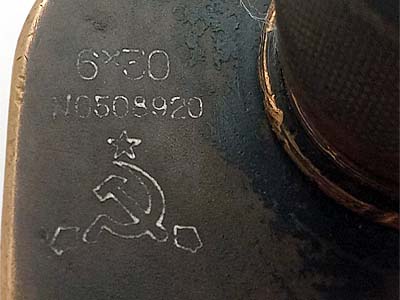
6×30 Standarized Model B-6, unknown date of manufacture, N0508920, Novosibiersk, Siberia
|
|
Soviet Russian 6×30 Standardized Model B-6 military service binoculars, production serial number, N0508920, heavy construction, made of brass, unknown date of manufacture by the Novosibiersk Instrument-Making Factory, Новосибирский приборостроительный завод (НПЗ), of Novosibiersk, Siberia. Left prism cover marked with “6×30” at the top, then by the production serial number, “N0508920”, then by the Soviet hammer, sickle, and star insignia, incorporating the manufacturer’s trademark logo. Right prism cover is blank. These 6×30 Standardized Model B-6 military service binoculars are accompanied by the original brown leather carrying strap. |
Izyum Factory of Optical Glass (IZOS)
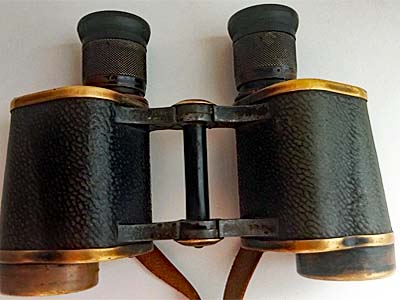
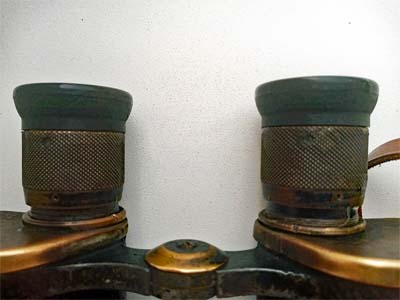
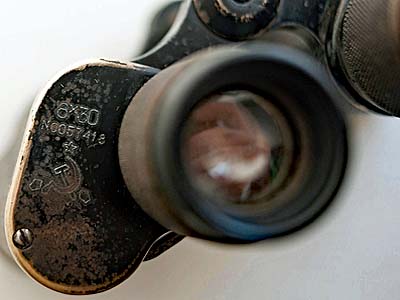
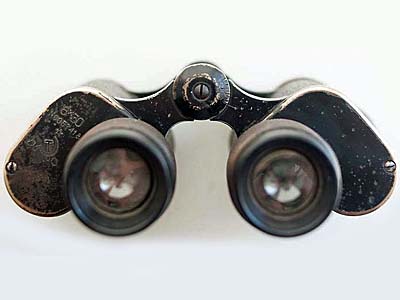
8×30 Standarized Model B-6, 1940, N0057418, Izyum, Ukraine
|
|
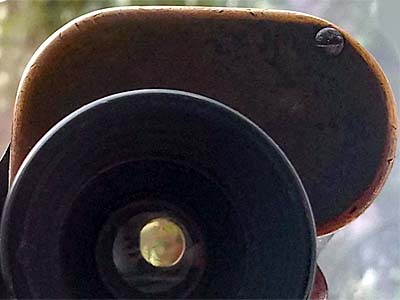
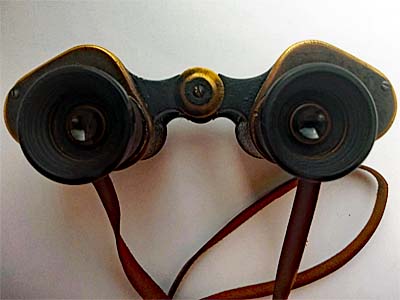
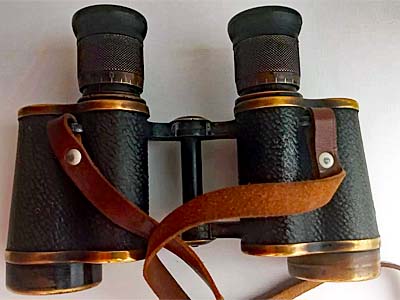
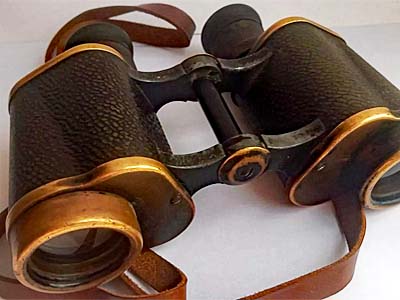
Soviet Russian 8×30 Standardized Model B-6 military service binoculars, production serial number, N0057418, heavy, made of brass, manufactured in 1940 by the Izyum Factory of Optical Glass (Изюм завод Оптического Стекла, ИЗОС), of Izyum, Ukraine (Изюм, Украина). These Russian military binoculars are marked on the left prism cover in white characters stamped from top to bottom with with 8×30 at the top, followed by the production serial number, N0057418, followed by the Soviet hammer, sickle, and star insignia, incorporating the manufacturer’s trademark logo. No year of manufacture is present. These 8×30 Standardized Model B-6 military binoculars are accompanied by the original brown leather carrying strap. The Izyum Factory of Optical Glass, established in 1940, was based in Izyum, Ukraine, 1940-1941, until evacuated to Tomsk, Siberia, 1941-1943, following the German invasion of Russia. |
8×30 Production Serial Numbers
Novosibiersk Instrument-Making Factory (NPZ) • Новосибирский приборостроительный завод (НПЗ)
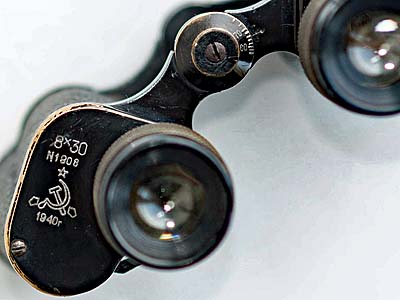
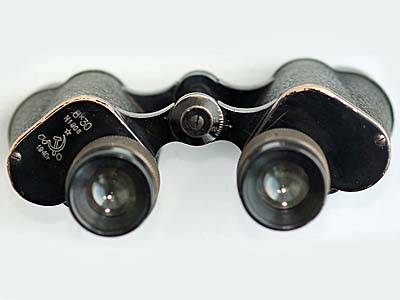
8×30 Standarized Model B-6, 1940, N1908, Novosibiersk, Siberia
|
|
Soviet Russian 8×30 Standardized Model B-6 military service binoculars, production serial number, N1908, heavy construction, made of brass, manufactured in 1940 by the Novosibiersk Instrument-Making Factory, Новосибирский приборостроительный завод (НПЗ), of Novosibiersk, Siberia. Left prism cover marked with “8×30” at the top, then by the production serial number, “N1908”, then by the Soviet hammer, sickle, and star insignia, incorporating the manufacturer’s trademark logo, then by “1940г” (г is abbreviation of год, year of manufacture). Right prism cover is blank. |
Izyum Factory of Optical Glass (IZOS)
6×30 Standardized Model B-6, 1941, N57481, Izyum, Ukraine
|
|
Soviet Russian 6×30 Standardized Model B-6 military service binoculars, production serial number N57481, heavy, made of brass, manufactured in 1941 by the Izyum Factory of Optical Glass (Изюм завод Оптического Стекла, ИЗОС), of Izyum, Ukraine (Изюм, Украина). These Russian military binoculars are marked on the left prizm cover in white characters stamped from top to bottom with with 6×30 at the top, followed by a single line showing the four digit production year 1941, the Soviet hammer, sickle, and star insignia, and the production serial number, N57481, followed at the bottom by the manufacturer’s trademark logo. These 6×30 Standardized Model B-6 military binoculars are accompanied by the original brown leather carrying strap, brown leather eye piece protector, and brown leather case with brown leather carrying strap. The Izyum Factory of Optical Glass, established in 1940, was based in Izyum, Ukraine, 1940-1941, until evacuated to Tomsk, Siberia, 1941-1943, following the German invasion of Russia. |
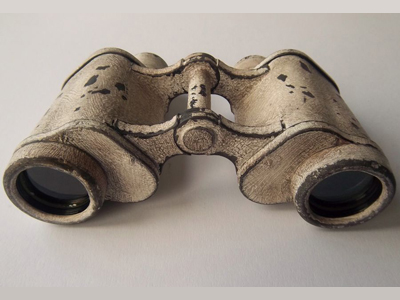
Izyum Factory of Optical Glass (IZOS)
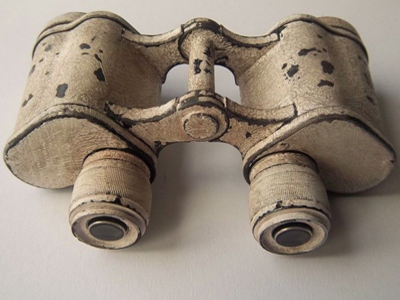
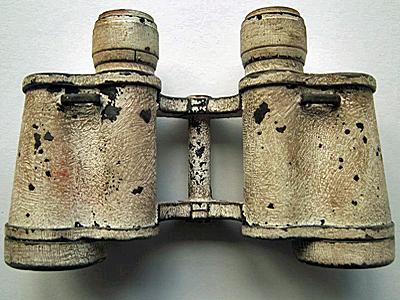
6×30 Standardized Model B-6, 1942, N4201911, Tomsk, Siberia
|
|
Soviet Russian 6×30 Standardized Model B-6 military service binoculars, production serial number N4201911, heavy, made of brass, manufactured in 1942 by the Izyum Factory of Optical Glass (Изюм завод Оптического Стекла, ИЗОС), of Tomsk, Siberia (Tomsk, Сибирь). These Russian military binoculars are marked on the left prizm cover in white characters stamped from top to bottom with 6×30 at the top, then by the production serial number, N4201911, then by the Soviet hammer, sickle, and star insignia, and finally by the manufacturer’s trademark logo. From 1940 to early 1941, the capital letter N preceded the full four number date of the production year. From late 1941 to 1945, the capital letter N preceded the last two numbers of the production year (41, 42, 43, 44, 45) as the first two numbers of the production serial number. |


Izyum Factory of Optical Glass (IZOS)
6×30 Standardized Model B-6, 1942, N4269770, Tomsk, Siberia
|
|
Soviet Russian 6×30 Standardized Model B-6 military service binoculars, production serial number N4269770, heavy, made of brass, manufactured in 1942 by the Izyum Factory of Optical Glass (Изюм завод Оптического Стекла, ИЗОС), of Tomsk, Siberia (Tomsk, Сибирь). These Russian military binoculars are marked on the left prizm cover in white characters stamped from top to bottom with 6×30 at the top, then by the production serial number, N4269770, then by the Soviet hammer, sickle, and star insignia, and finally by the manufacturer’s trademark logo. From 1940 to early 1941, the capital letter N preceded the full four number date of the production year. From late 1941 to 1945, the capital letter N preceded the last two numbers of the production year (41, 42, 43, 44, 45) as the first two numbers of the production serial number. These 6×30 Standardized Model B-6 military binoculars are accompanied by the original brown leather carrying strap. |


Новосибирский приборостроительный завод (НПЗ) • Novosibiersk Instrument-Making Factory (NPZ)
Novosibiersk, Siberia (Новосибирск, Сибирь), 1942-1945
The explosive German assault of Operation Barbarossa into western Russia on June 22, 1941 surprised and stunned Josef Stalin and the Russian supreme command. The lightning encirclement and destruction of entire Russian armies, and the overwhelming devastation of German firepower, resulted in the catastrophic collapse of Russian resistance during the first five months of the German invasion.
The lightning German assault through western Russia led to the emergency evacuation and relocation of Russian industrial factories located in western Russia far to the east, beyond the Ural Mountains, to protect them from being overrun by the rapidly advancing German blitzkrieg.
The Soviet hammer, sickle and star was adopted in 1923 and finalized in the 1924 Soviet Constitution.
1. State optical-mechanical factory (GOMZ), Leningrad (1940-1941);
Optical-mechanical factory No. 237 NKV (KOMZ), Kazan (since late 1941) .
The GOMZ factory produced binoculars in the 1920’s-1930’s, it stopped production of their own design B-1 6×30 model in 1936. In 1940 it restored binocular production, but this time it produced the standardized B-6 6×30 model. Production continued until the Autumn of 1941, when due to the German and Finn offensive on Leningrad, part of the GOMZ factory was evacuated to Kazan, and included into the structure of Kazan optical-mechanical factory. Technically, production of GOMZ binoculars ended in Autumn 1941, but during the initial production period in Kazan, the factory still used the GOMZ logo (stylized ray of light).
The post-evacuation marking is missing the hammer and sickle, which were used during 1940-1941 production in Leningrad. In early 1942, the factory marking was moved to the bridge instead of the left plate. Also, in early 1942, the factory finally started to use the GOMZ logo on binoculars (also a stylized ray of light). During 1940-1944, the production year was coded into the two first letters of the serial number (40, 41, and so on), starting in mid 1944 and later, a full year marking under the serial number was used.
After evacuation factory introduced many simplifications to construction. Late 1941 – early 1942 binoculars had plates made from silicium – aluminum alloy (sometime alloy plates are mixed with old design brass plates at one binoculars), later in 1942 alloy plates were replaced with steel plates, and steel plates in 1944 were replaced with copper plated steel plates. Also in early 1942 was eliminated rubber finish on the tubes (tubes were painted only with black paint), brass eyepiece diopter adjustment sleeves were replaced with cast sleeves also made from the silicium – aluminum alloy, also alloy was used in production of the other parts instead of brass, brass caps of the objective lens assemblies were replaced with steel caps. Because of these reason original condition early-mid war KOMZ binoculars are very difficult to find, alloy became very brittle after some use, and many of these binoculars had replaced parts.
In 1943 (possibly late 1942) rubber finish of the tubes was returned to production (prewar pattern was changed to unique to KOMZ dot pattern), cast alloy eyepiece sleeves remained in production up to 1945. In 1946 was returned into production prewar pattern with brass parts, also was changed style of the markings – they were moved to the left pate, and hammer and sickle marking was used again.
6×30 model (B-6 modification)
1.1. GOMZ factory marking, 1940-1941 (pre evacuation period).
Novosibirsk Instrument-Making Factory (NPZ)
NPZ (НПЗ), Новосибирский приборостроительный завод, Russian for “Novosibirsk Instrument-Making Factory,” is a mechanical factory originally established in 1905 as Factory No. 19 in the town of Krasnogorsk, a suburb northwest of Moscow, thirty kilometers (18.6 miles) from the Red Square.
The town of Красногорск (Krasnogorsk) was originally known as “posjolok Ban’ka” (“settlement Ban’ka“) settlement by the river running through the town. When a previous factory, Optical-Mechanical Factory No. 69, was established there in 1926, the town was renamed “rabochij posjolok Ban’ka” (“worker’s settlement Ban’ka“). The town was eventually named “gorod Krasnogorsk” (“town of Krasnogorsk“) on October 7, 1940.
In later years, Factory No. 19 was known also by other names, including the Krasnogorsk factory, and Factory No. 69 as of 1933, as well as NKOP (НКОП). It was moved to it’s present location in Novosibirsk in 1942.
Today, the Novosibirsk Instrument-Making Factory is a company based in Novosibirsk, Russia. The company produces optical instruments, automation equipment for industry, miscellaneous equipment and spare parts for agriculture, and consumer products. The production association was formerly part of the Concern “Optoprom.” Since 2014, it has been a part of the Shvabe Holding.
In 1942, a new factory, KMZ, Krasnogorski Mekhanicheskii Zavod, Krasnogorsk Mechanical Factory, was founded in the western Moscow suburb of Krasnogorsk.
The new factory, specializing in the production of optical equipment for the armed forces of the Soviet Union (USSR) and espionage cameras for the KGB, moved into buildings of the former Optical-Mechanical Factory No. 69 that had been previously moved to Novosibirsk (New Siberia).
Under the leadership of Joseph Stalin, Novosibirsk became one of the largest industrial centers of Siberia. Following the outbreak of World War II, the city hosted many factories relocated from western Russian.
Examples of their serial numbers are prefixed with N, NA, NB and then the production number. I believe they started over the prefixes for each year of producing the PE model 1931 (PE) scope. Meaning, you can have a 1933 scope with a production serial number prefixed by N, NA, NB as well as 1934, 1935, 1936 dated scopes with serials prefixed also by N, NA, NB.
Their original logo was the basic pentagon shape.

However, when used on optics, it appears elongated and pointing inward at an angle toward the Soviet hammer, sickle, and star coat of arms.
Novosibirsk Instrument-Making Plant (NPZ) logo.

The Novosibirsk Instrument-Making Factory (Новосибирский приборостроительный завод), a company based in Novosibirsk, Russia, was formerly part of the Concern “Optoprom.” It has been a part of the Shvabe Holding since 2014.
The Novosibirsk Instrument-Making Factory produces optical instruments, automation equipment for industry, miscellaneous equipment and spare parts for agriculture, and consumer products.
Products
- Fire control systems for armored vehicles (T-80, T-90 tanks) and self-propelled artillery (Akatsiya, Msta-S, Nona, and others)
- Tank commander’s devices
- Instrument complexes of round-the-clock intelligence
- Equatorial mounts for telescopes
- Catadioptric telescopes of the original Yuri Andreevich Klevtsov system, with apertures 150, 200 and 250 mm (TAL-150K, TAL-200K, TAL-250K)
- Achromatic refracting telescopes with apertures 75, 100 and 125 mm, apochromatic refracting telescopes on plain glasses 125 and 150 mm, classical apochromats — refractors 200 mm, 1PN93-2 night vision sight manufactured by the factory
- Reflectors with aperture 65 («Alcor»), 110 («Mizar»), 150 mm
- Night and day optical sights: PU, «Antisniper», SPP, NSPU, 1PN58, and others
- Laser sights CLN-1K and CLN-2K
NPZ
Novosibirsk Instrument Factory, Novosibirsk (=Новосибирский приборостроительный завод Нпз = Novosibirskiy priborostroitel’niy zavod NPZ). The original name of the factory was Precision Mechanics Plant, Krasnogorsk and later Plant 69. After WW2 this plant became known as NPZ. The plant was relocated in 1941 from Krasnogorsk to Novosibirsk. The plant produced various military items, and at least one camera, the Vostok. The logo continues used by NPZ, who now specialize in telescope making. The NPZ factory’s modern emblem has a slightly altered ratio from the early plant 69 logo.
NPZ
Novosibirsk Instrument Factory, Novosibirsk (=Новосибирский приборостроительный завод Нпз = Novosibirskiy priborostroitel’niy zavod NPZ). The original name of the factory was Precision Mechanics Plant, Krasnogorsk and later Plant 69. After WW2 this plant became known as NPZ. The plant was relocated in 1941 from Krasnogorsk to Novosibirsk. The plant produced various military items, and at least one camera, the Vostok. The logo continues used by NPZ, who now specialize in telescope making. The NPZ factory’s modern emblem has a slightly altered ratio from the early plant 69 logo.
ЗТМ, НПЗ
Завод точной механики, №19, №69 — Красногорск.
Новосибирский приборостроительный завод, №69 — Новосибирск.
Precision Mechanics Plant, No. 19, No. 69 — Krasnogorsk.
Novosibirsk Instrument-Making Plant, No. 69 — Novosibirsk.
 | Знак Павшинского завода точной механики 4): образующийся в центральной части пятиугольник — равносторонний. Завод точной механики (ЗТМ) № 19 НКОП, затем — завод № 69 им. Ленина (НКВ), был эвакуирован в 1941 году из Красногорска в Новосибирск и в итоге стал называться НПЗ. Большая часть военной продукции маркировалась иначе — см. примечание 2. Pavshinsky Precision Mechanics Plant 4: the pentagon formed in the central part is equilateral. Precision Mechanics Plant (PMP) No. 19 NKOP, then Plant No. 69 named after Lenin (NKV), was evacuated in 1941 from Krasnogorsk to Novosibirsk and eventually became known as the NPZ. Most military products were marked differently – see note 2. |
 | Позднее эмблема предприятия приобрела несколько изменённые пропорции. Интересно, что в таком виде знак как бы обратен призме Дове — символу Красногорского завода 5):  . .Later, the company’s emblem acquired slightly altered proportions. It is interesting that in this form the sign is, as it were, the inverse of the Dove prism – the symbol of the Krasnogorsk plant 5):. |
 | Современная эмблема предприятия уже потеряла преемственность идей, изначально заложенных в знак. The company’s current emblem has already lost the continuity of the ideas originally embedded in the sign. |
Novosibirsk Instrument-making Plant (NPZ)
A brief history of the company is that they were founded in 1905 as factory #19 in Krasnogorsk (aka factory #69 as of 1933, aka NKOP (НКОП), aka Krasnogorsk factory) but was moved to it’s final location in Novosibirsk.
Examples of their serial numbers are prefixed with N, NA ,NB and then the production number. I believe they started over the prefixes for each year of producing the PE model 1931 (PE) scope. Meaning you can have a 1933 scope with a serial prefixed by N, NA and NB as well as a 1934, 1935, 1936 dated scopes with serials prefixed by N, NA and NB
Their original logo was the basic pentagon shape.
https://npzoptics.ru/ Novosibirsk Instrument-Making Plant (Plant imeni V.I.Lenin)
 JSC “Novosibirsk Instrument-Making Plant” is one of the largest manufacturers of shooting and observation optics in Russia. The enterprise is included in the holding structure of JSC “Shvabe” as part of the state corporation “Rostec”. State Unitary Enterprise Production Amalgamation “Novosibirsk Instrument Making Plant” is one of the oldest enterprises in Russia. Being one of largest manufacturer of day light and night vision products our enterprise attracts attentions to scientific and research activities and development of new models and their serial production.
The Novosibirsk Instrument-Making Plant was founded in 1905 to manufacture artillery sights for the Imperial Russian Army. It made a significant contribution to equipping the Russian and Soviet armies during the world wars. The disintegration of the USSR brought extremely difficult economic conditions for the factory. Because military production was greatly curtailed, the factory was compelled to compete on the world market of optical devices…. Today Novosibirsk telescopes are well-known around the world and have earned an outstanding reputation.
PN-14K
BAt present JSC “Novosibirsk Instrument-Making Plant” is a universal, diversified association with a powerful scientific and technical potential, specializing in the design and manufacture of high-precision laser, optoelectronic and opto-mechanical devices. The specialists of the enterprise participated in the development and creation of the majority of optical and optoelectronic sights, fire control systems, surveillance and reconnaissance devices, within these areas a lot of theoretical and practical experience has been accumulated, unique technologies and precision technological equipment have been created. In the development of recent years, a promising element base is used – image intensifier tubes of generation 2+ and 3, programmable microprocessors, television and thermal imaging equipment with optical-electronic information processing systems.
Main directions of production: Manufacture of guidance and fire control systems for self-propelled artillery and armored vehicles; Production of observation and driving devices BTT; Production of all-day reconnaissance complexes for mobile reconnaissance points, including thermal imaging and television ones; Production of day, night, combined and thermal imaging sights for all types of small arms, ground artillery and grenade launchers; Manufacture of binocular observation devices with large aperture lenses; Production of laser simulators of firing and destruction; Production of secondary power sources for electro-optical converters; Production of high-precision instrumentation for industrial use; Manufacture of amateur and semi-professional astronomical telescopes. The company has a full production cycle, including testing of all products in its own control and testing center. The main strategic goal of the company is the growth and innovative development of business, maintaining and strengthening the organization’s position in the market, increasing the competitiveness and investment attractiveness of the business through the stable formation and implementation of a highly profitable portfolio of orders, the implementation of scientific, technical, production and human resources, integration and cooperation within the Shvabe JSC holding, development of production capacities, efficient use of resources and minimization of costs.
A great contribution to equipping with optical weapons during the Second World War was made by Special Plant No. 69, evacuated to Novosibirsk from Krasnogorsk, Moscow Region. In incredibly difficult conditions under the bombing of German aircraft in October-November 1941, the plant moved and in the shortest possible time, located in unsuitable premises, with a lack of qualified personnel (many plant workers went to the front and were replaced by women and teenagers), organized production and began to the production of industrial products in a new place.
The war made it necessary to direct all the efforts of the engineering and technical staff to the development and development of products needed by the front. The plant began to provide optics for all cannon artillery and tanks. Observation devices for artillery reconnaissance and artillery fire adjustment were produced (BST stereo tubes (AST), mortar sights (MP-41, MPM-44), tank sights (PT-1, PT-4, PTK-5, TMF, TMFD, TSh), sights for gunsights (PG), sights for fire control devices (ZVV, ZVG) and a whole range of stereo rangefinders for equipping anti-aircraft batteries (DYA, DYA-1, DYA-4, DYA-6, ZD). , but also managed to organize its production in the quantities needed by the army.
In the process of this hard work, subordinated to the call “Everything for the front – everything for victory”, the devices produced were continuously improved (their performance characteristics: accuracy, reduced labor intensity, metal consumption, ease of maintenance). So, when upgrading and replacing the DYa stereo rangefinder with the DYa-1 model, the weight of the kit was reduced from 728 kg to 535 kg, and the accuracy was increased by 4 times.
The plant team led by director A.S. Kotlyar, chief engineer D.F. Skarzhinsky, chief designer S.M. Nikolaev, chief technologist A.A. , chairman of the factory committee Razumovsky I.F., Komsomol organizer Korolev V.A.) showed miracles of labor prowess. Socialist emulation has taken on an unprecedented scale. The movement of the “two hundred” workers, who fulfill two norms a day, developed widely, then the movement of the “twenties” arose, fulfilling the monthly plan by the 20th day of the current month. Already in the middle of 1942, there were about 400 working “twenties” at the plant. The names of innovators and leaders will forever remain in the history of the plant: Sinitsina A.A., Guzikova M.F., Tarakanova I.Ya., Tkacha A.I., Semyonova D.S., Zelentsova G.D., Terentyeva V.V.
During the war years, the plant team won the All-Union Socialist Competition 34 times and was awarded the challenge banner of the Central Committee of the All-Union Communist Party of Bolsheviks, which was transferred to the plant for eternal storage. For selfless work during the war years, 162 employees of the plant were awarded government awards, and the plant was awarded the Order of Lenin by the Decree of the Presidium of the Supreme Soviet of the USSR of July 9, 1945.
2,525 factory workers went to the front as volunteers. 470 factory workers died heroically. As a tribute to the memory and gratitude to them, who gave their lives for the freedom of their Motherland, on May 8, 1975, the Monument of Glory was erected, on the marble slabs of which the names of the dead instrument makers are forever carved.
In 2015, in honor of the celebration of the 70th anniversary of the Great Victory and on the day of the 40th anniversary of the opening of the Monument of Glory, after its restoration, capsules were laid with earth from the battlefields in which the factory workers died, as well as a message – an appeal to future employees.
Novosibirsk Instrument-Making Plant (V.I. Lenin Plant)
during the Great Patriotic War
Special Plant No. 69, evacuated to Novosibirsk from Krasnogorsk in the Moscow Region, made a major contribution to equipping with optical weapons during the Great Patriotic War.
?_x_tr_sl=ru&_x_tr_tl=en&_x_tr_hl=en-US&_x_tr_pto=wapp)
In incredibly difficult conditions under the bombing of German aircraft in October-November 1941, the plant moved and in the shortest possible time, located in unsuitable premises, with a shortage of qualified personnel (many plant workers went to the front and were replaced by women and teenagers), organized production and began to manufacture industrial products in a new location.
The war forced all the efforts of the engineering and technical staff to be directed towards the development and mastering of products needed by the front. The plant began to supply optics for all barrel artillery and tanks. Observation devices for artillery reconnaissance and artillery fire adjustment (BST (AST) stereo tubes), mortar sights (MP-41, MPM-44), tank sights (PT-1, PT-4, PTK-5, TMF, TMFD, TSh), sights for gun sights (PG), sights for fire control devices (ZVV, ZVG) and a whole range of stereo rangefinders for equipping anti-aircraft batteries (DYa, DYa-1, DYa-4, DYa-6, ZD) were produced. The plant not only created optical weapons, but also managed to organize their production in the quantities required by the army.
In the process of this intense work, subordinated to the call “Everything for the front – everything for victory”, the manufactured devices were continuously improved (their tactical and technical characteristics: accuracy, reduced labor intensity, metal consumption, ease of maintenance). Thus, during the modernization and replacement of the DYa stereo rangefinder with the DYa-1 model, the weight of the set was reduced from 728 kg to 535 kg, and the accuracy was increased by 4 times.
?_x_tr_sl=ru&_x_tr_tl=en&_x_tr_hl=en-US&_x_tr_pto=wapp)
The plant’s team, led by Director A.S. Kotlyar, Chief Engineer D.F. Skarzhinsky, Chief Designer S.M. Nikolaev, Chief Technologist A.A. Mentz, and the party and Komsomol organizations (Party Organizer of the Central Committee of the All-Union Communist Party (Bolsheviks) Ya.S. Gietsel, Chairman of the Factory Committee I.F. Razumovsky, Komsomol Organizer V.A. Korolev) demonstrated miracles of labor valor. Socialist competition gained unprecedented scope. The movement of “two hundreders” – workers fulfilling two standards per day – developed widely, then the movement of “twenties” arose, fulfilling the monthly plan by the 20th of the current month. By mid-1942, there were already about 400 “twenties” workers at the plant. The names of innovators and leaders will remain forever in the history of the plant: Sinitsyn A.A., Guzikov M.F., Tarakanov I.Ya., Tkach A.I., Semenov D.S., Zelentsov G.D., Terentyev V.V. In 1944 alone, 11 shock teams were entered into the plant’s book of labor glory.
During the war, the plant’s team won the All-Union Socialist Competition 34 times and was awarded the challenge banner of the Central Committee of the All-Union Communist Party (Bolsheviks), which was transferred to the plant for permanent storage. For their selfless work during the war, 162 plant workers were awarded government awards, and the plant was awarded the Order of Lenin by the Decree of the Presidium of the Supreme Soviet of the USSR dated July 9, 1945.
2,525 plant workers volunteered for the front. 470 plant workers died heroically.
?_x_tr_sl=ru&_x_tr_tl=en&_x_tr_hl=en-US&_x_tr_pto=wapp)
As a tribute to the memory and gratitude to them, who gave their lives for the freedom of their homeland, on May 8, 1975, the Monument of Glory was erected, on the marble slabs of which the names of the fallen instrument makers are forever carved.
In 2015, in honor of the 70th anniversary of the Great Victory and on the 40th anniversary of the opening of the Glory Monument, after its restoration, capsules with soil from the battlefields in which the plant workers died were laid, as well as a message – an appeal to future employees of the refinery. It was bequeathed to be read during the days of the celebration of the 100th anniversary of the Great Victory.
Particles of soil from the battlefields where the refinery workers fought heroically, did not surrender, and died for their native land will be sacredly preserved by their fellow countrymen.
——————————————————
Novosibirsk Instrument-Making Factory (NPZ)
Новосибирский приборостроительный завод, Novosibirskiy priborostroitel’nyy zavod (НПЗ), Russian for “Novosibirsk Instrument-Making Factory (NPZ),” is a mechanical factory originally established in 1905 as Factory No. 19 in the town of Krasnogorsk, a suburb northwest of Moscow, thirty kilometers (18.6 miles) from the Red Square.
In later years, Factory No. 19 became known by other names, including the Krasnogorsk factory, and Factory No. 69 as of 1933, as well as NKOP (НКОП). It was moved to it’s present location in Novosibirsk in 1942.
The town of Красногорск (Krasnogorsk) was originally known as “posjolok Ban’ka” (“settlement Ban’ka“), a small community by the river running through the town. When a previous factory, Optical-Mechanical Factory No. 69, was established there in 1926, the town was renamed “rabochij posjolok Ban’ka” (“worker’s settlement Ban’ka“).
On October 7, 1940, the town was eventually renamed “gorod Krasnogorsk” (“town of Krasnogorsk“).
In 1942, a new factory, KMZ, Krasnogorski Mekhanicheskii Zavod, Krasnogorsk Mechanical Factory, was founded in the western Moscow suburb of Krasnogorsk.
The new factory, specializing in the production of optical equipment for the armed forces of the Soviet Union (USSR) and espionage cameras for the KGB, moved into buildings of the former Optical-Mechanical Factory No. 69 that had been previously moved to Novosibirsk (New Siberia).
Under the leadership of Joseph Stalin, Novosibirsk became one of the largest industrial centers of Siberia. Following the outbreak of World War II, the city hosted many factories relocated from western Russian.
Examples of their serial numbers are prefixed with N, NA, NB and then the production number. I believe they started over the prefixes for each year of producing the PE model 1931 (PE) scope. Meaning, you can have a 1933 scope with a production serial number prefixed by N, NA, NB as well as 1934, 1935, 1936 dated scopes with serials prefixed also by N, NA, NB.
Their original logo was the basic pentagon shape.
However, when used on optics, it appears elongated and pointing inward at an angle toward the Soviet hammer, sickle, and star coat of arms.
Novosibirsk Instrument-Making Plant (NPZ) logo.
The Novosibirsk Instrument-Making Factory (Новосибирский приборостроительный завод), a company based in Novosibirsk, Russia, was formerly part of the Concern “Optoprom.” It has been a part of the Shvabe Holding since 2014.
The Novosibirsk Instrument-Making Factory produces optical instruments, automation equipment for industry, miscellaneous equipment and spare parts for agriculture, and consumer products.
Products
- Fire control systems for armored vehicles (T-80, T-90 tanks) and self-propelled artillery (Akatsiya, Msta-S, Nona, and others)
- Tank commander’s devices
- Instrument complexes of round-the-clock intelligence
- Equatorial mounts for telescopes
- Catadioptric telescopes of the original Yuri Andreevich Klevtsov system, with apertures 150, 200 and 250 mm (TAL-150K, TAL-200K, TAL-250K)
- Achromatic refracting telescopes with apertures 75, 100 and 125 mm, apochromatic refracting telescopes on plain glasses 125 and 150 mm, classical apochromats — refractors 200 mm, 1PN93-2 night vision sight manufactured by the factory
- Reflectors with aperture 65 («Alcor»), 110 («Mizar»), 150 mm
- Night and day optical sights: PU, «Antisniper»
Today, the Novosibirsk Instrument-Making Factory is based in Novosibirsk, Russia. The company produces optical instruments, automation equipment for industry, miscellaneous equipment and spare parts for agriculture, and consumer products. The production association was formerly part of the “Optoprom” Concern. Since 2014, it has been a part of the Shvabe Holding.
Novosibirsk Instrument-Making Plant (V.I. Lenin Plant)
during the Great Patriotic War
Special Plant No. 69, evacuated from Krasnogorsk in the Moscow Region to Novosibirsk, made a major contribution to equipping the Soviet armed forces with optical equipment during the Great Patriotic War.
In October-November 1941, in incredibly difficult conditions under the bombing of German aircraft, the plant moved in the shortest possible time. Located in unsuitable premises, with a shortage of qualified personnel (many plant workers went to the front and were replaced by women and teenagers), the plant organized production and began to manufacture industrial products in its new location.
The war forced all the efforts of the engineering and technical staff to be directed towards the development and mastering of products needed at the front.
The plant began to supply optics for artillery and tanks. Observation devices for artillery reconnaissance and artillery fire adjustment (BST (AST) stereo tubes), mortar sights (MP-41, MPM-44), tank sights (PT-1, PT-4, PTK-5, TMF, TMFD, TSh), sights for gun sights (PG), sights for fire control devices (ZVV, ZVG) and a whole range of stereo rangefinders for equipping anti-aircraft batteries (DYa, DYa-1, DYa-4, DYa-6, ZD) were produced. The plant not only created optical weapons, but also managed to organize their production in the quantities required by the army.
In the process of this intense work, subordinated to the call “Everything for the front – everything for victory”, the manufactured devices were continuously improved (their tactical and technical characteristics: accuracy, reduced labor intensity, metal consumption, ease of maintenance). Thus, during the modernization and replacement of the DYa stereo rangefinder with the DYa-1 model, the weight of the set was reduced from 728 kg to 535 kg, and the accuracy was increased by 4 times.
The plant’s team, led by Director A.S. Kotlyar, Chief Engineer D.F. Skarzhinsky, Chief Designer S.M. Nikolaev, Chief Technologist A.A. Mentz, and the party and Komsomol organizations (Party Organizer of the Central Committee of the All-Union Communist Party (Bolsheviks) Ya.S. Gietsel, Chairman of the Factory Committee I.F. Razumovsky, Komsomol Organizer V.A. Korolev) demonstrated miracles of labor valor.
Socialist competition gained unprecedented scope. The movement of “two hundreders” – workers fulfilling two standards per day – developed widely, then the movement of “twenties” arose, fulfilling the monthly plan by the 20th of the current month. By mid-1942, there were already about 400 “twenties” workers at the plant. The names of innovators and leaders will remain forever in the history of the plant: Sinitsyn A.A., Guzikov M.F., Tarakanov I.Ya., Tkach A.I., Semenov D.S., Zelentsov G.D., Terentyev V.V. In 1944 alone, 11 shock teams were entered into the plant’s book of labor glory.
During the war, the plant’s team won the All-Union Socialist Competition 34 times and was awarded the challenge banner of the Central Committee of the All-Union Communist Party (Bolsheviks), which was transferred to the plant for permanent storage. For their selfless work during the war, 162 plant workers were awarded government awards, and the plant was awarded the Order of Lenin by the Decree of the Presidium of the Supreme Soviet of the USSR dated July 9, 1945.
2,525 plant workers volunteered for the front. 470 plant workers died heroically.
As a tribute to the memory and gratitude to them, who gave their lives for the freedom of their homeland, on May 8, 1975, the Monument of Glory was erected, on the marble slabs of which the names of the fallen instrument makers are forever carved.
In 2015, in honor of the 70th anniversary of the Great Victory and on the 40th anniversary of the opening of the Glory Monument, after its restoration, capsules with soil from the battlefields in which the plant workers died were laid, as well as a message – an appeal to future employees of the refinery. It was bequeathed to be read during the days of the celebration of the 100th anniversary of the Great Victory.
Particles of soil from the battlefields where the refinery workers fought heroically, did not surrender, and died for their native land will be sacredly preserved by their fellow countrymen.