
This is a list of serial numbers, observed in collections and recorded from sources online, of German S.F.14.Z.Gi. binoculars manufactured from 1933 to 1945, marked — “DIENSTGLAS” — equipment of the German armed forces during World War II.
Definitions — Essential Basic Information |
|||
| Doppelfernrohr (literally “double telescope”) |
D.F. or DF |
Doppelfernrohr (literally “double telescope”) — “binoculars” — was marked in weißer Schrift (white letters “D.F.” or “DF”) on Dienstglas manufactured before and during World War II. | |
| Strichplatte (Reticle) | m or MH/6400 |
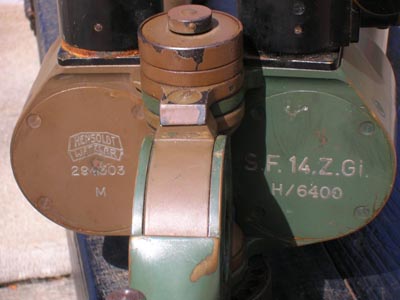
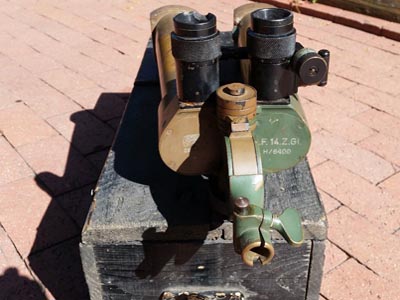
A Strichplatte (reticle) range finding scale, measured in millimeters, was often built into the right prism of a Dienstglas, and marked on the right prism cover by “m” or “M” followed by “H/6400” in weißer Schrift (white letters).
The letter “m” or “M” (indicating millimeters) preceded the designation “H/6400” (indicating that the millimeter scale is graduated into 6400 segments measured in mils). Between 1938 and 1939, the “m” or “M” was discontinued, and only the “H/6400” was retained to show that a Strichplatte (reticle) range finding scale was built into a particular Dienstglas. The “m” or “M” preceding “H/6400” is often confused with the capital letter “M” marked beneath or near the Nazi Eagle symbol that identifies property of the German Marine (Navy). The term reticle (from Latin, rēticulum, a little net) describes a network of fine lines etched within the focal plane of an optical instrument, and used to measure the size or position of objects under observation. Another term for reticle is graticule, first encountered in British military technical manuals of World War I, and currently in British publications and web sites. |
|
| Schwarz leder oder Vulkanite Körperbedeckung | Black leather or “Vulkanite” (a synthetic, leather-like, early form of plastic) was used as a body covering on Dienstglas manufactured before World War II. Early in the war, a black “rice” body covering (black paint mixed with crushed rice to give a rough body texture) also became a common Dienstglas body finish.
As wartime material shortages and minimal manufacturing techniques went into effect, paint alone became the prominent Dienstglas body covering, notably the use of dark gray paint and Sandgelb (sand yellow) paint from September 1943 to the end of the war. Sandgelb was ordered to be used on new optical equipment made after September 1943, and existing optics were also ordered to be repainted with the new sand yellow color. Sellers on eBay often erroneously claim the Sandgelb sand yellow color to be somehow related to the German Afrika Korps. |
||
| Brass, Aluminum, and Bakelite | Brass was a common metal used in Dienstglas construction before World War II, but was quickly replaced by aluminum as wartime material shortages became apparent. Toward the end of the war, even Presstoff (Bakelite) was used as a Dienstglas production material. | ||
| Okularshutz (eye piece protector) or Regenschutzdeckel (rain protection cover) or Benutzerkappe (user cap) | An Okularshutz (eye piece protector) is an oval lens shield placed over Dienstglas rear lenses to keep out rain and dirt. Usually made of Leder (leather), Presstoff (Bakelite), or Gummi (rubber), the device was attached to the Dienstglas carrying strap, or by a fabric covered spring system attached to the Dienstglas spindle.
The Okularshutz (eye piece protector) is also referred to as a Regenschutzdeckel (rain protection cover) or a Benutzerkappe (user cap) for rear lenses. |
||
| Anknöpflasche (button flap) | In the German armed forces, in addition to the leather neck strap, an Anknöpflasche (leather button flap) could be connected through the front spindle of the Dienstglas for attachment to a jacket button to keep the Dienstglas from bouncing and swinging while running. The button flap is often found attached to German WW II Dienstglas, especiallly the light in weight 6x30s. | ||
| Presstoff (Bakelite) | Before and during World War II, Presstoff (Bakelite), an early form of plastic, was used in the manufacture of Dienstglas carrying cases, bayonet handles, pilot goggles, field telephones, water bottles, storage boxes, anti-personnel and anti-tank mines, and hundreds of other items of military equipment. | ||
| Cold resistant greases | K.F. or KF |
K.F. or KF — Kälte Fett — referred to the cold resistant grease “Invarol” that was marked in weißer Schrift (white letters “K.F”. or “KF”) on Dienstglas manufactured (or returned to repair facilities for maintenance, repair, or regreasing) during 1940 and 1941. | |
| O | O — Vakuumfett 1416 — referred to the cold resistant grease “Vacuum” that was marked with a hellblaue Kreis (light blue circle “O”) during 1942. | ||
| + | + — Instrumentenfett 1442 — referred to the cold resistant grease “Instrument Grease 1442” that was marked with a hellblaue Kreuz (light blue cross “+”) during 1942 and 1943. | ||
| Δ | Δ — referred to the cold resistant grease of an unknown name that was marked with a hellblaue Dreieck (light blue triangle “Δ”) during 1943 to 1945. | ||
|
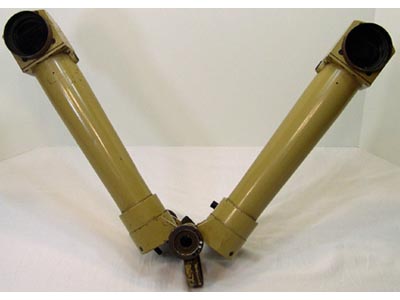
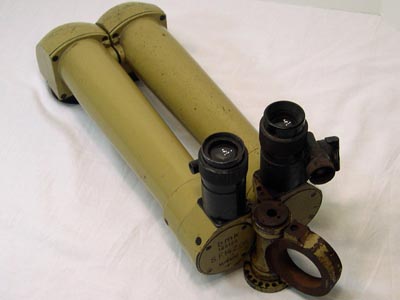
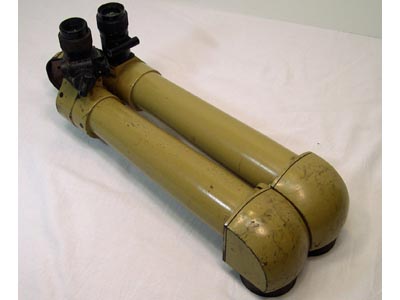
With its twin periscopic extensions swiveled out from the parallel, the Scherenfernrohr provided observers greater depth perception when targeting enemy troops and hardware. (Illustration by Gregory Proch)
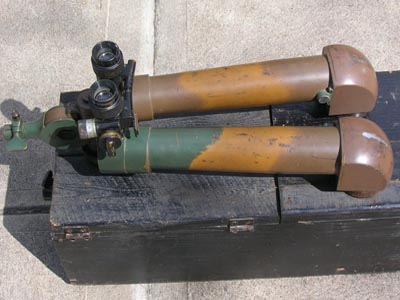
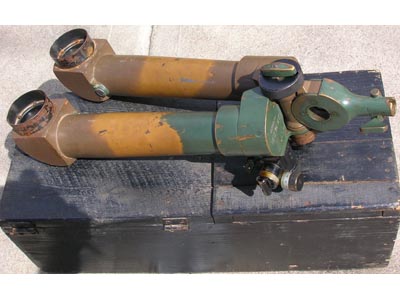
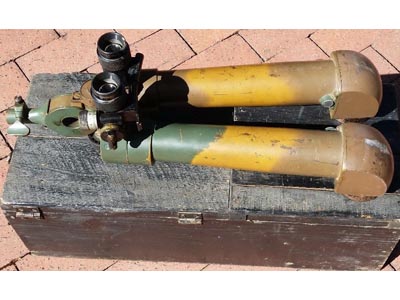
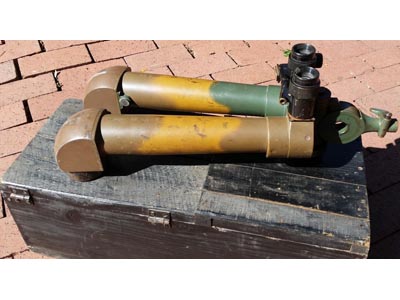
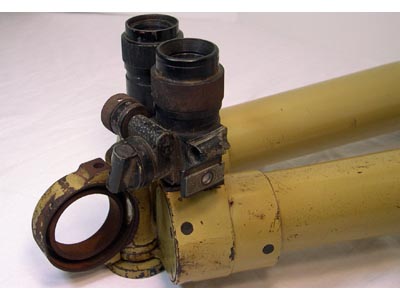
In 1894 the German optics firm of Carl Zeiss introduced a new type of prism binoculars, an 8- to 10-power device fitted with adjustable twin periscopic extensions connected by a hinge. Zeiss called its invention the Scherenfernrohr (“scissors telescope”). An observer could position its tubular “ears” upright and parallel to each other or splayed out for greater depth perception, causing objects to appear in modeled relief, strongly distinct from the background. This cross between binoculars and a periscope enabled the observer to remain safely concealed behind walls, trees or other cover with only the upper lenses visible, an advantage with obvious military applications. In 1905, three years before its patent was to expire, Zeiss produced three large versions of the Scherenfernrohr: the fixed-position Hypoplast, an army-issue variant and a field artillery model. After 1908 other countries produced their own versions of the scissors telescope, which the British nicknamed “donkey ears.” When World War I broke out and the opposing armies burrowed into trenches along the Western Front, the periscopic properties of the Scherenfernrohr soon earned regard as a lifesaving feature. Through World War II the design remained a useful tool for observation, artillery fire direction and a variety of other applications. The postwar West German Bundeswehr did not use Scherenfernrohren, but East Germany’s Nationale Volksarmee did right up until the 1990 reunification.
Although made with later war cost saving features, build quality is high and better than that of the cxn (Busch) 10×50 Dienstglas. Optically, the 10×50 Dienstglas is very good, particularly when the plastic eye cups are removed, enabling the user to see the entire field of view. Visibility is improved with the eye cups removed, because the metal rings that the eye cups screw into project 4 mm beyond the surface of the rear lens, preventing the user’s eyes from getting too close to them. This feature may have been introduced so that the dienstglas could be used while wearing glasses, goggles, or gas mask. of Manufacture: 302223 = Probably 1944-1945 Notes: Dienstglas = service glass; cxn = 3 letter wartime German coding for the manufacturer Emil Busch Rathenow; K.F. = a code for the lubricant Kältefest; H/6400 = a marking often seen on German WW II army binoculars referencing the graticule’s mil graduations. The Dienstglas 6X30 was introduced during the 1920’s and during WWII was the German army’s primary binocular. During the war it was produced in the hundreds of thousands by many different optical manufacturers in Germany, and except for minor variations most are mechanically and optically the same as the civilian model Zeiss Silvamar 6X30 (manufactured 1910– 1975 with the 365 gr lightweight version introduced 1935). Beginning in late 1940, manufacturers’ names were not marked on weapons and equipment supplied to German armed forces. Instead, three letter codes came into existence to prevent the Allies from determining where the instrument was made. Also, later in the war the coverings and finishing of Dienstglas 6X30 binoculars were changed due to shortages of materials. Initially most were covered in a synthetic leatherette called Vulkanite and painted black, but by war’s end leatherette coverings were discontinued and they were finished with only a black or tan coloured textured paint. It is an eBay myth that tan coloured Dienstglas binoculars are Afrika Corps binoculars – research indicates the Deutsches Afrikacorps were equipped with conventionally coloured black binoculars and that tan coloured binoculars were not introduced until later 1943-1944. Some later war Dienstglas binoculars such as the above cxn example were alternatively covered with a lacquered black painted composite paper. Although such Dienstglas binoculars are not rare, they are not seen as frequently as the leatherette or texturized paint finished ones. The leather button flap (Anknopflasche) attached to the front of German binoculars is meant to be attached to a jacket button to keep the binocular from swinging during activity. It is often found on German WWII binoculars particularly the light in weight 6X30s. German binoculars were also supplied with a leather or bakelite rain cover (Regenschutzdeckel) attached to the neck strap.
The German 6×30 is equal to other WW II 6×30 military binoculars with uncoated lenses, and has a slightly wider field of view. The build quality is very good, and provides an excellent field of vision. Weighing just 377 grams, the German 6×30 is easily lighter in weight than other WWI binoculars. For example, the Canadian REL CGB 37MA weighs 897 grams, the British Taylor-Hobson No. 2 Mk III weighs 872 grams, the U.S. Nash-Kelvinator M3 weighs 624 grams, and the U.S. Wollensak M5 weighs 521 grams. With a Bausch & Lomb type body, the U.S. M3 and Canadian REL, had a stronger and more weatherproof body, and many U.S. 6x30s made in 1944-1945 had coated lenses, giving them increased light transmission. Some Carl Zeiss Kriegsmarine 6x30s did have coated lenses, but the German Army Dienstglas did not. |
Unmarked |
|||
| S/N | C/R Mark | Identifying Features | Mfg / Maintenance |
beh (Ernst Leitz, Wetzlar, Deutschland) |
|||
| S/N | C/R Mark | Identifying Features | Mfg / Maintenance |
| 15924 | + | Scherenfernrohr S.F.14.Z.Gi. H/6400 beh : Sandgelb (sand yellow) painted body, left prism cover marked “beh” and “+” (in blue) over “15924” over “S.F.14.Z.Gi.” over “H.6400” Strichplatte (reticle), right prism cover blank | beh : 15924 Mfg. about 19xx “+” : 1942 – 1943 |
blc (Carl Zeiss, Militarabtailung, Jena, Deutschland) |
|||
| Zeiss Dienstglas Production Numbers, Military and Civilian Source : Produktions und Vertriebsstatistiken (Production and sales statistics) aus (from) BACZ 8401, 11809, 17119, 19607, 23209-23270. Recorded : “jeweils bis Sept. 30” Presumably : “each year until Sept. 30” Serial Numbers |
|||
| S/N | C/R Mark | Identifying Features | Mfg / Maintenance |
bmj (Hensoldt u. Söhne, Mechanisch-Optische Werke AG, Wetzlar, Deutschland) |
|||||
| S/N | C/R Mark | Identifying Features | Mfg / Maintenance | ||
| 294303 |
|
bmj : 294303 Mfg. about 19xx
|
|||
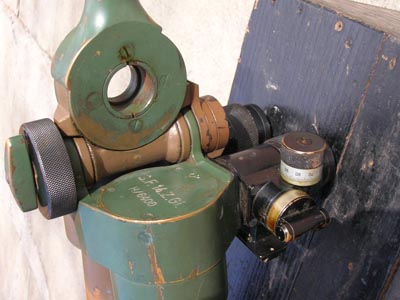
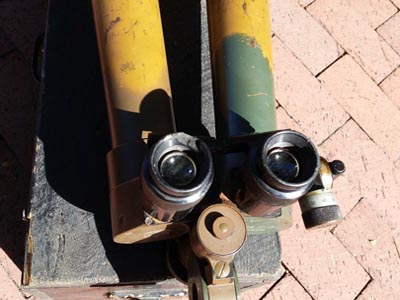
| 378572 | Scherenfernrohr S.F.14.Z.Gi. H/6400 bmj : dark green painted body, left prism cover marked “bmj” over “378572” over “M” (mils), right prism cover marked “S.F.14.Z.Gi” over “H/6400” Strichplatte (reticle), level near right rears lens marked “bmj” over “378572” over “H.6400” Strichplatte (reticle) | bmj : 378572 Mfg. about 19xx
|
|||
| 450408 | + | Scherenfernrohr S.F.14.Z.Gi. H/6400 bmj : dark green painted body, left prism cover marked “bmj” over “K” (Kreigsmarine — Navy) over “+” and “450408”, right prism cover marked “S.F.14.Z.Gi” over “H/6400” Strichplatte (reticle), level near right rears lens marked “bmj” over “450408” over “H.6400” Strichplatte (reticle) | bmj : 450408 Mfg. about 19xx “+” : 1942 – 1943 |
||
| 598175 | + | Scherenfernrohr S.F.14.Z.Gi. H/6400 bmj : light gray painted body, left prism cover marked “bmj” over “+” over “598175” over “S.F.14.Z.Gi.” over “H.6400” Strichplatte (reticle), right prism cover blank | bmj : 116788 Mfg. about 19xx “+” : 1942 – 1943 |
||
bmk (Srb u. Stys, Fabrik praeziser Messinstrumente, Prague, Czechoslovakia) |
|||||
| S/N | C/R Mark | Identifying Features | Mfg / Maintenance | ||
| 93227 | Scherenfernrohr S.F.14.Z.Gi. H/6400 bmk : dark gray painted body, left prism cover marked “bmk” over “93227”, right prism cover marked “S.F.14.Z.Gi” over “H/6400” Strichplatte (reticle) | bmk : 93227 Mfg. about 19xx
|
|||
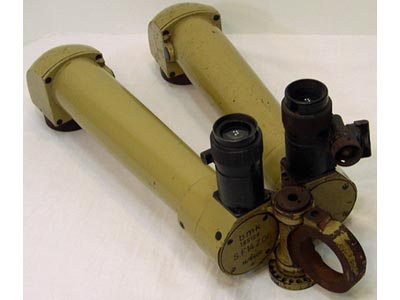
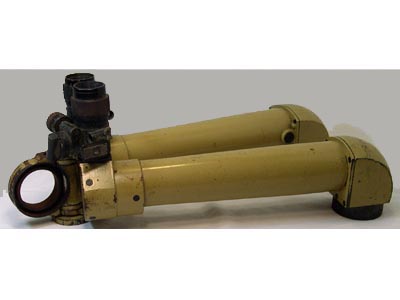
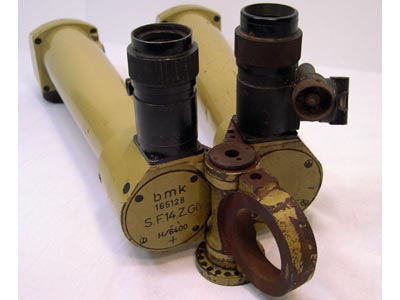
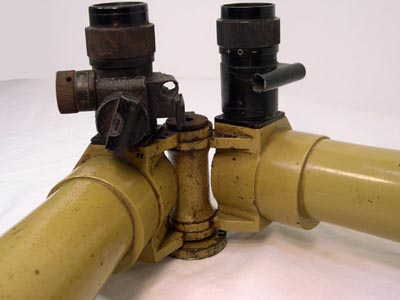
| 165128 | + |
|
bmk : 165128 Mfg. about 19xx “+” : 1942 – 1943 |
||
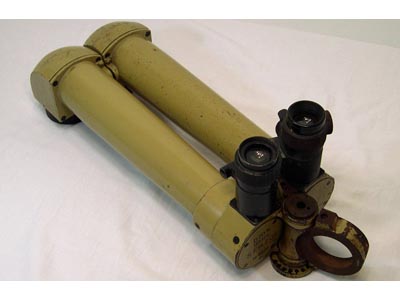
cxn (Emil Busch AG, Optische Industrie, Rathenow, Deutschland) |
|||
| S/N | C/R Mark | Identifying Features | Mfg / Maintenance |
| 116788 | Δ | Scherenfernrohr S.F.14.Z.Gi. H/6400 cxn : Sandgelb (sand yellow) painted body, left prism cover marked “cxn” over “Δ” and “116788” over “S.F.14.Z.Gi.” over “H/6400” Strichplatte (reticle) | cxn : 116788 Mfg. about 19xx “Δ” : 1943 – 1945 |
dkl (Josef Schneider, Kreuznach, Deutschland) |
|||
| S/N | C/R Mark | Identifying Features | Mfg / Maintenance |
dhq (Moeller G.m.b.H., J.D., Wedel, Schleswig-Holstein, Deutschland) |
|||
| S/N | C/R Mark | Identifying Features | Mfg / Maintenance |
| 14732 | Scherenfernrohr S.F.14.Z.Gi. H/6400 dhq : originally Sandgelb yellow painted body, now black painted body, left prism cover marked “dhq” over “14732” over “S.F.14.Z.Gi” over “H/6400” Strichplatte (reticle) | dhq : 14732 Mfg. about 19xx
|
|
rln (Carl Zeiss, Jena, Deutschland) |
|||
| S/N | C/R Mark | Identifying Features | Mfg / Maintenance |